
TL;DR: As of March 2026, the VA takes an average of 75.7 days to complete a disability-related claim (VA.gov). Individual claims range from 30 days or less (for a Decision Ready Claim) to more than a year for complex cases that need a C&P exam or an appeal. This guide walks Virginia veterans through the five phases of the claim process, what’s driving current wait times, and the practical steps that actually shorten your timeline.
Filing a VA disability claim is one of the more patience-testing parts of veteran life. You submit your evidence, wait for a letter, and check the VA portal a hundred times in between. The question almost every veteran asks is the same: how long is this actually going to take? The honest answer depends on which claim type you file, what evidence is already on paper, and whether your case needs a Compensation & Pension exam. In our Stafford office, the veterans who get decisions fastest are usually the ones who file a Fully Developed Claim with complete medical evidence on day one. Everyone else waits somewhere between the VA’s monthly average and the outside edge of the backlog.

How long does the VA take to decide a disability claim right now?
The VA’s current average processing time is 75.7 days as of March 2026, according to VA.gov’s official claim-processing tracker. That figure is a monthly average across every disability-related claim the Veterans Benefits Administration completes, so individual veterans land on both sides of it. A simple, well-documented claim can close in under 30 days. A claim that needs an exam, multiple service-connected conditions, or evidence the VA has to request from outside providers can stretch past six months.
Why do veterans see such different numbers online? The VA publishes a new average every month, so a blog post from 2024 citing “140 days” is quoting an older monthly average, not a wrong one. Different law firms also quote different ranges because they see different case mixes. The number to anchor on is the current VA.gov figure for the month you’re filing in.
The five phases of the VA disability claim process
Every disability claim moves through the same five phases inside the VA’s workflow, whether you file online, on paper, or through a Veterans Service Officer. The VA’s own claim status tool labels each phase so you can see where your case is at any moment. Phase 3, Evidence Gathering, Review, and Decision, is the one that consumes most of the clock.
| Phase | Typical Duration | What’s Happening |
|---|---|---|
| 1. Claim received | Within 1-2 weeks of filing | The VA logs your claim, assigns it a date, and sends an acknowledgement letter. |
| 2. Initial review | A few days to a few weeks | A claims processor checks whether you’ve attached what’s required. Missing evidence triggers a request and adds weeks. |
| 3. Evidence gathering, review, and decision | 30-90+ days (often the longest phase) | The VA pulls service treatment records, VA hospital records, and private provider records. If a C&P exam is needed, it’s scheduled here. |
| 4. Preparation for decision & notification | 1-3 weeks | A rater assigns a disability percentage and writes up the decision. A quality-review step happens before the letter goes out. |
| 5. Decision mailed | Up to 10 business days after decision | You receive a packet with your rating, effective date, and first payment timing. First payment typically lands within 15 days of a 10 percent or higher rating. |
The 10-business-day mail window on Phase 5 is set by the VA itself (VA.gov). If you haven’t received your decision letter within that window after your claim closes, call the VA or check the claim status tool before assuming something went wrong.
Processing times by claim type: what actually matters
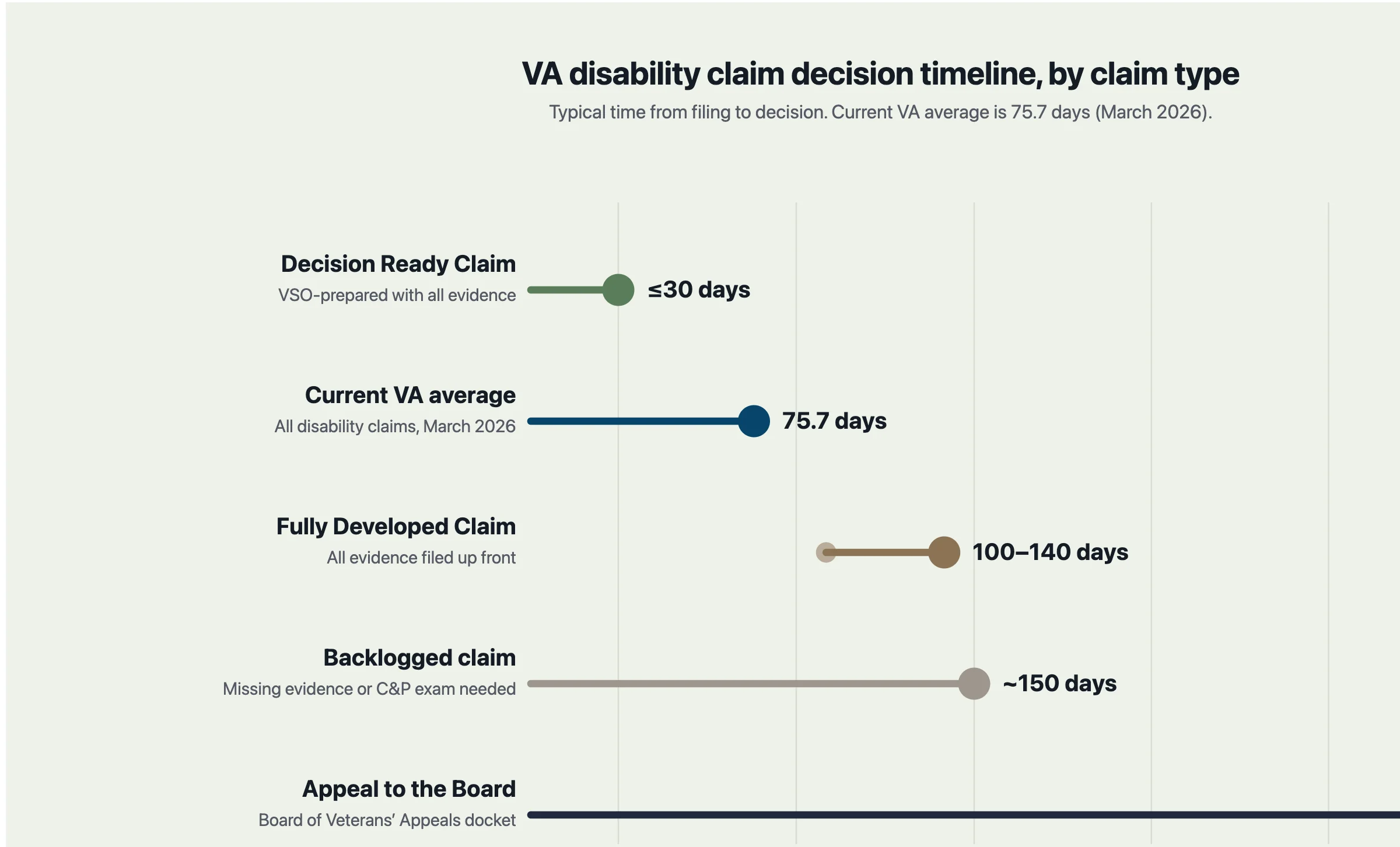
Claim type is the single biggest lever you control. A Decision Ready Claim (DRC) submitted through an accredited Veterans Service Organization gets you a decision in 30 days or less, per the VBA’s DRC program. A Fully Developed Claim (FDC), where you submit all evidence up front, typically closes in 100-140 days. A standard claim that requires the VA to chase down evidence sits at the monthly average (75.7 days in March 2026) at best and drifts toward 150 days when a C&P exam is needed.
Appeals are a different clock entirely. A Higher-Level Review generally decides within 4-5 months. A Supplemental Claim depends on the new evidence you file. A Board of Veterans’ Appeals docket frequently runs a year or more, with the direct review lane moving fastest and the evidence-submission and hearing lanes moving slowest. If your initial claim is denied, the path you choose on appeal changes the timeline dramatically.
What factors affect your VA disability claim timeline?
Four factors move the needle on most claims: claim type, evidence completeness, whether a C&P exam is needed, and the regional backlog. Everything else is secondary. A veteran who files online, attaches every relevant medical record, and responds to VA messages within 24 hours will usually close in under the monthly average. A veteran who files on paper, waits on records from a hospital that’s slow to respond, and misses a C&P appointment will drift toward the long tail.
Evidence completeness
Missing a single service treatment record, DD-214, or private medical opinion will add weeks. The VA is required to assist in gathering evidence, but the veteran is still responsible for identifying what exists and where to get it. A buddy statement or lay evidence letter is often the piece veterans leave out.
C&P exam scheduling
If the VA needs a Compensation & Pension exam, the contracted examiner (usually VES, QTC, or LHI) has to find you an appointment, conduct the exam, and upload the report. Clinics in busy regions, including much of Northern Virginia, run several weeks out. Showing up prepared with your medical records and a written symptom log keeps the exam from needing a follow-up.
Regional backlog
Processing is distributed across regional offices, and some run faster than others. The Reddit forum that appears on page one of Google for this exact search shows veterans reporting current averages closer to 150 days when they’re assigned to a backlogged office (r/VeteransBenefits). The VA publishes office-level data publicly, and your regional assignment isn’t something you can pick.
Claim complexity
Claims with a single, well-documented condition close faster than claims with five conditions, secondary conditions, presumptive conditions under the PACT Act, or TDIU (Total Disability Individual Unemployability) requests. Every additional condition adds its own evidence trail.
Can you speed up a VA disability claim?

Yes, and the speedup is usually measured in weeks, not days. The single biggest move is filing a Fully Developed Claim or Decision Ready Claim with every piece of evidence attached at submission, which skips most of Phase 3 entirely. The next biggest move is preparing for any C&P exam the VA schedules: bring your records, bring a written statement describing symptoms on bad days, and don’t cancel or reschedule unless there’s no other option.
Smaller moves add up. Respond to every VA letter within 10 business days. Check the VA claim status tool weekly so you catch evidence requests fast. If you file on paper, switch to eBenefits or VA.gov for faster processing and clearer status visibility. Keep your address and phone number current, because a missed letter triggers a deferral that can set you back a month.
What if your VA claim is stuck or delayed?
Most claims that look stuck are actually moving through Phase 3, just slowly. Log in to the claim status tool and check the phase marker before you assume something’s wrong. If the claim has sat in the same phase for 60 days with no status changes, that’s the point to escalate. Your first call should be to the VA’s benefits line at 1-800-827-1000 or the accredited representative listed on your claim.
If the VA is missing evidence it should have requested, file a written request for a Notice of Disagreement on that specific issue (for pre-2019 claims) or a Supplemental Claim with the missing evidence attached (for newer claims). If the delay crosses 180 days without explanation, that’s typically when Virginia veterans start asking whether it’s time to bring in an attorney.
When a Virginia veteran should consider a VA-accredited attorney
Most initial claims don’t need an attorney. A VSO, like DAV or American Legion, is free and handles Fully Developed Claims well. An attorney becomes worth the fee when a claim has been denied and you’re heading into a Higher-Level Review or Board appeal, when multiple conditions are being undervalued, or when a PACT Act presumptive claim is being wrongly denied. Only VA-accredited attorneys can legally represent you on VA benefits claims, a status governed by 38 CFR 14.629.
The Law Office of Miles Franklin represents Virginia veterans on VA disability claims at every stage, from initial filing through Board of Veterans’ Appeals. If your claim has been denied, delayed past a reasonable window, or rated lower than your evidence supports, a consultation will tell you whether an appeal is worth filing. Contact our Stafford office to talk through your case.
Frequently asked questions
How long are VA disability claims taking right now?
The VA’s official March 2026 average is 75.7 days to complete a disability-related claim (VA.gov). Individual timelines range from 30 days for Decision Ready Claims to over a year for complex claims with C&P exams or appeals. Check the VA’s current monthly figure for the most accurate estimate at the time you file.
What’s the difference between a Fully Developed Claim and a standard claim?
A Fully Developed Claim is one where the veteran certifies that all available evidence has been submitted up front, letting the VA skip most of the evidence-gathering phase. FDCs typically close in 100-140 days versus 75-150 days for standard claims, with much tighter predictability. A VSO or accredited attorney can help you confirm your claim qualifies as fully developed before submitting.
How much does a C&P exam add to the timeline?
A Compensation & Pension exam usually adds 3-8 weeks to a claim. The VA’s contracted examiner has to schedule, conduct, and upload the exam report before the claim can move to rating. Exam scheduling is slower in metropolitan areas, including Northern Virginia, where contracted clinics frequently run 4 weeks out or longer.
How long do VA disability appeals take?
A Higher-Level Review typically closes in 4-5 months. A Supplemental Claim depends on the new evidence filed. A Board of Veterans’ Appeals docket routinely runs more than a year, with direct review moving fastest and hearings moving slowest. The lane you choose at the appeal stage drives the timeline more than the evidence itself.
When will I get my first VA disability payment after approval?
If your decision is 10 percent or higher, the first payment typically lands within 15 days of the decision letter (VA.gov). Back pay, if owed, is calculated from the effective date the VA assigns and paid as a lump sum after the first recurring payment clears. Bank processing time adds 1-3 business days on top.
Questions about your VA benefits?
Every situation is different. If you have questions about how Virginia law applies to yours, contact the Law Office of Miles Franklin to schedule a consultation.
Schedule a Consultation →