
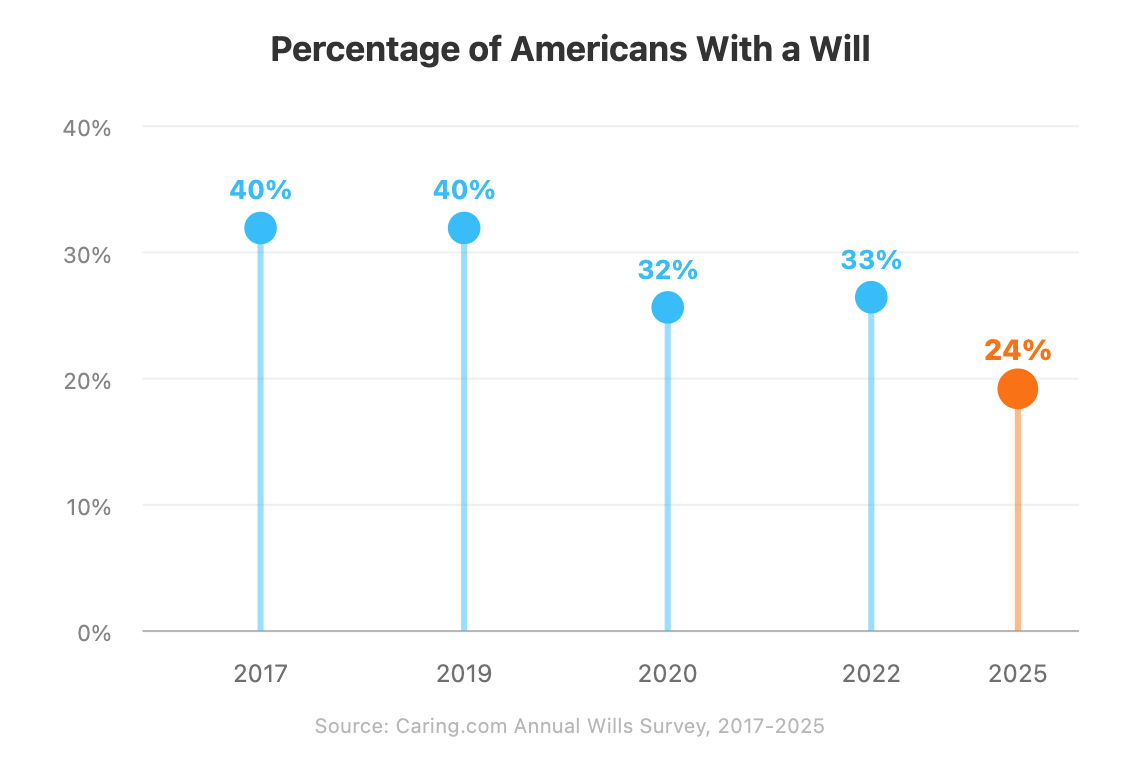
Choosing between a will and a trust is one of the most consequential decisions Virginia families face when planning their estate. Yet according to the 2025 Caring.com Wills Survey, only 24% of Americans currently have a will – down from 33% just three years earlier. Even fewer, roughly 13%, have a trust. For Virginia residents, the stakes are particularly high: probate can cost 3% to 7% of your estate’s total value and drag on for six to eighteen months.
This guide breaks down the real differences between wills and trusts under Virginia law, with actual cost data, probate timelines, and a clear framework for deciding which option fits your situation.
TL;DR: In Virginia, a will costs $150–$1,500 upfront but triggers probate (6–18 months, 3–7% of estate value). A trust costs $1,000–$4,000 upfront but skips probate entirely, saving your family tens of thousands of dollars and months of delay. Most Virginia families with assets over $200K benefit from a trust. (NCOA, 2025)
What Is the Difference Between a Will and a Trust in Virginia?
A will and a trust both transfer your assets after death, but they work through fundamentally different legal mechanisms. According to the Virginia Code § 64.2-200, if you die without either document, the state decides who inherits your property – and the result often surprises families. A surviving spouse with children from a prior relationship, for instance, receives only one-third of the estate.
A will is a legal document that takes effect after you die. It names an executor, specifies who receives your assets, and designates guardians for minor children. However, a will must go through Virginia’s probate process before any distributions occur.
A trust is a legal entity that holds your assets during your lifetime and transfers them according to your instructions after death. Because the trust – not you personally – owns the assets, they pass directly to beneficiaries without probate court involvement.
Here’s how they compare at a glance:
| Feature | Will | Revocable Living Trust |
|---|---|---|
| Takes effect | After death only | Immediately upon creation |
| Probate required? | Yes | No |
| Privacy | Public record | Private |
| Guardianship for minors | Yes | No (requires a will) |
| Incapacity protection | No | Yes |
| Upfront cost | $150–$1,500 | $1,000–$4,000 |
| Timeline to distribute | 6–18 months (probate) | Days to weeks |
How Many Americans Actually Have an Estate Plan?
The numbers are stark – and getting worse. The 2025 Caring.com annual survey of over 2,500 adults found that only 24% of Americans have a will, down from 33% in 2022. A separate Trust & Will survey of 10,000 respondents put the number at 31% with a will and just 11% with a trust. Either way, the majority of Americans have no estate plan at all.
Why the gap? According to AARP, 47% say they simply “haven’t gotten around to it,” while 29% believe they don’t have enough assets to justify one. Both reasons are dangerous. Virginia’s intestacy laws don’t care about your intentions – they follow a rigid formula.
What Are the Benefits of Having a Will in Virginia?
Despite the advantages of trusts, a will remains the foundation of most Virginia estate plans. A November 2025 Pew Research Center study found that most Americans don’t have a will until their 70s – but about 8 in 10 adults over age 80 do. The takeaway? Don’t wait until your 70s. Here’s why a will matters now.

You Can Name a Guardian for Your Minor Children
This is something a trust cannot do. If you have children under 18, a will is the only legal document in Virginia where you can designate who raises them if both parents die. Without this designation, a court decides – and the judge may not pick the person you’d choose. If you have minor children, you need a will regardless of whether you also create a trust.
A Will Streamlines the Probate Process
While a will doesn’t avoid probate, it makes the process far smoother. Your executor has clear legal authority to act on your behalf, pay debts, and distribute assets according to your wishes. Without a will, Virginia’s intestacy laws take over, and the court must appoint an administrator – adding delays and legal costs.
Virginia’s Small Estate Shortcut
For estates valued under $75,000, Virginia offers a simplified process called a small estate affidavit (Va. Code § 64.2-601). You must wait at least 60 days after death, but then assets can transfer without full probate proceedings. For modest estates, a well-drafted will may be all you need.
What Are the Advantages of a Trust Over a Will?
For Virginia families with moderate to substantial assets, a revocable living trust offers advantages that a will simply can’t match. The National Council on Aging reports that attorney-drafted trusts cost $1,000 to $4,000 – but this upfront investment often saves families tens of thousands in probate fees.

You Avoid Virginia Probate Entirely
Assets held in a trust pass directly to your beneficiaries without court involvement. There’s no six-to-eighteen-month wait. No probate tax. No public record. For families who value speed and privacy, this is often the deciding factor.
A Trust Protects You During Incapacity
A will only takes effect after death. If you become incapacitated due to illness or injury, a will does nothing. A trust, on the other hand, names a successor trustee who can immediately step in to manage your finances, pay bills, and handle property – without the need for a court-appointed guardianship or conservatorship.
Your Estate Stays Private
When a will enters probate in Virginia, it becomes a public court record. Anyone can look up the details – what you owned, who inherited it, and how much they received. A trust keeps all of this information private. For families who prefer discretion, that matters.
Direct Access for Beneficiaries With Special Needs
A properly structured trust can provide for a family member with disabilities without jeopardizing their eligibility for government benefits like Medicaid or Supplemental Security Income (SSI). A will distributing assets outright could disqualify them from these critical programs.
How Much Does Probate Cost in Virginia?
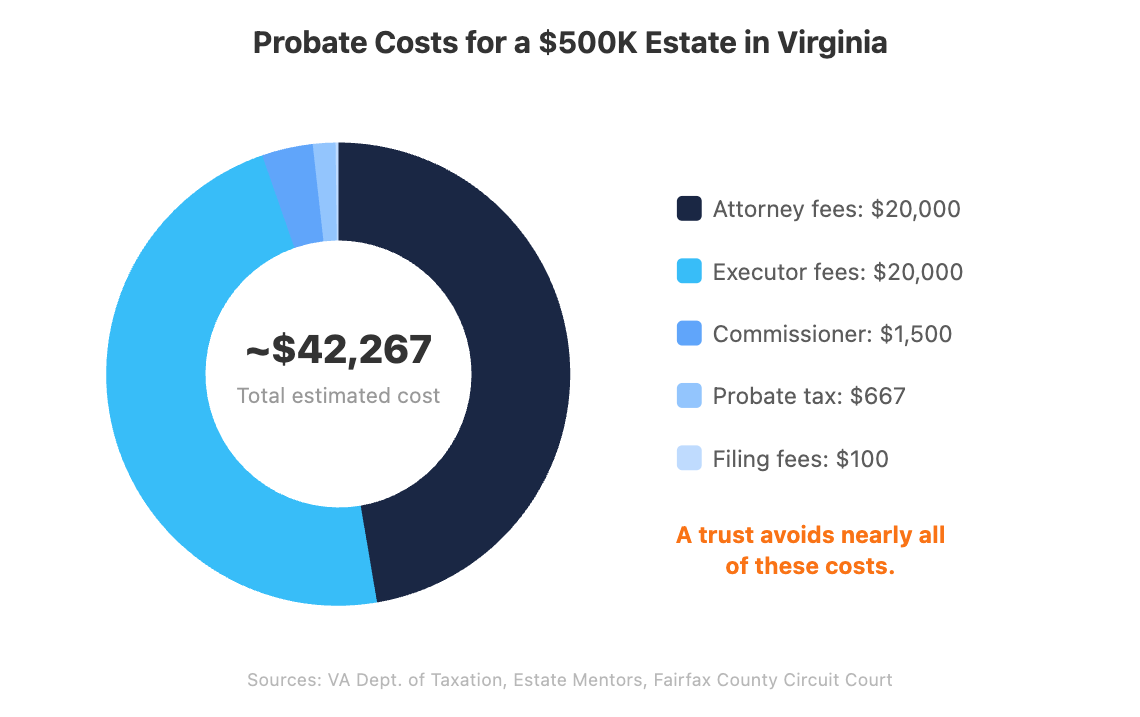
Probate costs in Virginia typically range from 3% to 7% of the total estate value, according to World Population Review. For a $500,000 estate, that translates to $15,000 to $35,000 in combined fees. Let’s break down where that money goes.
The Virginia Department of Taxation charges a probate tax of $0.10 per $100 of estate value for estates exceeding $15,000. Localities can add roughly one-third more. Attorney fees for probate administration typically run 3% to 5% of estate value (Va. Code § 64.2-1208). Virginia law allows reasonable executor compensation, typically around 5% of the estate’s value.
Will vs Trust: Which Costs More Upfront?
A trust costs more to create than a will – but the math shifts dramatically when you factor in probate. According to SmartAsset, an attorney-drafted will runs $940 to $1,500 for an individual, while a revocable living trust costs $1,000 to $4,000. Online services offer lower-cost alternatives: roughly $100 to $200 for a will and $400 to $600 for a trust.
But here’s the question most people miss: what does it cost your family after you die?
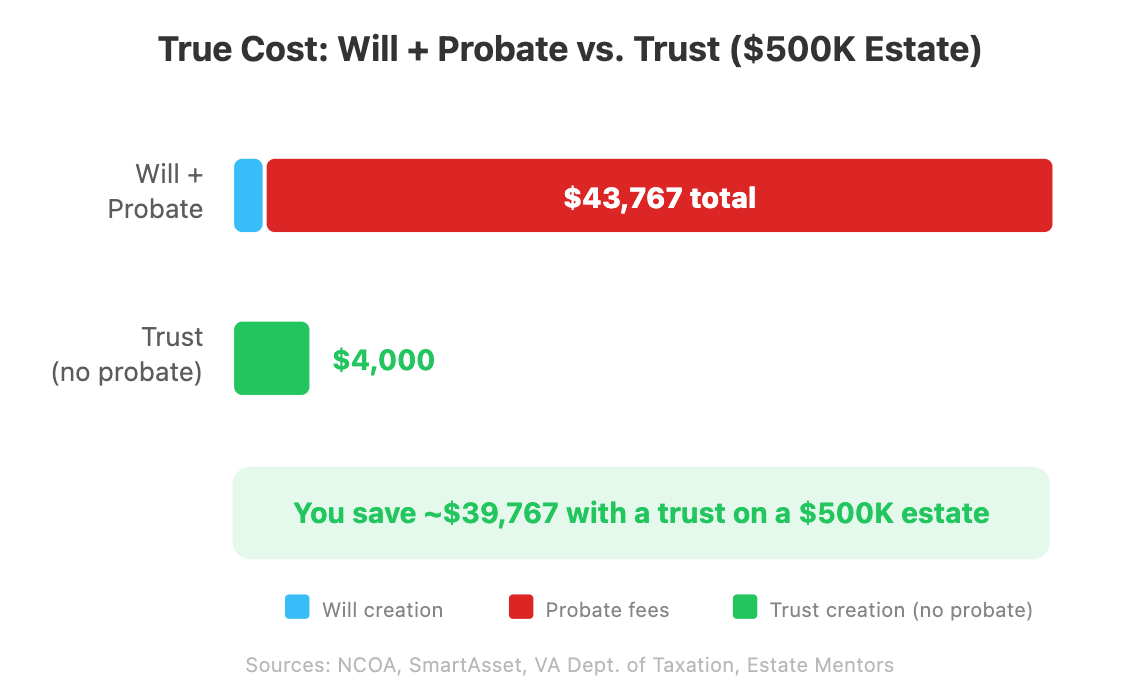
The pattern is clear. For smaller estates under $75,000, Virginia’s small estate affidavit makes a will sufficient. For estates between $50,000 and $200,000, the decision depends on your priorities around privacy and speed. Above $200,000, the probate cost savings from a trust almost always justify the higher creation cost.
When Should You Choose a Trust Instead of a Will in Virginia?
Not every Virginia family needs a trust. But certain situations make the case overwhelming. Based on Virginia law and common estate planning scenarios, consider a trust if any of these apply to you:
- Your estate exceeds $200,000 in total assets (including your home, retirement accounts, and life insurance). The probate cost savings alone justify a trust at this threshold.
- You own real estate in multiple states. Without a trust, your family may need to open probate proceedings in each state where you own property – a process called ancillary probate.
- You value privacy. Virginia probate records are public. If you don’t want your financial details available to anyone who asks, a trust keeps everything confidential.
- You have a blended family. Trusts offer more precise control over how and when assets pass to stepchildren, children from prior relationships, and a current spouse.
- A family member has special needs. A special needs trust protects government benefit eligibility while providing supplemental support.
- You want incapacity protection. A trust lets your successor trustee manage your affairs immediately if you become unable to do so.
Even if you choose a trust, you’ll still need a basic will. In Virginia, most estate planning attorneys recommend a “pour-over will” that catches any assets not already in the trust and directs them into it upon death. It also serves as the only place you can name a guardian for minor children.
What About Virginia Estate Taxes?
Good news for Virginia residents: the state has no estate tax and no inheritance tax, per the Virginia Department of Taxation (repealed effective July 1, 2007). However, federal estate tax still applies to estates exceeding the exemption threshold.
As of 2026, the federal estate tax exemption stands at $15 million per individual ($30 million per married couple), following the One Big Beautiful Bill Act which made this higher exemption permanent (IRS, 2025). Estates above this threshold face a 40% tax rate. For the vast majority of Virginia families, federal estate tax isn’t a concern – but the probate costs discussed above absolutely are.
FAQ: Virginia Wills and Trusts
Do I need both a will and a trust in Virginia?
In most cases, yes. A trust handles the bulk of your asset distribution and avoids probate, but only a will can name a legal guardian for your minor children under Virginia law. Estate planning attorneys typically recommend a “pour-over will” alongside your trust to catch any assets not titled in the trust’s name.
How long does probate take in Virginia?
Virginia probate typically takes 6 to 18 months. Simple estates with no disputes may resolve in 6 to 9 months, while complex or contested estates can take two years or longer. The executor must file an inventory within 4 months of qualifying and the first accounting within 16 months (Va. Code § 64.2-1300).
Can I create a will or trust without an attorney in Virginia?
Legally, yes. Online services like LegalZoom or Trust & Will offer DIY wills starting around $100 to $200 and trusts for $400 to $600. However, mistakes in a DIY estate plan can cost your family far more than attorney fees. Virginia has specific witnessing and notarization requirements that must be followed precisely for your documents to be valid.
What happens if I die without a will or trust in Virginia?
Virginia’s intestate succession laws determine who inherits your property. If you have a surviving spouse and children from that spouse, your spouse receives everything. But if you have children from a different relationship, your spouse receives only one-third of the estate while your children split the remaining two-thirds (Va. Code § 64.2-200). You have no say in the outcome.
Is a revocable living trust the same as an irrevocable trust?
No. A revocable living trust can be changed or dissolved at any time during your lifetime – you maintain full control. An irrevocable trust, once created, generally cannot be modified. Irrevocable trusts offer stronger asset protection and potential tax benefits but require giving up control of the assets. Most families start with a revocable trust for flexibility.
Planning your estate in Virginia? Whether you need a will, a trust, or both, the right choice depends on your family’s specific circumstances. Contact The Law Office of Miles Franklin to discuss which option best protects your family’s future.
Related reading:
- Beyond the Will: How a Living Trust Can Protect Your Stafford VA Family’s Future
- How Reimbursements Work for Executors and Administrators of an Estate
- Estate Planning Services
Questions about your estate plan?
Every situation is different. If you have questions about how Virginia law applies to yours, contact the Law Office of Miles Franklin to schedule a consultation.
Schedule a Consultation →