
Many holiday custody fights in Virginia do not start with a bad parent. They start with a vague sentence. An order that says “holidays shared” or “reasonable holiday visitation” leaves the hard parts open: what time Thanksgiving starts, who drives, whether winter break is split in half or by the holiday itself, and what happens when Christmas lands on the other parent’s regular weekend. Parents then fill those gaps under pressure, a few days before the break, often by text message. This guide is written for parents in Stafford, Spotsylvania, and Fredericksburg. It walks through the gaps Virginia orders often leave, four common holiday patterns, the clauses worth writing down, a fill-in template for Thanksgiving through New Year’s built around the 2026-27 school calendars, and how to turn an agreement into an order a court can enforce.
Why “holidays shared” causes disputes
The Code of Virginia tells courts how to decide custody, not what the holiday calendar should say. Section 20-124.2 directs the court to give primary consideration to the best interests of the child, to assure minor children of frequent and continuing contact with both parents when appropriate, and to treat neither parent as favored by law. Nothing in that section or in § 20-124.3 lists Thanksgiving, winter break, or New Year’s. Those details are written into each order, either by the parents’ agreement or by the judge after a hearing.
That flexibility is useful, because families celebrate differently. It also means an order is only as clear as its wording. A regular weekly schedule gets tested every week, so problems surface early. A holiday schedule gets tested once a year, often after both parents have made travel plans. A phrase that seemed fine in the spring can mean two different things by November.

Here are the gaps that come up most often when an order uses general language:
- Start and end times. Does Thanksgiving mean Thursday only, or Wednesday after school through Sunday evening? Does “Christmas” mean Christmas Eve, Christmas Day, or both?
- Which schedule wins. When a holiday falls on the other parent’s regular weekend, does the holiday schedule replace the weekend, or does the weekend parent keep it?
- School break boundaries. Is winter break measured from the last day of school or from a fixed date? What happens to a teacher workday tacked onto the end of the break?
- Exchanges. Who drives, where the handoff happens, and whether the time shifts if one parent is traveling.
- Travel. Whether a parent may take the child out of state for the holiday, and how much notice the other parent gets.
Each of those questions has a reasonable answer. The trouble comes when the order does not give one, and each parent reads the silence in their own favor. Virginia’s factors make this more than a scheduling headache. Factor 6 of § 20-124.3 asks how each parent supports the child’s relationship with the other parent, including whether a parent has unreasonably denied access. Factor 7 asks about each parent’s ability to cooperate in and resolve disputes. A holiday standoff can become evidence in a later custody case, which is one more reason to settle the details early.
Four holiday patterns Virginia parents use
Most holiday schedules are built from a small number of patterns. None of them is required by Virginia law, and none is automatically better. The right one depends on the distance between the homes, the child’s age, how each family celebrates, and how well the parents handle exchanges. Many orders mix patterns, for example alternating Thanksgiving by year while splitting winter break in halves.
| Pattern | How it works | Tends to fit when | Watch for |
|---|---|---|---|
| Alternate years | One parent has the holiday in even-numbered years, the other in odd-numbered years. | Homes are far apart, or one parent travels to extended family for the holiday. | A parent goes a full year without that holiday. Name which parent has even years. |
| Split day | The holiday is divided, for example morning with one parent and afternoon and evening with the other. | Homes are close, and both families celebrate on the same day. | Two exchanges in one day. Set an exact exchange time and place. |
| Fixed holiday | The same parent has the same holiday every year, for example Christmas Eve with one parent and Christmas Day with the other. | Each family has its own long-standing tradition on a different day. | Works only if both parents value different days. Revisit it as the child grows. |
| School-break halves | Winter break is divided into a first half and a second half, and the halves swap each year. | Both parents want real time during the break, not only the holiday itself. | Define where the break starts and ends, and the exact midpoint time. |
Source: Va. Code §§ 20-124.2 and 20-124.3. Patterns described as drafting options; Virginia law does not prescribe any of them.
A few practical notes on choosing. Alternating years is clear to read and enforce, because each year has one answer. Split days preserve every holiday for both parents but double the number of handoffs, which can be hard on a young child and on parents who struggle to be in the same place. Fixed holidays work well when the families’ traditions truly fall on different days. School-break halves give both parents meaningful time over a long break, but they depend on clear definitions of where the break begins and ends.
Whatever you choose, write the pattern into the order in plain terms. “Father shall have Thanksgiving in even-numbered years” is clearer for everyone to follow, including a judge, than “the parties shall alternate Thanksgiving.”
The 2026-27 school breaks in Stafford and Spotsylvania
Most holiday schedules hang on the school calendar, so start there. The Stafford and Spotsylvania school divisions set different Thanksgiving breaks this year but the same winter break. According to the calendars posted by each division:
- Stafford County Public Schools: Thanksgiving break runs Wednesday, November 25 through Friday, November 27, 2026. Winter break runs Monday, December 21, 2026 through Friday, January 1, 2027. The first semester ends December 18. (Stafford calendar)
- Spotsylvania County Public Schools: fall break runs the full week of Monday, November 23 through Friday, November 27, 2026, with Thanksgiving on November 26. Winter break runs December 21, 2026 through January 1, 2027. January 4, 2027 is listed as a school professional learning and teacher workday. (Spotsylvania calendar)
Those dates raise two drafting points. If your order defines Thanksgiving as “the school Thanksgiving break,” the same words mean three days in Stafford and five days in Spotsylvania. That matters when the parents live in different counties, or when a child changes schools. Also, both divisions end winter break on New Year’s Day, a Friday this year, so in Stafford a schedule that ends “the day before school resumes” lands on a weekend. In Spotsylvania, the January 4 teacher workday may push that day to Monday, so check the calendar. Either way, decide whether those extra days belong to the holiday schedule or the regular schedule.
School calendars change from year to year. Spotsylvania’s school board has already voted for a three-day fall break in 2027-28, according to the Fredericksburg Free Press. Families in Fredericksburg City schools should check their own division’s calendar. For that reason, many orders define holidays by event (“from the end of the last school day before winter break”) rather than by fixed dates, and the parents check the calendar each fall.
The clauses to write down
A good holiday provision answers the questions a tired parent will ask on December 23. The table below lists the clauses that close the most common gaps, with sample wording. The wording is an illustration to adapt, not a form any Virginia court requires.
| Clause | What it settles | Sample wording |
|---|---|---|
| Start and end times | Exactly when each holiday period begins and ends | “Thanksgiving begins Wednesday at 6:00 p.m. and ends Sunday at 6:00 p.m.” |
| Priority over the regular schedule | What happens when a holiday falls on the other parent’s regular time | “The holiday schedule takes priority over the regular schedule. The regular schedule resumes after the holiday period ends.” |
| Exchange place and driver | Where the handoff happens and who drives | “The parent beginning the holiday period picks up the child at the other parent’s home, unless the parents agree in writing to another place.” |
| Travel notice | Out-of-town trips during a holiday period | “A parent traveling overnight outside Virginia with the child gives the other parent the destination, address, and return date at least 14 days in advance.” |
| Contact during the holiday | Calls or video chats with the parent who does not have the child | “The child may have a phone or video call with the other parent on the holiday between 5:00 p.m. and 7:00 p.m.” |
| Even and odd years | Which parent starts the rotation | “Mother has Thanksgiving in even-numbered years and Father in odd-numbered years.” |
Sample wording for illustration only. The notice period and times shown are examples, not legal requirements.
The priority clause closes one of the most frequent gaps. Without it, a holiday that lands on the other parent’s weekend creates two competing claims to the same day, and both parents can point to the order. With it, the answer is on the page.
Be careful not to confuse travel notice with relocation notice. Virginia law already requires every custody or visitation order to include 30 days’ advance written notice to the court and the other parent of any intended relocation or change of address, unless the court, for good cause shown, orders otherwise. That rule is in § 20-124.5. It covers moving, not a holiday trip to see relatives. Holiday travel notice is something parents write into their own agreement, with whatever period suits the family. If moving away is on the table, the separate rules on relocation in Virginia custody cases apply.
For the exchange itself, keep it neutral and predictable. Many families use the other parent’s home, as in the sample clause, or a public place halfway between. If exchanges have been tense, either parent can ask the court for help: § 20-124.3 allows the court, at the request of either party, to order that the exchange of a child take place at an appropriate meeting place. A clear time, a clear place, and a clear driver take most of the friction out of the handoff.
Finally, think about the child’s age. A schedule that works for a teenager with a part-time job and friends of their own may not suit a preschooler who does best with fewer transitions. Virginia’s first best-interest factor asks the court to consider the child’s changing developmental needs, so build in a date to review the holiday plan, such as when the child starts middle school.
Fill-in template: Thanksgiving through New Year’s
This template uses the 2026-27 calendars above. It assumes an alternate-years pattern for Thanksgiving and school-break halves for winter, but you can swap in any pattern from the first table. Fill in the blanks together, then compare the result against your current order line by line. If your order already covers a holiday, the order controls. A template filled in at the kitchen table does not change it.
| Holiday period | Starts | Ends | Exchange place | Even years | Odd years |
|---|---|---|---|---|---|
| Thanksgiving | End of school before the break (Stafford: Tue. Nov. 24; Spotsylvania: Fri. Nov. 20) or ______ | Sun. Nov. 29 at ______ | ______ | ______ | ______ |
| Winter break, first half | End of school Fri. Dec. 18 at ______ | Fri. Dec. 25 at ______ (or ______) | ______ | ______ | ______ |
| Winter break, second half | Fri. Dec. 25 at ______ | Sun. Jan. 3 at ______ | ______ | ______ | ______ |
| New Year’s Eve and Day | Part of the second half, or Thu. Dec. 31 at ______ | Fri. Jan. 1 at ______ | ______ | ______ | ______ |
| Holiday call | The child may call or video chat with the other parent on Thanksgiving, Christmas Eve, Christmas Day, and New Year’s Day between ______ and ______. | ||||
Break dates from the Stafford County Public Schools 2026-2027 calendar and the Spotsylvania County Public Schools 2026-27 Instructional Calendar. Blanks are for the parents to complete.
Look at how the dates play out this year. In Stafford, the last school day before Thanksgiving is Tuesday, November 24. In Spotsylvania, it is Friday, November 20, because the whole week is off. That difference is why the template ties the start to the end of the last school day. If the parents live in different school divisions, or the child may change schools, both parents should check the calendars every fall before the holiday arrives.
Winter break needs the same care. Both divisions dismiss for winter break after Friday, December 18. A noon exchange on December 25 splits Christmas Day itself. In 2026 it gives the first half about seven days and the second half about nine, through Sunday, January 3. Parents who want equal halves can set the exchange on December 26 instead. Spotsylvania families should note the January 4 teacher workday. If school is not in session that day, say whether it belongs to the holiday or the regular schedule.
Once the halves are set, the rotation does the rest. The illustration below shows how an alternate-years plan swaps each period every year, so each parent has every holiday in turn over two years.
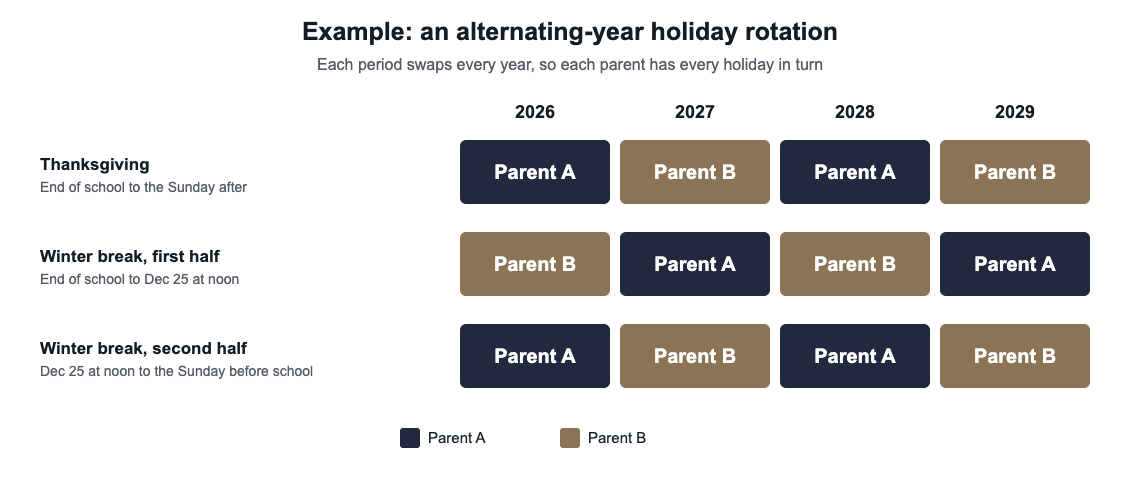
Two drafting tips make the template hold up. First, use the same names your order uses, such as “Mother” and “Father” or the parents’ names, so nobody argues later about who “Parent A” was. Second, write down what happens if the parents agree to a one-time change: for example, “any change must be agreed in writing, by text or email, before the holiday period begins.” That keeps a single flexible year from being read as a new permanent schedule.
Turning an agreement into a consent order
An agreement between parents is a good start, but only a court order can be enforced through show cause or contempt. If you and the other parent agree on a holiday schedule, the usual step is to ask the court to enter it as a consent order. According to the Virginia Judicial System’s self-help guide, once parents have an agreement, “it is finalized in court.”
Which court depends on where your case stands:
- No order yet, no divorce pending. The J&DR court has jurisdiction over custody and visitation under § 16.1-241. The case usually belongs in the court of the county or city that is the child’s home, under the venue rules in § 16.1-243. The self-help guide says parents start the paperwork through the local Court Services Unit of the J&DR court.
- An existing J&DR order. The self-help guide says a parent who wants to change a J&DR order, and is not involved in a divorce, must file in the same J&DR court that entered the last order. One form the district courts use to ask for changes to an existing order is DC-630, a Motion to Amend or Review Order. The Court Services Unit can confirm the right filing for a custody or visitation change. If the parents disagree, the court considers a change only after a material change of circumstances since the last order, and then only if the change is in the child’s best interests, as the self-help guide explains.
- A divorce in Circuit Court. The Circuit Court can decide custody as part of the divorce. The self-help guide notes that after a divorce is final, the Circuit Court typically sends custody back to the J&DR court for later changes.

After a contested hearing, § 20-124.3 requires the judge to state findings on the relevant factors. Consent orders are excepted from that findings requirement. In a consent order, the parents have set the terms, and the judge reviews and enters them. In the J&DR court, § 16.1-278.15 gives the judge the same range of custody orders the Circuit Court could make. Best interests remain the test in every custody or visitation case under § 16.1-278.15(G), whether or not the parents agree. The Court Services Unit or the clerk can tell you how your court accepts an agreed order and whether both parents need to appear.
Two more points are worth knowing. First, under § 16.1-278.15, parents in a contested custody or visitation case must show they attended an approved parent education seminar of at least four hours within the prior 12 months, or will attend within 45 days after the court appearance. The fee is based on ability to pay and capped at $50. The court may grant an exemption for good cause or if no program is reasonably available. In uncontested cases, the court may require the seminar only if it finds good cause.
Second, if you have not reached an agreement yet, mediation can help. Under § 20-124.4, the court refers appropriate cases to a dispute resolution orientation session at no cost. Section 20-124.2 notes that the goals of custody mediation may include a proposal for the child’s residential schedule and for how future disputes will be handled. More on that process is in this guide to mediation in Virginia custody cases.
Timing matters too. Thanksgiving 2026 is November 26. An agreement reached in the days before Thanksgiving is still worth writing down, but there may not be time for a court to enter a new order before the holiday. If your case is just starting, the difference between temporary and final orders explains what can be in place in the meantime; see temporary vs. final custody orders in Virginia.
When the other parent will not follow the schedule
Start with the order, not the argument. Read exactly what it says about the holiday, the times, and the exchange. If the order is clear and the other parent does not follow it, Virginia law gives you several tools. If the order is vague, those tools are weaker. In practice, it is hard to hold someone in contempt for missing a term the order never stated. That is the strongest reason to fix the wording before the next holiday.
| Option | What it does | Virginia law |
|---|---|---|
| Show cause and contempt | Asks the court to require the other parent to explain the violation, and to hold a willful violator in contempt | § 16.1-292 (J&DR orders); § 20-124.2(E) |
| Change the order | Asks the court to revise custody or visitation because circumstances have changed. Intentional withholding of visitation without just cause may be such a change | § 20-108 |
| Weighed in a later custody case | A parent’s support of the child’s relationship with the other parent, and any unreasonable denial of access, is a best-interest factor | § 20-124.3, factor 6 |
| Criminal charge in serious cases | A knowing, wrongful, and intentional clear and significant violation of a custody or visitation order is a crime | § 18.2-49.1 |
Source: Va. Code §§ 16.1-292, 18.2-49.1, 20-108, 20-124.2 and 20-124.3, read November 16, 2026.
The first two options are the ones families use most. Under § 16.1-292, a person who violates a J&DR custody or visitation order may be proceeded against by an order to show cause, for contempt of court, or both. Section 20-124.2(E) gives the court continuing authority to enforce its custody orders, including the power to punish a willful failure to comply as contempt. If the problem keeps repeating, § 20-108 lets the court revise the order as the circumstances of the parents and the benefit of the children require. It also says plainly that intentionally withholding visitation without just cause may be a material change of circumstances that justifies a change of custody, at the court’s discretion.
The criminal statute is for serious cases. Under § 18.2-49.1, a first offense is a Class 3 misdemeanor, a second violation within 12 months of a first conviction is a Class 2 misdemeanor, and a third within 24 months of the first conviction is a Class 1 misdemeanor. Knowingly, wrongfully, and intentionally withholding a child outside Virginia in clear and significant violation of a custody or visitation order is a Class 6 felony.
In the moment, a few habits protect you and your child. Do not try to collect the child by force or hold the child back in return; matching one violation with another hands the other parent the same arguments. Keep a dated record of what happened, including texts or emails about the holiday, the time you arrived for the exchange, and who was there. Keep your own messages short and focused on the child. Then talk with a lawyer about which remedy fits, because the right step depends on what the order says and how often the problem has happened.

What a template can and cannot do
A holiday template is a drafting aid. It helps two parents see the decisions they need to make and put them in writing. It is not a court standard, and it is not a prediction of what a judge in Stafford, Spotsylvania, or Fredericksburg would order after a hearing. Judges decide contested cases on the child’s best interests and on the evidence in front of them. Two families with the same calendar can end up with very different schedules, and both can be right for their children.
A template also cannot override an existing order. If your order says the holidays alternate by year and you fill in a template that splits the day, the order still controls until a court enters a new one. Informal changes by agreement can work for a particular holiday or year when both parents follow them. The risk is that, if the arrangement breaks down, the court enforces the written order, not a text message thread. When the new plan is meant to last, ask the court to enter it.
Some situations call for a lawyer’s review before you sign anything: a history of family abuse, a parent planning to move, a child with special needs, a military parent facing deployment, or an order from another state. Each brings its own rules. In some, a schedule that looks fair on paper can create real problems later.
Get your holiday schedule in writing before the break
Miles Franklin helps parents in Stafford, Fredericksburg, Spotsylvania, and the surrounding counties review custody orders, draft clear holiday provisions, and turn agreements into consent orders in the J&DR court. If your order is vague, or the other parent is not following it, a consultation can help you decide the next step.
Or call (276) 773-6102.
Frequently Asked Questions About Holiday Custody in Virginia
Does Virginia have a standard holiday custody schedule?
No. The Code of Virginia does not set a default holiday schedule. Under §§ 20-124.2 and 20-124.3, the court decides custody and visitation on the child’s best interests, and the holiday details are written into each family’s order, either by the parents’ agreement or by the judge after a hearing.
Can parents agree to a different holiday schedule than the one in their order?
Parents can agree informally to a change for a particular holiday or year, but the written order still controls until a court changes it. If the informal arrangement breaks down, the court enforces the order. To make a new holiday schedule binding, the parents can ask the court that now has the case, usually the J&DR court that entered the last order, to enter their agreement as a consent order.
Which court handles a holiday custody change in Stafford or Spotsylvania?
Usually the Juvenile and Domestic Relations District Court. The Virginia courts’ self-help guide says a parent who wants to change a J&DR order, and is not in a divorce, files in the same J&DR court that entered the last order. Custody can also be decided by the Circuit Court as part of a divorce.
What if a holiday falls on the other parent’s regular weekend?
That depends on the wording of your order. Many orders say the holiday schedule takes priority over the regular schedule and the regular schedule resumes afterward. If your order says nothing, the gap is worth fixing in writing, because both parents can point to the order and claim the same day.
What can I do if the other parent keeps the children past the holiday?
If the order is clear, you can ask the court for a show cause order or a contempt finding under § 16.1-292 (for J&DR orders) and § 20-124.2(E). Under § 20-108, intentionally withholding visitation without just cause may be a material change of circumstances that justifies a change of custody. In serious cases, a knowing, wrongful, and intentional clear and significant violation is a crime under § 18.2-49.1. Keep a dated record, and do not respond by withholding the child in return.
Do I need to give notice before taking my child out of state for a holiday?
Check your order first, because many orders include a travel notice clause. Virginia law, § 20-124.5, requires custody and visitation orders to include 30 days’ advance written notice of an intended relocation or change of address, which covers moving rather than a holiday trip. Parents can write their own holiday travel notice period into their agreement.
Questions about custody or visitation?
Every situation is different. If you have questions about how Virginia law applies to yours, contact the Law Office of Miles Franklin to schedule a consultation.
Schedule a Consultation →