
If you are facing a divorce or a custody case in the Fredericksburg area, you want an attorney who knows the courts you will actually stand in. I am Miles Franklin, a family law attorney based in nearby Stafford, and I represent clients throughout the Fredericksburg region, including the City of Fredericksburg, Spotsylvania, Stafford, and King George. This page explains which Fredericksburg court hears your case, what Virginia requires before you can file for divorce, how a custody case moves from petition to order, and what to expect along the way.

Family law representation across the Fredericksburg area
Family matters are rarely straightforward, and no two families are the same. I take the time to understand your circumstances and build a plan around your goals, whether that means reaching a fair agreement or preparing your case for a judge. My family law practice covers the issues that most often bring people to my office:
- Divorce, including contested and uncontested cases
- Child custody and visitation
- Child support and spousal support
- Prenuptial agreements and property division
- Adoption, paternity, and grandparents’ rights
If adoption is what brings you here, my step-by-step guide to adoption in Virginia covers each route, the consent deadlines, and what the home study involves.
You can learn more about my full approach on my Virginia family law page. If your situation crosses into another area of law, I also handle estate planning, criminal defense, and veterans’ benefits, so you do not need to hire a separate attorney for related matters.
Which court handles your family law case in the Fredericksburg area?
One of the most common questions I hear is simply where a case is filed. In Virginia, the answer depends on the type of relief you are seeking, and the Fredericksburg area has a helpful bit of consistency: the City of Fredericksburg, Spotsylvania, Stafford, and King George are all part of the same 15th Judicial Circuit. That means the same regional court structure applies wherever you live in the area.
As a general rule, Circuit Courts grant divorces and divide marital property, while Juvenile and Domestic Relations (J&DR) District Courts handle custody, visitation, child and family support, and family-abuse protective orders. Here is where your case would be filed, by locality:
| Locality | Circuit Court (divorce, property) | J&DR District Court (custody, support, protective orders) |
|---|---|---|
| City of Fredericksburg | 701 Princess Anne Street, Suite 100 Fredericksburg, VA 22401 |
615 Princess Anne Street Fredericksburg, VA 22401 |
| Spotsylvania County | 9107 Judicial Center Lane Spotsylvania, VA 22553 |
9113 Courthouse Road, Building B Spotsylvania, VA 22553 |
| Stafford County | 1300 Courthouse Road Stafford, VA 22555 |
1300 Courthouse Road Stafford, VA 22555 |
| King George County | 10446 Government Center Blvd., Suite 271 King George, VA 22485 |
10446 Government Center Blvd., Suite 169 King George, VA 22485 |
A Fredericksburg mailing address does not always mean a Fredericksburg court. The City of Fredericksburg is an independent city with its own courts, and many homes with a Fredericksburg mailing address actually sit in Spotsylvania County or Stafford County. The court that hears your case follows the city or county, not the post office. If you live in one of those neighborhoods, your divorce may belong in the Spotsylvania or Stafford Circuit Court instead, and your custody case in that county’s J&DR court. Getting this right at the start avoids a filing in the wrong place and the delay that follows.
Divorce in Fredericksburg: residency, grounds, and the separation clock
Virginia sets specific requirements before you can file for divorce, and understanding them early can save you a great deal of frustration. Under Virginia Code Section 20-97, at least one spouse must have been a bona fide resident and domiciliary of Virginia for at least six months before the divorce suit is filed. If you recently moved to the Fredericksburg area from another state, that clock matters.
For a no-fault divorce, under Virginia Code Section 20-91, spouses must live separate and apart, without cohabitation and without interruption, for one year. That drops to six months if you have no minor children and have signed a separation agreement. The separation has to be real and provable, and the date it began matters, so I talk through the facts with every client before counting the months.
Virginia also keeps fault grounds. They include adultery that happened before the date of the last separation (a 2026 amendment added that limit), a felony conviction with a sentence of more than one year where the spouses have not lived together since, and cruelty or willful desertion, which require waiting one year from the act before the divorce can be granted. A fault ground can matter beyond the divorce itself. Under Section 20-107.1, adultery can bar the spouse who committed it from receiving spousal support, with narrow exceptions. Fault grounds also require proof, and proof costs time and money, so whether to plead one is a strategic decision I walk through carefully with each client.
Where the divorce is filed is a separate question from whether you can file. Virginia’s venue statute, Section 8.01-261, generally points to the city or county where the two of you last lived together as a married couple, or where the other spouse now lives. For many of my clients, that is the Fredericksburg Circuit Court on Princess Anne Street.
How a Fredericksburg divorce moves through the Circuit Court
Every case is different, but most divorces in the Fredericksburg Circuit Court follow the same broad path. Knowing it in advance takes a lot of the uncertainty out of the process.
- The complaint is filed. Your divorce begins when a complaint stating your grounds is filed with the Circuit Court clerk. In Fredericksburg, the court’s page on vacourts.gov notes that every civil filing needs a civil cover sheet (Form CC-1416).
- Your spouse is served. Once served, your spouse generally has 21 days to file a response under the Rules of the Supreme Court of Virginia.
- Temporary orders, if needed. While the case is pending, the court can enter temporary orders under Section 20-103 covering matters such as spousal and child support, custody, and who stays in the family home.
- Information is exchanged. Both sides gather financial records and other evidence, and this is usually when settlement talks become productive.
- Agreement or trial. If you reach a written agreement, the court can incorporate it into the final decree under Section 20-109.1. If you do not, the judge decides the disputed issues after hearing evidence.
- The final decree. The divorce is complete when the judge signs the final decree of divorce.
When spouses agree on everything, an uncontested divorce can often be finished on written evidence rather than live testimony, because Section 20-106 allows the evidence to be presented by affidavit or deposition in qualifying cases. My guide to filing an uncontested divorce in Virginia walks through those requirements in more detail.

How long all of this takes depends far more on how much the two of you disagree than on the court. An uncontested case with a signed agreement can move quickly once the separation period has run. A contested case with disputes over the house, retirement accounts, or the children takes longer, because each disputed issue needs evidence and court time. I give every client a realistic estimate for their own situation rather than a one-size-fits-all number.
Property, debt, and spousal support in a Fredericksburg divorce
Dividing property and debt
Virginia is an equitable distribution state. Under Virginia Code Section 20-107.3, the Circuit Court first classifies what you own and owe as separate, marital, or part of each. It then values the marital property and divides it fairly, which does not always mean equally. The court weighs factors such as each spouse’s monetary and nonmonetary contributions to the family and to the property, the length of the marriage, how and when assets were acquired, and the debts tied to them. My guide to property division in a Virginia divorce explains each step.
Spousal support
Under Virginia Code Section 20-107.1, a court may award spousal support after weighing a list of statutory factors, including the length of the marriage, each spouse’s needs and resources, the standard of living during the marriage, and each spouse’s earning capacity. Support can be paid for a defined period, for an undefined period, or as a lump sum. My guide to how Virginia courts decide spousal support covers the factors in depth.
Custody and visitation in the Fredericksburg J&DR court
If you and the other parent are not married, or you are married but no divorce has been filed, a custody or visitation case usually starts in the J&DR District Court. Section 16.1-241 gives that court jurisdiction over custody, visitation, and child support, and Section 16.1-243 generally sends a custody case to the court for the city or county that is the child’s home. For a child who lives in the City of Fredericksburg, that is the J&DR court at 615 Princess Anne Street, which, according to its page on vacourts.gov, currently hears custody, visitation, and support matters on the second and fourth Mondays. If a divorce is filed and custody or support is set for a hearing in the Circuit Court within 21 days of the filing, Section 16.1-244 generally moves those issues to the Circuit Court, so the divorce and the custody case are decided together.
Virginia recognizes two kinds of custody. Legal custody is decision-making authority over the child’s upbringing, such as schooling and medical care. Physical custody is where the child lives. Under Section 20-124.1, either one can be shared jointly or held by one parent. Section 20-124.2 says there is no presumption in favor of either parent, and directs the court to assure children frequent and continuing contact with both parents when that is appropriate. Mothers and fathers start on equal footing.
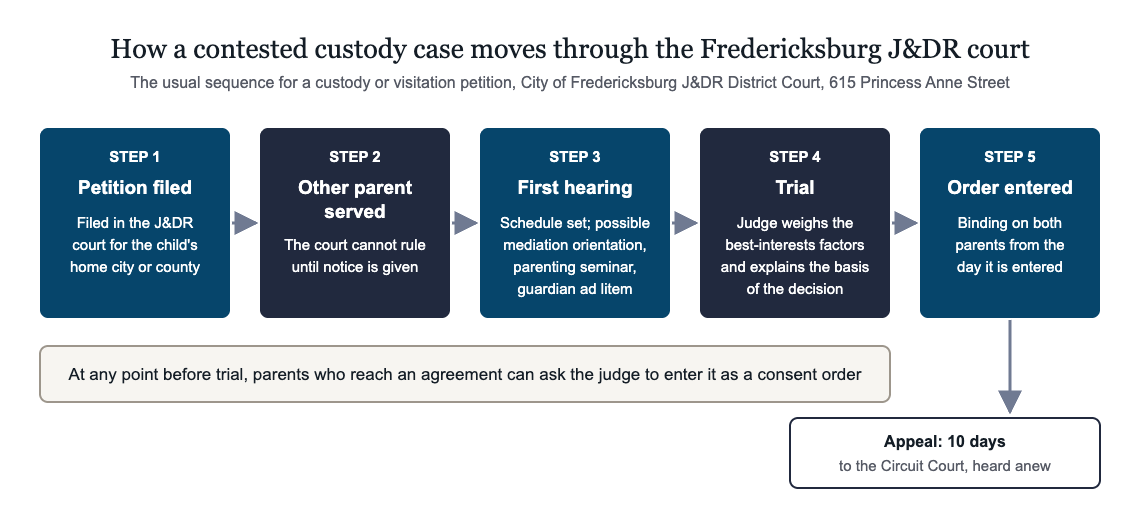
The judge decides custody and visitation based on the child’s best interests, using the factors in Section 20-124.3. They include the child’s age and needs, each parent’s physical and mental condition, the existing relationship between each parent and the child, each parent’s role in the child’s upbringing, each parent’s willingness to support the child’s relationship with the other parent, the child’s reasonable preference when the child is mature enough, and any history of family abuse. The judge must explain the basis of the decision, so preparation around these factors is where a custody case is won or lost.
Court-referred mediation
Not every custody case has to be fought out in a courtroom. Under Virginia Code Section 20-124.4, in an appropriate case the court refers parents to a dispute resolution orientation session at no cost to them, and it screens for any history of family abuse before making that referral. Parents in a contested custody, visitation, or support case must also attend a parent education seminar of at least four hours, either in the 12 months before their court appearance or within 45 days after it, under Section 16.1-278.15. When the child’s interests are not otherwise adequately represented, the judge can also appoint a guardian ad litem, a lawyer for the child, under Section 16.1-266. Reaching a resolution you helped shape is often better for your children than a decision imposed after a trial. I help clients prepare for these sessions and protect their interests throughout, and I am ready to try the case when an agreement is not possible.
Child support alongside custody
Child support follows the statewide guideline in Virginia Code Section 20-108.2. The guideline amount is presumed correct, and it is built from both parents’ incomes, the number of children, and costs such as health insurance and work-related child care. Custody and support are connected. When each parent has the child for more than 90 days a year, the shared custody calculation applies, which can change the number considerably. My guide to how child support is calculated in Virginia walks through the math with examples.

A judge can depart from the guideline when applying it would be unjust or inappropriate, but the court has to explain why in writing. Support can also be changed later. If income, custody, or a child’s needs change in a meaningful way, either parent can ask the court to modify the order. Until a court enters a new order, the existing one stays in force. Under Section 20-108, a change in support can reach back only to the date the other parent was served with the petition, never earlier, so a parent whose income drops should file promptly rather than simply paying less.
After the order: deadlines that matter in Fredericksburg cases
Several firm deadlines shape family cases in Virginia, and missing one can cost you an option that cannot be recovered. These are the ones I see matter most often for Fredericksburg families, and the table below collects them in one place.
The ten-day appeal deadline surprises many parents. If you disagree with a J&DR ruling on custody or support, an appeal sends the case to the Circuit Court, where it is heard again from the beginning rather than reviewed on the record. That is a real second chance, but only if the appeal is noted on time.
| Situation | Deadline | Source |
|---|---|---|
| Responding after you are served with a divorce complaint | 21 days after service | Rule 3:8, Rules of the Supreme Court of Virginia |
| Appealing a J&DR custody, visitation, or support order to the Circuit Court | 10 days after the order is entered | Va. Code § 16.1-296 |
| Moving a child’s residence when a custody or visitation order is in place | 30 days’ advance written notice to the court and the other parent | Va. Code § 20-124.5 |
| Filing for divorce after moving to Virginia | 6 months of residency by at least one spouse | Va. Code § 20-97 |
Why work with a local Fredericksburg-area family law attorney
Raised in Virginia and practicing from Stafford, I know the Fredericksburg region and its courts. I am a solo practitioner, which means you work directly with me from your first consultation through the resolution of your case, not a rotating team of associates. My background as a former Virginia Army National Guard paralegal and a policy consultant shapes how I prepare: carefully, thoroughly, and with respect for what is at stake for your family.
In practice, that means a few concrete things. I tell you early which court your case belongs in and what that court will expect. I help you gather the financial records and parenting history a Fredericksburg judge will want to see, before the other side asks for them. I give you a straight answer about what a fair agreement looks like, so you can decide whether settling or going to trial makes more sense. Every client’s situation is different, and every client deserves to be heard. Whether your case can be resolved through a fair agreement or needs to be argued in front of a judge, I will work toward the best possible outcome for you and your family.
Talk with a Fredericksburg divorce and custody attorney
If you have questions about a divorce, custody, or support matter in Fredericksburg, Spotsylvania, Stafford, or King George, I am here to help you understand your options and protect what matters most to your family. Call (276) 773-6102 or send me a few details and I will get back to you.
Frequently asked questions
Do I have to live in Fredericksburg to hire you?
No. I represent clients throughout the Fredericksburg region, including the City of Fredericksburg, Spotsylvania, Stafford, and King George, all of which are part of Virginia’s 15th Judicial Circuit. My office is in Stafford, a short drive from Fredericksburg.
Which court will hear my divorce?
Divorces in Virginia are decided in the Circuit Court, usually for the city or county where you and your spouse last lived together or where your spouse now lives. For the City of Fredericksburg, that is the Fredericksburg Circuit Court at 701 Princess Anne Street. A Fredericksburg mailing address can still place you in Spotsylvania or Stafford County, so check the locality first.
How long do I have to be separated before filing for divorce in Virginia?
Under Virginia Code Section 20-91, spouses generally must live separate and apart for one year, or for six months if they have no minor children and have signed a separation agreement. At least one spouse must also have lived in Virginia for six months. Fault-based grounds follow different rules.
Where do I file for custody in Fredericksburg?
If no divorce is pending, a custody or visitation petition usually goes to the J&DR District Court for the child’s home city or county. For a child who lives in the City of Fredericksburg, that is the Fredericksburg J&DR District Court at 615 Princess Anne Street.
Does Virginia favor mothers in custody cases?
No. Virginia Code Section 20-124.2 says there is no presumption in favor of either parent. The judge decides based on the child’s best interests, using the factors in Section 20-124.3, and must explain the basis of the decision.
Can custody or support be handled without a trial?
Often, yes. Many custody and support matters are resolved through negotiation or court-referred mediation under Virginia Code Section 20-124.4. I help clients pursue a fair agreement whenever possible and prepare thoroughly for court when it is not.
If you are weighing a divorce, custody, or support question in the Fredericksburg area, the sooner you understand your options the more of them you have. Call (276) 773-6102 or use the form below to schedule a consultation.