
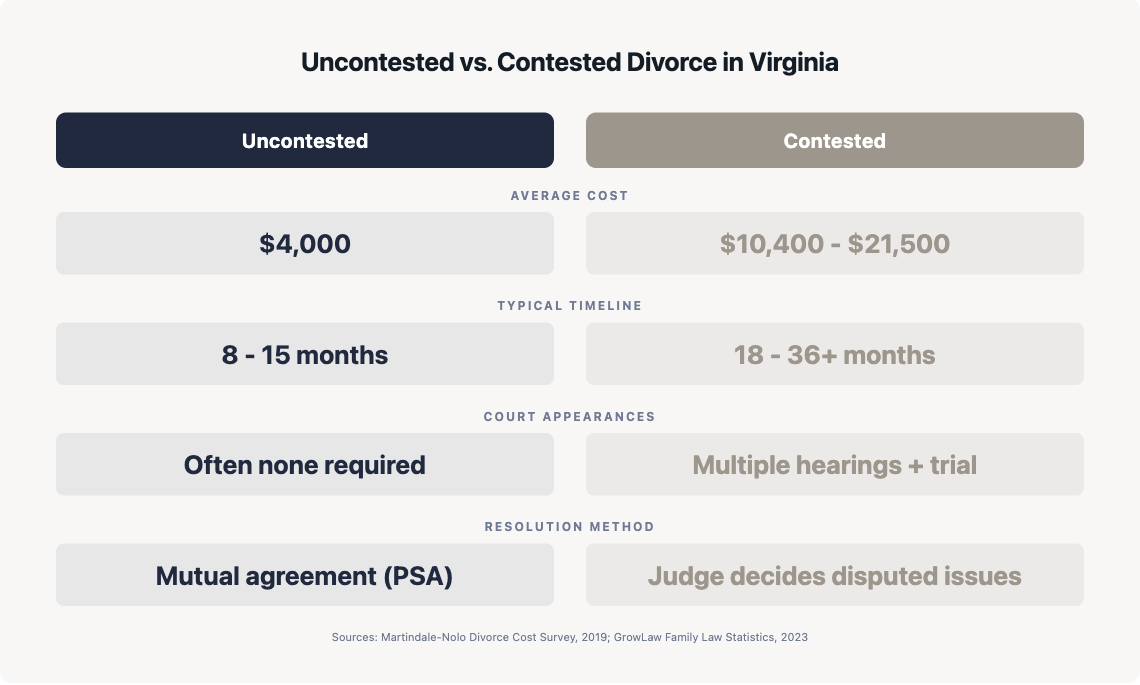
An uncontested divorce is the fastest, least expensive way to end a marriage in Virginia. National divorce cost surveys show that couples who resolve their divorce by mutual agreement spend an average of $4,000 on legal fees, compared to $10,400 or more for contested cases that settle before trial. Nationally, over 80% of divorces are resolved through mutual agreement rather than a judge’s ruling (GrowLaw, 2023).
If you and your spouse can agree on the major issues, including property division, spousal support, and child custody, an uncontested divorce lets you move forward without the emotional and financial toll of a courtroom battle. But Virginia law still requires you to meet several specific conditions before a court will grant the divorce.
Here is what you need to know about each requirement, what it costs, and how long the process takes.
TL;DR: An uncontested divorce in Virginia requires six months of separation (one year if you have children), a signed property settlement agreement, a corroborating witness, and Virginia residency for at least six months. The average cost with an attorney is around $4,000, and most cases finalize within 8 to 15 months total. Virginia Code § 20-91 and § 20-97 govern the eligibility requirements.
What Makes a Divorce “Uncontested” in Virginia?
A divorce is uncontested when both spouses agree on every major issue: how to divide property and debts, whether either spouse will pay support, and how to handle custody and visitation if there are children. According to 2023 family law data, roughly 81.6% of divorces nationwide are resolved by mutual agreement (GrowLaw, 2023). That means the majority of couples do find common ground.
In an uncontested divorce, you and your spouse negotiate a property settlement agreement that becomes a binding contract enforceable by the court. You typically do not need to appear before a judge or go through a trial. Under Virginia Code § 20-106, the court can accept sworn affidavits instead of live testimony when both parties have a signed settlement agreement.
What’s the difference between that and a contested divorce? In a contested case, a judge decides the disputed issues for you, often after months of discovery, depositions, and hearings. Is it worth fighting over? Sometimes, yes. But when agreement is possible, the financial and emotional savings are significant.
What Are the Legal Requirements for an Uncontested Divorce in Virginia?
Virginia law requires you to meet several conditions before a circuit court will grant an uncontested divorce. The Stafford County Circuit Court filing fee is $86 (Stafford County Circuit Court, 2026). But the legal requirements go well beyond filling out forms. Here is what you need.
Residency Requirement
Under Virginia Code § 20-97, at least one spouse must have been a bona fide resident of Virginia, domiciled in the Commonwealth, for at least six months before filing. “Domiciled” means Virginia is your permanent home, not just a temporary address.
Military members stationed in Virginia can meet this requirement from the time they establish Virginia as their home of record. You file the divorce complaint in the circuit court of the county or city where you last lived together, or where the defendant currently resides. For couples in the Stafford, Fredericksburg, and Spotsylvania area, that typically means the Stafford County Circuit Court or the Fredericksburg Circuit Court.
Separation Period
Virginia is a no-fault divorce state, meaning you don’t need to prove wrongdoing by either spouse. However, under Virginia Code § 20-91(A)(9), you must live separate and apart for a required period before the court will grant a divorce:
- Six months if you have no minor children together and have a signed property settlement agreement
- One year if you have minor children, regardless of whether you have a settlement agreement
What does “living separate and apart” actually mean? You and your spouse must reside in different dwellings with the intent that the separation is permanent. Sleeping in separate bedrooms within the same house generally does not satisfy this requirement unless very specific conditions are met. There must also be no marital relations during the separation period, or the clock resets back to zero.

Corroborating Witness
Even in an uncontested divorce, Virginia requires a corroborating witness to verify the separation. This is someone, typically a friend, family member, or neighbor, who can testify that you and your spouse have been living apart for the required period. The witness must have personal knowledge of the separation, meaning they visited your separate residences or otherwise observed that you were no longer living together.
In most uncontested cases, the witness provides testimony through a short hearing or a sworn deposition rather than a full trial. Your attorney can identify a suitable witness and prepare them for what to expect. This step trips up some couples who don’t realize it’s required until late in the process.
Property Settlement Agreement
A property settlement agreement (PSA) is the backbone of an uncontested divorce. This written contract, signed by both spouses, addresses:
- Division of marital property (home, vehicles, bank accounts, retirement accounts)
- Division of marital debts (mortgages, credit cards, loans)
- Spousal support terms, if applicable
- Child custody and visitation schedules
- Child support amounts, calculated under Virginia’s child support guidelines
Under Virginia Code § 20-109.1, a court will generally affirm and incorporate a property settlement agreement into the final decree unless it finds the terms unconscionable. Both spouses should fully disclose their financial situations before signing. An agreement signed under pressure or without complete financial disclosure could be challenged later.

Valid Signatures and Notarization
Both spouses must sign the property settlement agreement, and their signatures must be notarized. Virginia law treats this document like a contract, so formalities matter. If one spouse later claims they didn’t agree to the terms, proper signatures and notarization provide evidence that the agreement was voluntary.
In addition to the settlement agreement, the spouse who files (the plaintiff) must sign a verified complaint for divorce. Under Virginia Code § 20-99.1:1, the other spouse (the defendant) typically signs an acceptance of service or a waiver, confirming they received notice of the filing and do not object.
How Long Does an Uncontested Divorce Take in Virginia?
On average, a divorce takes about 12 months from start to finish. An uncontested divorce in Virginia typically falls within 8 to 15 months, depending on whether you have children. Here’s a rough breakdown:
- Separation period: 6 months (no minor children with PSA) or 12 months (with minor children)
- Preparing and signing the PSA: 2 to 8 weeks, depending on complexity
- Filing and court processing: 4 to 6 weeks after the separation period ends
By contrast, contested divorces that go to trial average 17.6 months and can stretch well beyond two years. How much of your life do you want spent in a courtroom? For most couples, the answer is as little as possible.
How Much Does an Uncontested Divorce Cost in Virginia?
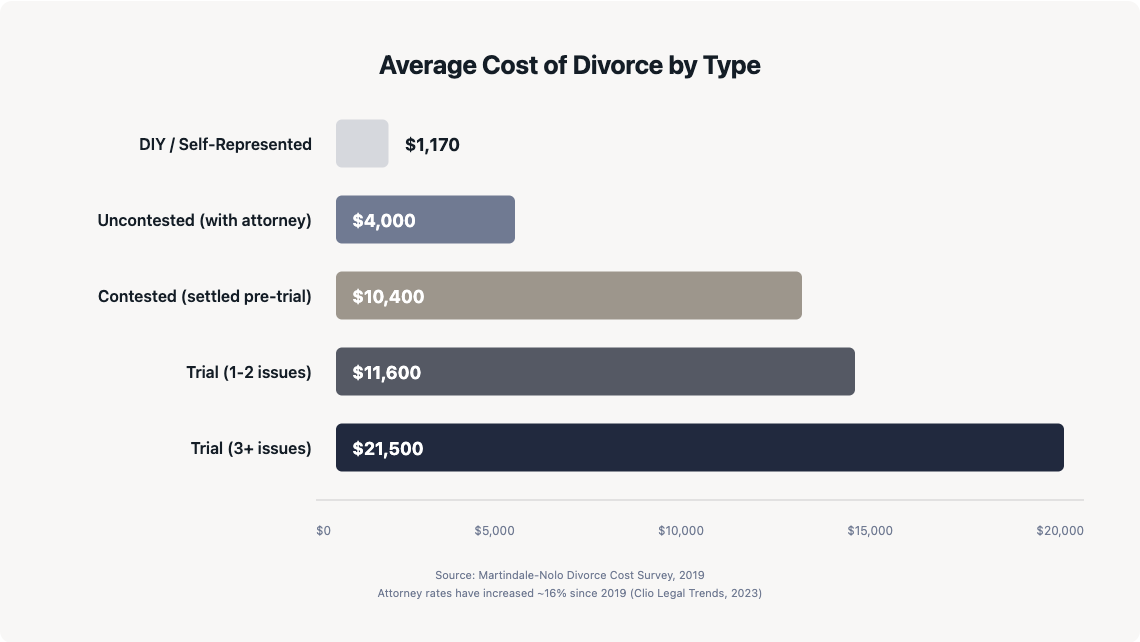
National divorce cost surveys put the average cost of an uncontested divorce with an attorney is $4,000, compared to $10,400 for a contested divorce that settles before trial and up to $21,500 for a case with three or more disputed issues that goes to trial. Average family law attorney hourly rates have risen to $312 as of 2023 (Clio Legal Trends Report, 2023), so current costs may be somewhat higher.
Virginia’s circuit court filing fee for divorce is $86 in Stafford County (Stafford County Circuit Court, 2026). Additional costs may include notarization fees, process server fees if needed, and potential mediation costs if any issues require professional help to resolve.
What Mistakes Can Delay or Derail an Uncontested Divorce?
Even when both spouses agree on everything, procedural errors can stall the process. Watch out for these common pitfalls:
- Incomplete financial disclosure. If one spouse hides assets or fails to disclose debts, the entire settlement agreement could be challenged under Virginia Code § 20-109.1.
- Vague custody language. Terms like “reasonable visitation” leave too much room for future disagreements. Specific schedules, holiday rotations, and decision-making authority should all be spelled out clearly.
- Forgetting retirement accounts. Dividing a 401(k) or pension requires a separate Qualified Domestic Relations Order (QDRO). Leaving this out of the PSA is one of the most expensive oversights.
- Resuming marital relations during separation. Any sexual contact during the separation period resets the clock. This is one of the most frequently misunderstood requirements.
- Not having a corroborating witness prepared. Some couples don’t realize Virginia requires third-party testimony until they’re ready to file.
Why Does an Attorney Still Matter in an Uncontested Divorce?
Because both spouses agree on the terms, some people assume they can handle an uncontested divorce without legal counsel. A 2020 report from the Institute for the Advancement of the American Legal System found that 61.9% of uncontested divorce cases had no legal representation for either party (IAALS, 2020). That’s a risky approach.
Working with an experienced family law attorney helps ensure your property settlement agreement is thorough, enforceable, and actually protects your interests. Small oversights, like failing to address how retirement accounts are divided or leaving ambiguous custody language, can create costly disputes years down the road. An attorney also makes sure you meet every procedural requirement the first time, so your case doesn’t get sent back for corrections.
If you have questions about filing for an uncontested divorce in Virginia, contact the Law Office of Miles Franklin at (276) 773-6102 or schedule a consultation to discuss your situation.
Couples who signed a prenuptial agreement before marriage often have a head start here, because the agreement may already settle how property and support are handled, which makes the property settlement agreement easier to finalize.
Frequently Asked Questions About Uncontested Divorce in Virginia
Can my spouse and I use the same attorney for an uncontested divorce?
No. Virginia’s Rules of Professional Conduct generally prohibit an attorney from representing both sides in a divorce, even an uncontested one. One attorney can draft the property settlement agreement and represent one spouse, while the other spouse should have the agreement reviewed by their own attorney before signing. This protects both parties and helps the agreement hold up if challenged later.
Do I have to go to court for an uncontested divorce in Virginia?
In many uncontested cases, you don’t need to appear in court at all. Under Virginia Code § 20-106, the court can accept sworn affidavits and depositions in place of live testimony when both parties have a signed property settlement agreement. Your attorney can advise whether your specific circuit court requires an appearance.
What happens if we agree on most issues but disagree on one?
If you agree on most terms but have one or two sticking points, mediation can often bridge the gap without converting your case to a contested divorce. A mediator helps both spouses negotiate the remaining issues. If mediation fails and the dispute reaches court, a judge decides only those specific issues while the rest of your agreement stays intact.
Can I file for an uncontested divorce before the separation period ends?
You can begin preparing the property settlement agreement and gathering documents during the separation period, but you cannot file the complaint for divorce until the required six-month or one-year separation period is complete. The complaint must state under oath that you have lived separate and apart for the full statutory period.
Can an uncontested divorce become contested after filing?
Yes. If one spouse changes their mind about the terms after filing, the case can become contested. This is one reason having a well-drafted property settlement agreement matters. Once both parties sign the PSA and it’s incorporated into a court decree under Virginia Code § 20-109.1, it becomes enforceable as a court order and is difficult to overturn.
Questions about your divorce?
Every situation is different. If you have questions about how Virginia law applies to yours, contact the Law Office of Miles Franklin to schedule a consultation.
Schedule a Consultation →