
Spousal support is the part of a Virginia divorce that people most often assume works like child support, and it does not. There is no schedule to read the final number off of, no worksheet that converts two incomes into an award, and no bracket that says a marriage of a certain length earns a certain result. What Virginia has instead is a statute that tells a judge exactly what to think about, in what order, and then requires the judge to write down which of those considerations produced the outcome. Va. Code § 20-107.1 is that statute, and it is the reason two families with identical incomes can leave court with different orders.
The practical consequence is that a spousal support case is won or lost on evidence rather than arithmetic. Income and earning capacity, the decisions the couple made about whose career came first, what the property division left each person holding, and the reason the marriage ended all carry statutory weight. This guide walks the whole statute in the order a Virginia court applies it, from the temporary order entered while the case is pending through the day support finally ends.

Two questions, and only one of them has a formula
Section 20-107.1(E) opens with an entitlement test that has nothing to do with money. Before a court considers amount or duration, it “shall consider the circumstances and factors which contributed to the dissolution of the marriage, specifically including adultery and any other ground for divorce under the provisions of subdivision A (3) or (6) of § 20-91 or § 20-95.” Those grounds are a felony conviction with more than a year of confinement, cruelty, reasonable apprehension of bodily hurt, and willful desertion or abandonment. Fault is not a tiebreaker in Virginia. It is the first thing on the list.
Only after that does the statute turn to the second question. “In determining the nature, amount and duration of an award pursuant to this section, the court shall consider the following,” and then thirteen numbered factors follow. Nothing in that list is weighted. Nothing in it produces a number. A judge who finds support appropriate has to build the award out of evidence on those thirteen items and then explain, in writing, which ones did the work.
The one place Virginia does supply arithmetic is temporary support, the order that holds a household together while the divorce is pending. That formula lives in § 20-103 for circuit court cases and in § 16.1-278.17:1 for juvenile and domestic relations district court cases. It is a genuine presumption with real percentages, and it is also explicitly walled off from the final decision.
Temporary support while the case is pending has a real formula
Section 20-103(E) creates a presumption that the amount produced by the statutory formula is the correct amount of pendente lite spousal support. The percentages sit in subsection (G) and depend on one fact only, whether the couple has minor children in common.
Where there are minor children, the presumptive award is the difference between 26 percent of the payor spouse’s monthly gross income and 58 percent of the payee spouse’s monthly gross income. Where there are no minor children, it is the difference between 27 percent of the payor’s monthly gross income and 50 percent of the payee’s. “Monthly gross income” carries the same meaning it has in § 20-108.2, the child support statute, which defines it as all income from all sources and then lists more than twenty examples.
Three procedural rules shape how that number lands. Subsection (F) requires the court to decide spousal support first when both spousal and child support are on the table, because spousal support received is added to gross income and spousal support paid is subtracted from it before the child support guideline runs. Subsection (A1) requires the award to be paid from the obligor’s post-separation income unless the court finds good cause to order otherwise. Subsection (J) says the order has no presumptive effect and is not determinative when the underlying case is decided, which is the statute’s way of saying that a generous or stingy temporary order proves nothing about the final one.
Subsection (H) permits deviation from the presumptive amount for good cause shown, including evidence about the parties’ current financial circumstances or the effect of a tax exemption and any credits flowing from it. Good cause has to be shown on the record. It is not assumed.
Running the formula on real numbers
Take a Stafford County couple where one spouse earns $6,000 a month gross and the other earns $2,000. Combined monthly gross income is $8,000, which is below the $10,000 ceiling, so the presumption applies.
With no minor children, the calculation is 27 percent of $6,000, which is $1,620, minus 50 percent of $2,000, which is $1,000. The presumptive pendente lite award is $620 a month. With two minor children, the calculation changes to 26 percent of $6,000, which is $1,560, minus 58 percent of $2,000, which is $1,160, for a presumptive award of $400 a month. The presence of children lowers the spousal figure because the child support guideline is about to run separately on the same two incomes.
That second step is where the ordering rule in § 20-103(F) matters. Once the $400 spousal award is set, the child support worksheet treats the payee’s monthly gross as $2,400 and the payor’s as $5,600, because § 20-108.2(C) provides that spousal support received is included in gross income and spousal support paid is deducted from it when paid under an order or written agreement. Running child support first and spousal support second produces a different answer, and it is the wrong order.
| Step | No minor children | Two minor children |
|---|---|---|
| Payor share | 27% of $6,000 = $1,620 | 26% of $6,000 = $1,560 |
| Payee share | 50% of $2,000 = $1,000 | 58% of $2,000 = $1,160 |
| Presumptive award | $620 per month | $400 per month |
| Combined gross tested against the ceiling | $8,000, under the $10,000 limit | $8,000, under the $10,000 limit |
| Effect on the child support worksheet | Not applicable | Payee gross becomes $2,400, payor gross becomes $5,600 |
| Authority | § 20-103(G), (I) | § 20-103(F), (G), (I); § 20-108.2(C) |
The $10,000 ceiling, and what happens above it
Section 20-103(I) limits the presumptive formula to cases where the parties’ combined monthly gross income does not exceed $10,000. That is a hard edge, not a guideline. A couple at $10,100 combined is outside the presumption entirely, and the statute supplies no substitute number for them.
Above the ceiling, a pendente lite request is decided on the evidence the parties put in front of the court. That usually means income and expense statements, pay records, and testimony about what it actually costs to run the two households the separation created. The court retains all the authority listed in § 20-103(A), which is considerably broader than a monthly check. It can order the other spouse to provide health care coverage unless coverage cannot be obtained, order a party to pay secured or unsecured debts incurred jointly or by either party, grant exclusive use and possession of the family residence during the case, require security to abide the eventual decree, take steps to preserve either spouse’s estate so it is still there when the case ends, and compel a party to maintain an existing life insurance policy and name the other spouse or an appropriate person as beneficiary.
There is also a jurisdictional wrinkle worth knowing. Under § 20-103(A2), where a juvenile and domestic relations district court has been divested of a case because a divorce was filed, and no final support order was entered there, a circuit court award of spousal or child support is retroactive to the date the juvenile court proceeding began, provided the petitioner exercised due diligence in getting the other party served. Filing in the juvenile court first can therefore preserve a start date that would otherwise be lost.
Adultery can bar an award, and 2026 narrowed when
Section 20-107.1(B) contains the hardest rule in the statute. No permanent maintenance and support shall be awarded from a spouse if there exists in that spouse’s favor a ground of divorce under subdivision A(1) of § 20-91. Read plainly, a spouse who committed adultery cannot collect support from the spouse they wronged. The bar is on the award itself, not on the amount.
The exception is narrow and expensive to prove. A court may award support anyway if it determines, from clear and convincing evidence, that denying support would constitute a manifest injustice, based on the respective degrees of fault during the marriage and the relative economic circumstances of the parties. Both halves of that test matter. Economic devastation alone does not get there if the fault is one-sided, and one-sided fault does not get there if the parties are similarly situated financially.
Two features of the ground itself deserve attention. First, § 20-91(A)(1) reaches sodomy or buggery committed outside the marriage in addition to adultery. Second, the General Assembly amended the subdivision in 2026 so that it now reads “for adultery that occurred prior to the date of the last separation of the parties.” Conduct after the last separation no longer supplies the ground, which means it no longer triggers the § 20-107.1(B) bar either. That is a meaningful change for anyone who separated, began a new relationship, and then found the question raised in a divorce filed later.
Proof standards have not moved. Section 20-99(1) still requires corroboration for every ground except the no-fault ground in § 20-91(A)(9), so uncorroborated testimony does not establish adultery.
| Ground | Statute | Effect on support |
|---|---|---|
| Adultery, or sodomy or buggery outside the marriage, occurring before the last separation | § 20-91(A)(1) | Bars a permanent award from the wronged spouse unless denial would be a manifest injustice, proven by clear and convincing evidence |
| Felony conviction, confinement over one year, no resumed cohabitation | § 20-91(A)(3) | Considered in the entitlement question under § 20-107.1(E); no statutory bar |
| Cruelty, reasonable apprehension of bodily hurt, willful desertion or abandonment | § 20-91(A)(6) | Considered in the entitlement question under § 20-107.1(E); no statutory bar |
| Grounds for divorce from bed and board | § 20-95 | Considered in the entitlement question under § 20-107.1(E); no statutory bar |
| One year separate and apart, or six months with an agreement and no minor children | § 20-91(A)(9) | No effect standing alone; § 20-91(A)(9)(c) says a no-fault decree does not lessen a support obligation unless another ground is proven |
The thirteen factors a Virginia court has to weigh
Once support is on the table, § 20-107.1(E) lists thirteen considerations that determine the nature, amount, and duration of the award. The statute does not rank them, does not assign weights, and does not say how many have to favor a party before an award follows. What it does do is make the list exhaustive in one direction: a judge may consider other equities under factor thirteen, but may not skip the twelve that come before it.
Reading the list as a checklist is the wrong instinct. Most of the thirteen are really questions about evidence, and the party who shows up with documents rather than adjectives tends to do better. Tax returns, pay stubs, retirement statements, benefit summaries, tuition records, and a clear account of who did what during the marriage are what these factors are made of.
The list also repays being read in groups rather than one line at a time. Factors one, seven, and eight describe what each spouse has right now, in income, property, and whatever the equitable distribution ruling produced. Factors nine, ten, and eleven describe what each spouse can earn going forward and what it would take to change that. Factors two, three, five, six, and twelve describe the marriage itself, the standard of living it established, how long it lasted, and what each person put into it that never showed up on a pay stub. Factor four covers age and health, and factor thirteen is the catch-all that lets a court weigh taxes and the circumstances of the breakup alongside everything else. A case that is strong in one group and silent in the others is usually a case that has not been fully prepared.
| # | Factor | What proves it |
|---|---|---|
| 1 | Obligations, needs, and financial resources of the parties, including income from pension, profit sharing, or retirement plans of any kind | Tax returns, pay records, plan statements, monthly budgets, debt schedules |
| 2 | The standard of living established during the marriage | Bank and card records, housing costs, travel and schooling patterns over several years |
| 3 | The duration of the marriage | The marriage certificate and the date of separation as defined in § 20-107.1(G) |
| 4 | Age and physical and mental condition of the parties, and any special circumstances of the family | Medical records, treating provider testimony, disability determinations |
| 5 | Whether a child’s age, condition, or circumstances make it appropriate that a party not work outside the home | School and medical records, care schedules, provider letters |
| 6 | Contributions, monetary and nonmonetary, of each party to the well-being of the family | Testimony, calendars, records of caregiving, household management, and unpaid work in a family business |
| 7 | Property interests of the parties, real and personal, tangible and intangible | Deeds, titles, account statements, business valuations |
| 8 | The provisions made with regard to marital property under § 20-107.3 | The equitable distribution ruling or the settlement agreement itself |
| 9 | Earning capacity, including skills, education, training, and present employment opportunities | Work history, licenses, vocational evaluation, local job market evidence |
| 10 | The opportunity, ability, time, and cost for a party to acquire education, training, and employment to raise earning ability | Program costs, admission requirements, completion timelines |
| 11 | Decisions about employment, career, economics, education, and parenting made during the marriage and their effect on earning potential, including time out of the job market | Employment history, relocation records, correspondence showing the decision and who made it |
| 12 | The extent to which either party contributed to the other’s education, training, career position, or profession | Tuition payments, loan records, evidence of support during training years |
| 13 | Other factors, including tax consequences and the circumstances that contributed to the dissolution, necessary to consider the equities | Tax analysis, and the fault evidence already developed under the entitlement question |
Income and earning capacity do most of the work
Factors one, nine, ten, and eleven all point at the same underlying question, which is what each spouse can realistically earn going forward. Factor one is about actual resources today, and it specifically sweeps in income from pension, profit sharing, and retirement plans of whatever nature, so a spouse drawing from a plan cannot treat that stream as invisible. Factor nine moves from what a person earns to what a person could earn, naming skills, education, training, and the present employment opportunities for someone with that profile.
Factor ten is the one people underestimate. It asks about the opportunity for, ability of, and the time and costs involved for a party to acquire the education, training, and employment needed to raise earning ability. That is a concrete evidentiary question with concrete answers. A certificate program that takes eighteen months and costs a known amount supports a defined-duration award shaped around that timeline. A vague assertion that the other spouse “could get a job” supports very little.
Factor eleven then looks backward at the choices that produced the current gap. Decisions about employment, career, economics, education, and parenting arrangements made during the marriage, and their effect on present and future earning potential, are expressly in the statute, and so is the length of time one or both parties have been absent from the job market. A spouse who left a career to follow a military transfer or to raise children is describing a statutory factor, not asking for sympathy.

Length of the marriage shapes the form, not a formula
Duration of the marriage is factor three, and it is one factor among thirteen. Virginia’s Code contains no brackets, no thresholds, and no rule that a marriage of a given length produces a given type of award. Anyone who has read that a marriage of a certain number of years automatically earns permanent support has read something the statute does not say.
What length actually does is interact with the other factors. A long marriage tends to make factors two, six, eleven, and twelve heavier, because there has been more time to establish a standard of living, more accumulated nonmonetary contribution, and more time out of the job market to account for. A short marriage where both spouses kept working tends to leave those factors thin. The mechanism is evidentiary, not arithmetic.
Section 20-107.1(G) supplies the two definitions that matter for measuring any of this. “Date of separation” means the earliest date at which the parties are physically separated and at least one party intends the separation to be permanent, provided the separation is continuous after that. “Defined duration” means a period of time either with a specific beginning and ending date, or specified in relation to the occurrence or cessation of an event or condition other than death or termination under § 20-110.
Nonmonetary contributions are a statutory factor, not a courtesy
Factor six requires the court to consider the contributions, monetary and nonmonetary, of each party to the well-being of the family. Virginia treats these as the same kind of input, which is why the same language appears in the property division statute. Raising children, running a household, managing the logistics that let the other spouse travel or work long hours, and unpaid work in a family business are all contributions the statute expects to hear about.
Factor twelve is more specific and is often the strongest card a lower-earning spouse holds. It asks the extent to which either party has contributed to the attainment of education, training, career position, or profession of the other party. A spouse who worked while the other finished a degree, licensing program, or residency is describing factor twelve exactly. Tuition receipts, loan records, and tax returns from those years turn that story into evidence.
Factor five sits alongside them. Where the age, physical or mental condition, or special circumstances of a child of the parties would make it appropriate that a party not seek employment outside the home, the statute directs the court to weigh that. This is not the same as the child support calculation, and it does not require the child to be an infant. A child with significant medical or educational needs can make a parent’s absence from the job market a present fact rather than a past choice.
Property division and support are decided together
Factors seven and eight tie the support analysis directly to what each spouse walks away owning. Factor seven covers property interests, real and personal, tangible and intangible. Factor eight is narrower and more pointed: the provisions made with regard to the marital property under § 20-107.3.
That means the equitable distribution ruling is an input to the support ruling, not a parallel track. A spouse who receives an income-producing asset, a larger share of retirement, or the marital residence free of debt has different needs afterward than a spouse who receives cash and a car. Arguing the two issues as though they were unrelated is one of the more common ways a strong support position gets weakened.
Retirement assets deserve their own attention here, because they appear twice. Factor one counts income from pension, profit sharing, or retirement plans of whatever nature as a present financial resource, and factor eight counts whatever the court did with those plans under § 20-107.3(G). The orders used to divide retirement accounts therefore change the support picture on both sides of the ledger.
| Property outcome | Effect on the support factors | Statute |
|---|---|---|
| Income-producing asset awarded to the lower earner | Raises that spouse’s financial resources under factor one and reduces demonstrated need | § 20-107.1(E)(1), (7), (8) |
| Marital residence awarded with the mortgage attached | Adds a fixed obligation that offsets the value received; factor one weighs obligations as well as resources | § 20-107.1(E)(1), (7) |
| Share of a pension divided by order | Counts as income from a retirement plan under factor one once it is in pay status, and as a property provision under factor eight | § 20-107.1(E)(1), (8); § 20-107.3(G) |
| Lump sum cash equalization payment | Changes present resources without creating income; often argued alongside a defined-duration award | § 20-107.1(C), (E)(7), (8) |
| Marital debt assigned to the higher earner | Reduces that spouse’s ability to pay, which is squarely within factor one | § 20-107.1(E)(1); § 20-103(A)(i)(b) |
The four forms an award can take
Section 20-107.1(C) gives the court its menu. Maintenance and support may be decreed in periodic payments for a defined duration, in periodic payments for an undefined duration, in a lump sum award, or in any combination of those. That is the whole list, and the combination option is used more often than people expect. A lump sum that covers a training program paired with periodic payments during it is one award, not two.
The difference between defined and undefined duration is not a difference in generosity. It is a difference in what happens later. A defined-duration award can be modified only on a petition filed within the time the award covers, under § 20-109(B), and the modification standard there is stricter than the general one. An undefined-duration award stays open to the general modification standard in § 20-109(A) for as long as it runs.
Lump sum awards carry their own consequence. Because they are not periodic, the termination events that end periodic support do not operate on them in the same way, and the tax analysis under factor thirteen is different. A lump sum is also the only form that removes future collection risk entirely, which matters when the payor’s income is volatile or difficult to reach.
Reserving the right to ask later
Section 20-107.1(D) lets a court do something short of awarding support: reserve a party’s right to receive it in the future. A reservation is not a small thing. It keeps the door open in a case where support is not appropriate today but the circumstances that would justify it are foreseeable.
The statute attaches a presumption to the length of that reservation. Where the right to support is reserved, there is a rebuttable presumption that the reservation continues for a period equal to 50 percent of the length of time between the date of the marriage and the date of separation. A marriage that ran sixteen years from wedding to separation carries a presumed eight-year reservation. Once granted, the duration of the reservation is not subject to modification, which cuts both directions.
There is also a 2020 change that catches people. Unless otherwise provided by stipulation or contract executed on or after July 1, 2020, or unless otherwise ordered by the court on or after July 1, 2020, a party seeking to exercise a reserved right to support must prove a material change of circumstances first. The reservation preserves the ability to ask. It does not preserve the ability to ask for no reason.
The judge has to write it down
Section 20-107.1(F) turns the factor list into a paper requirement. In contested circuit court cases, any order granting, reserving, or denying a request for spousal support must be accompanied by written findings and conclusions identifying the factors in subsection (E) that support the order. An order that simply announces a number has a problem on appeal.
The subsection asks for two more things. Any order granting or reserving support has to state whether the retirement of either party was contemplated and specifically considered by the court, and if so, the order must state the facts the court contemplated and specifically considered about that retirement. That requirement exists because of what § 20-109 does with retirement later, and an order that is silent on it leaves the question wide open.
Where the court awards periodic support for a defined duration, the findings must identify the basis for the nature, amount, and duration of the award, and where appropriate, specify the events and circumstances the court reasonably contemplated in making it. Those specified events are the raw material for a later modification petition under § 20-109(B), which allows modification where an anticipated event that was significant to the award does not in fact occur through no fault of the party seeking the change.
| Requirement | Applies to | Why it matters later |
|---|---|---|
| Written findings identifying the § 20-107.1(E) factors relied on | Any contested circuit court order granting, reserving, or denying support | Supplies the record for appellate review |
| Statement whether retirement was contemplated and specifically considered | Any order granting or reserving support | First of the six factors a court weighs on a retirement-based modification under § 20-109(F) |
| Basis for nature, amount, and duration | Periodic awards for a defined duration | Frames what counts as a material change not reasonably contemplated |
| Events and circumstances reasonably contemplated | Periodic awards for a defined duration, where appropriate | Creates the second modification path in § 20-109(B), for an anticipated event that does not occur |
| Written findings on any modification or termination order | Any order granting or denying modification or termination | Required by § 20-109(G), which also directs the court to consider each party’s assets and any income they generate |
What the order itself must contain
Where there are no minor children the parties have a mutual duty to support, § 20-107.1(H) lists seven items every spousal support order entered on or after October 1, 1985 must contain, including orders that simply confirm a separation agreement. These are administrative on their face and consequential in practice, because they are what makes an order enforceable without a return trip to court.
The seventh item is the one to read twice. Every such order must contain notice that, in determining a spousal support obligation, the obligation as it becomes due and unpaid creates a judgment by operation of law. Nobody has to go back to court to convert a missed payment into a judgment. It becomes one on its own.
Items two, four, and five are the ones that decide whether an order can be enforced without argument later. Support has to be stated in fixed sums with the payment interval, the date payments are due, and the date the first payment is due, which is what makes a missed payment identifiable to the day. If arrearages already exist, the order has to name who is owed, how much, the period the figure covers, and a direction that money coming in credits current support first with any excess applied to arrears. If overages exist, the order has to say who is owed, how much, and how the overage gets repaid. Orders that skip these details are the ones that generate a second hearing about what the first hearing decided.
| # | Required content |
|---|---|
| 1 | Identifying information for each party where known, including name, date of birth, social security number, addresses, telephone numbers, driver’s license number, and employer, with an exception protecting a party at risk of physical or emotional harm |
| 2 | The amount of periodic support expressed in fixed sums, with the payment interval, the date payments are due, and the date the first payment is due |
| 3 | A statement whether there is an order for health care coverage for a party |
| 4 | If arrearages exist, who is owed, how much, the period covered, and a direction that payments credit current support first and any excess to arrears |
| 5 | If overages exist, who is owed, how much, the period covered, and how the overage is to be paid |
| 6 | Where payments go directly to the payee, at least 30 days advance written notice of any address change and notice of a phone number change within 30 days |
| 7 | Notice that the support obligation as it becomes due and unpaid creates a judgment by operation of law |
Agreements usually control, and the 2018 rule changed how
Most Virginia spousal support outcomes are written by the parties, not by a judge. Section 20-109(C) is why. In suits for divorce, annulment, and separate maintenance, if a stipulation or contract signed by the party who might otherwise receive relief is filed before entry of a final decree, no decree directing support, suit money, counsel fees, or any other condition may be entered except in accordance with that contract. If the contract is filed after the final decree and a party moves, the court shall modify its decree to conform to it.
The 2018 amendment added an important limit on how airtight those contracts are. No request to modify spousal support based on a material change in circumstances or on the terms of the contract may be denied solely on the basis of the terms of a stipulation or contract executed on or after July 1, 2018, unless the contract expressly states that the amount or duration of spousal support is non-modifiable. Silence no longer closes the door. Express language does.
Two neighboring statutes finish the picture. Section 20-109.1 lets a court affirm, ratify, and incorporate a valid agreement into its decree, after which the agreement is deemed for all purposes a term of the decree and is enforceable the same way any other decree provision is. It also provides that on the death or remarriage of the spouse receiving support, support terminates unless the agreement says otherwise. Section 20-155 governs marital agreements between spouses and contains a trap: a reconciliation after signing a separation or property settlement agreement abrogates the agreement unless the agreement expressly says otherwise. Couples who sign, reconcile, and separate again are often surprised to learn the document no longer exists. A premarital agreement is governed by the related sections that precede § 20-155.
| Situation | Result | Statute |
|---|---|---|
| Contract filed before the final decree | The court may not enter a support decree except in accordance with it | § 20-109(C) |
| Contract filed after the final decree, and a party moves | The court shall modify the decree to conform to the contract | § 20-109(C) |
| Contract executed on or after July 1, 2018 that is silent on modifiability | A modification request cannot be denied solely because of the contract’s terms | § 20-109(C) |
| Contract that expressly states amount or duration is non-modifiable | The modification limit holds, and the retirement provisions in § 20-109(F) do not apply to it | § 20-109(C), (F) |
| Agreement affirmed, ratified, and incorporated into the decree | Deemed a term of the decree and enforceable as one | § 20-109.1 |
| Parties reconcile after signing a separation agreement | The agreement is abrogated unless it expressly says otherwise | § 20-155 |
Changing an award after it is entered
Section 20-109(A) is the general modification power. On petition of either party, the court may increase, decrease, or terminate the amount or duration of any spousal support that may thereafter accrue, whether previously or later awarded, as the circumstances may make proper. The words “thereafter accrue” are doing real work: modification operates forward, never backward.
For defined-duration awards, § 20-109(B) adds a separate and narrower gate. The petition has to be filed within the time covered by the duration of the award. Then, after considering the § 20-107.1(E) factors, the court may change amount or duration only on finding either that there has been a material change in the circumstances of the parties that was not reasonably in the contemplation of the parties when the award was made, or that an event the court anticipated would occur during the award, and which was significant in making it, did not in fact occur through no fault of the party seeking the modification. That subsection applies to suits for initial support orders filed on or after July 1, 1998 and to modifications arising from them.
Section 20-109(G) closes the loop on process. In any modification or termination action, once the court finds a material change, it may consider the § 20-107.1(E) factors and the retirement factors, shall consider each party’s assets and property interests from the date of the support order through the hearing along with any income those assets generate, and must issue written findings identifying the factors that support the ruling.
Retirement is a material change by statute
Before 2018, a payor who retired had to argue that retirement was a material change at all. Section 20-109(E) removed that argument. For purposes of modification, and without limiting any other basis for a change, the payor spouse’s attainment of full retirement age is a material change in circumstances. The statute defines full retirement age as the normal retirement age at which a person is eligible for full retirement benefits under the federal Social Security Act, and expressly says it does not mean early retirement age.
Finding a material change is only the first half. Section 20-109(F) then requires the court to determine whether a modification or termination should actually be granted, and to weigh six listed factors on top of the § 20-107.1(E) factors it may also consider. The first of those six is whether retirement was contemplated and specifically considered when support was awarded, which is precisely the statement § 20-107.1(F) requires the original order to contain.
Two limits ride along. The retirement provisions are subject to § 20-109(C) on stipulations and contracts, and they do not apply at all to a contract or stipulation that is non-modifiable. Subject to that, they apply regardless of when the original suit was filed or the original order entered.
| # | Factor | What the court is looking for |
|---|---|---|
| 1 | Whether retirement was contemplated and specifically considered when support was awarded | The statement § 20-107.1(F) requires in the original order |
| 2 | Whether the retirement is mandatory or voluntary, and its terms and conditions | Employer policy, pension election documents, separation terms |
| 3 | Whether retirement would change the income of either the payor or the payee | Benefit statements and post-retirement income projections for both parties |
| 4 | The age and health of the parties | Medical records and current age relative to full retirement age |
| 5 | The duration and amount of spousal support already paid | Payment history from the date of the order |
| 6 | The assets or property interests of each party from the date of the order to the hearing | Account statements, property records, and income those assets generate |
A year of cohabitation ends support
Section 20-109(A) contains a termination rule that operates independently of everything else in the statute. On order of the court based on clear and convincing evidence that the spouse receiving support has been habitually cohabiting with another person in a relationship analogous to a marriage for one year or more, commencing on or after July 1, 1997, the court shall terminate support and maintenance. “Shall” is the operative word. This is not a factor to weigh.
There are exactly two ways out. The first is a stipulation or contract that provides otherwise, which is one of the more commonly negotiated terms in a Virginia settlement agreement. The second is proof by the spouse receiving support, by a preponderance of the evidence, that termination would be unconscionable. That is a higher bar than unfair or inconvenient.
Three details drive most cohabitation litigation. The relationship must be analogous to a marriage, not merely a shared address, so shared finances, shared responsibilities, and how the parties present themselves matter more than a lease. The cohabitation must be habitual and must run a year or more, which means an on-and-off arrangement may not qualify. And the burden on the moving party is clear and convincing evidence, which is a demanding standard. The subsection applies to all support orders and decrees regardless of when the suit was filed, when the order was entered, or when a modification petition was filed.

Remarriage and death end it, and silence is expensive
Section 20-109(D) provides that unless otherwise provided by stipulation or contract, spousal support terminates on the death of either party or on the remarriage of the spouse receiving support. Section 20-110 says the same thing more sharply and adds a penalty.
Under § 20-110, if a former spouse receiving support remarries, support ceases as of the date of that marriage. The spouse entitled to support has an affirmative duty to notify the payor immediately. Failure to do so entitles the payor to restitution equal to the amount of any current support paid after the date of the remarriage, together with interest from the date of the remarriage and reasonable attorney fees and costs. Section 20-109(D) repeats the notification duty and directs that notice go to the payor’s last known address.
Death is handled at both ends of the statute. Section 20-107.1(A) says the court has no authority to decree maintenance and support payable by the estate of a deceased spouse, so an award cannot be entered against an estate in the first place. Section 20-109(D) then ends an existing award on the death of either party unless a contract provides otherwise. That last clause is why parties who want support to survive a death have to say so, and why § 20-107.1:1 exists.
| Event | Effect | Requires a hearing? | Statute |
|---|---|---|---|
| Remarriage of the payee | Support ceases as of the date of the marriage; payee must notify the payor immediately | No, it operates by law; a motion may still be needed for restitution | §§ 20-109(D), 20-110 |
| Failure to give notice of remarriage | Payor is entitled to restitution of post-remarriage payments, plus interest and reasonable attorney fees and costs | Yes | § 20-110 |
| Death of either party | Support terminates unless a stipulation or contract provides otherwise | No | § 20-109(D) |
| Habitual cohabitation analogous to marriage for one year or more | The court shall terminate, subject to a contrary contract or proof that termination would be unconscionable | Yes, on clear and convincing evidence | § 20-109(A) |
| The end date of a defined-duration award | Support ends on the stated date or on the named event other than death or § 20-110 termination | No | § 20-107.1(C), (G) |
| Termination on a modification petition | Support ends prospectively from the date notice of the petition reached the other party | Yes | §§ 20-109(A), 20-112 |
The filing date is the earliest a change can reach
Section 20-112 is short and costs people more money than any other sentence in the chapter. When proceedings are reopened to increase, decrease, or terminate spousal support, the petitioning party must give notice to the other party by service of process or by order of publication. Then: except as provided by § 20-110, no support order may be retroactively modified, but it may be modified with respect to any period during which a petition for modification is pending, and only from the date notice of that petition has been given to the responding party.
Read that against a common sequence. A payor loses a job in January, spends five months looking for equivalent work, files a modification petition in June, and gets the other party served in July. Support at the old rate accrued every month from January through July, and every one of those months is a judgment by operation of law. The petition reaches back to July and no further. The five months of waiting were not preserved. They were forfeited.
The same rule protects a payee whose circumstances worsen. Waiting to file while hoping the situation improves does not bank the increase. The only date that matters is the date notice reached the other side.
Unpaid support is a judgment, and it collects interest
Two statutes make spousal support arrears far harder to negotiate down than people expect. Section 20-107.1(H)(7) requires every qualifying order to carry notice that the obligation, as it becomes due and unpaid, creates a judgment by operation of law. Section 20-78.2 then provides that the entry of a support order under §§ 20-107.1 through 20-109 constitutes a final judgment for any sums in arrears, and that the order shall include interest on the arrearage at the judgment interest rate in § 6.2-302, which is six percent a year, unless the party owed the money waives interest in a writing submitted to the court.
Section 20-78.2 also supplies a fee trigger. The order may include reasonable attorney fees where the total arrearage for support and maintenance, excluding interest, is equal to or greater than three months of support. Three missed months is the line where the cost of collection can start shifting to the person who did not pay.
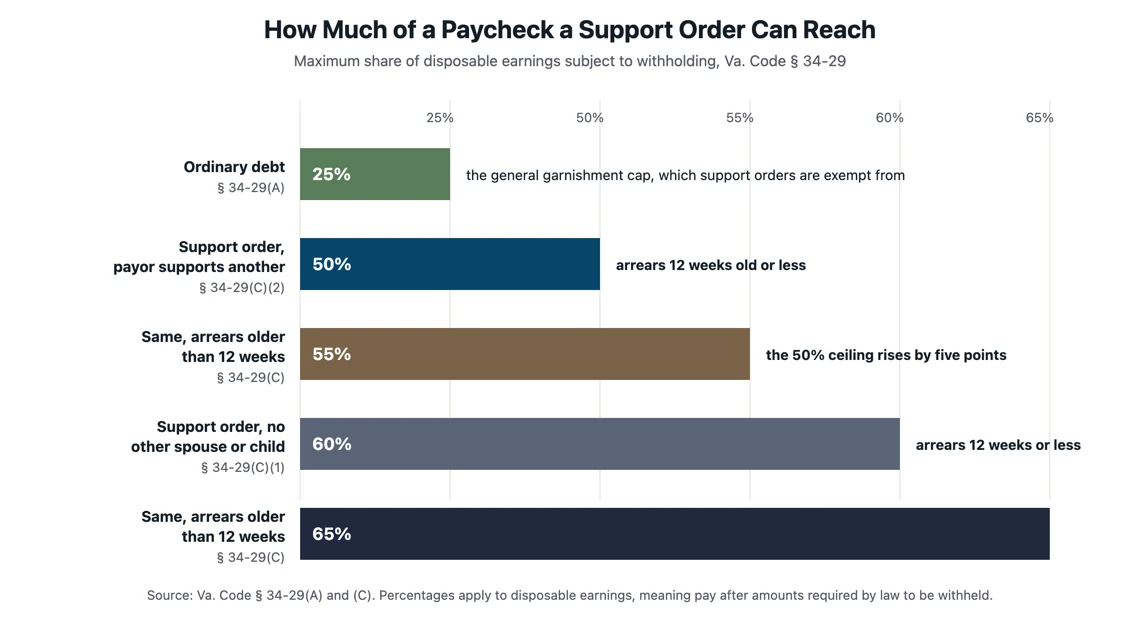
Collection itself usually runs through an income deduction order. Section 20-79.3 lists what such an order must contain, including a direction that the employer withhold a fixed amount or the maximum permitted by § 34-29, whichever is less, and a statement of that maximum percentage. Section 34-29(C) sets the support withholding ceilings well above ordinary garnishment, and § 20-114 separately allows a court to require a recognizance, with or without surety, for compliance with a support decree.
Securing the award with life insurance
Section 20-107.1:1, added in 2017, gives courts a tool for the risk that § 20-109(D) creates by ending support on death. Where a support order has been entered, the court may order a party to maintain an existing life insurance policy on the insured party’s life, designate the other party as beneficiary of all or part of the death benefit for as long as the support obligation runs, allocate the premium cost between the parties with all premiums billed to the policyholder, and execute the consents needed for the insurer to confirm to the beneficiary that the policy is in good standing.
The power has real boundaries. The policy has to be one purchased during the marriage, issued through the insured’s employment, or within the insured’s effective control. The party ordered must have the right to designate a beneficiary, the payee must have been designated as a beneficiary during the marriage, and the payee must have an insurable interest under § 38.2-301(B). The obligation ceases when the support obligation ceases. The section does not apply to second-to-die policies, and the court may not impose the cost of converting a term policy to a permanent one. Where a group policy is terminated by the employer or an involuntary change in employment ends it, that cannot be the basis for a contempt finding.
One drafting point matters for later. An order under this section is modifiable on a material change including a change in the payor’s marital status, but the statute expressly says that change in marital status may not be treated as a § 20-107.1 factor or as a material change in any proceeding to modify spousal support itself.
| # | Factor |
|---|---|
| 1 | The age, health, and insurability of the insured party |
| 2 | The age and health of the payee spouse |
| 3 | The cost of the life insurance policy |
| 4 | The amount and term of the award of spousal support or separate maintenance |
| 5 | The prevailing insurance rates at the time of the order |
| 6 | The ability of either spouse to pay the premium cost |
| 7 | Any other factor the court deems necessary or appropriate to reach a fair order |
The tax treatment changed in 2019
For decades, spousal support moved income from a higher bracket to a lower one, and that shift was part of every negotiation. The federal rule changed for agreements executed after 2018. According to the IRS, alimony or separate maintenance payments are deductible by the payer spouse and includible in the recipient spouse’s income only if paid under a divorce or separation agreement executed before 2019. The payer cannot deduct payments made under an agreement executed after 2018, and the recipient does not include them in gross income.
There is one bridge between the two regimes. A pre-2019 agreement that is later modified keeps its original treatment unless the modification expressly states that the repeal of the alimony deduction applies to the modification. That sentence is an active drafting decision, not boilerplate, and anyone modifying an older Virginia order should know which side of it they are choosing.
Tax consequences are not an afterthought in Virginia. Factor thirteen in § 20-107.1(E) expressly names the tax consequences to each party as something the court considers in reaching an equitable result, and § 20-103(H) lists the impact of a tax exemption and any resulting credits as good cause for deviating from the temporary formula.
| Agreement or order | Deductible by the payer? | Taxable to the recipient? |
|---|---|---|
| Executed before 2019, never modified | Yes | Yes |
| Executed after 2018 | No | No |
| Executed before 2019, later modified without the express repeal language | Yes, the original treatment continues | Yes |
| Executed before 2019, later modified with language expressly applying the repeal | No | No |
Which court decides a spousal support case
Two different courts can enter a spousal support order in Virginia, and which one a person starts in depends on whether a divorce has been filed. Under § 16.1-241(L), a juvenile and domestic relations district court has jurisdiction over any person who seeks spousal support after having separated from a spouse. That is the forum for someone who is separated, needs support now, and is not ready to file for divorce.
Two features of that subsection are worth knowing before choosing a courthouse. A decision under § 16.1-241(L) is not res judicata in a later circuit court action for spousal support, so a juvenile court ruling does not lock in the outcome of a later divorce. And the circuit court has concurrent original jurisdiction over the same claims, which means the choice is genuinely a choice. Once a divorce is filed and the juvenile court is divested under § 16.1-244, the circuit court takes the support issues joined in the divorce, and § 20-103(A2) makes the circuit court’s award retroactive to the juvenile court filing date where no final support order had been entered there.
For families in the firm’s service area, the routing looks like the table below. Note that the juvenile and domestic relations courts are frequently in different buildings from the circuit courts, and in Spotsylvania and Fredericksburg they are on different streets entirely.
| Locality | Juvenile and Domestic Relations District Court | Circuit Court |
|---|---|---|
| Stafford County | 1300 Courthouse Road, Stafford. Clerk: James B. Thompson | 1300 Courthouse Road, Stafford. Clerk: Hon. Kathy M. Sterne |
| City of Fredericksburg | 615 Princess Anne Street, Fredericksburg. Clerk: Julie A. Dobson | 701 Princess Anne Street, Suite 100, Fredericksburg. Clerk: Hon. Jeff Small |
| Spotsylvania County | 9113 Courthouse Road, Judicial Center Building B, Spotsylvania. Clerk: Susan Klingensmith | 9107 Judicial Center Lane, Spotsylvania. Clerk: Hon. Christalyn M. Jett |
| King George County | 10446 Government Center Blvd., Suite 169, King George. Clerk: Sherry L. Taylor | 10446 Government Center Blvd., Suite 271, King George. Clerk: Hon. Jessica M. Mattingly |
| Prince William County | 9311 Lee Avenue, First Floor, Manassas. Clerk: Monica J. Burnett | 9311 Lee Avenue, Third Floor, Manassas. Clerk: Hon. Jacqueline C. Smith |
The mistakes that cost people the most
Most of the damage in a Virginia spousal support case is done before anyone walks into a courtroom, and almost all of it is avoidable. The pattern repeats: a date is missed, a document is not read closely, or an assumption imported from another state turns out not to be Virginia law.
The single most expensive habit is waiting. Section 20-112 forecloses any retroactive change before notice, so every month spent hoping circumstances will improve is a month locked at the old rate and accruing as a judgment under § 20-78.2. The second most expensive is treating a temporary order as a preview of the final one, when § 20-103(J) says in plain terms that it has no presumptive effect.
A third category is quieter and shows up years later. Agreements that say nothing about cohabitation, orders that say nothing about retirement, and separation agreements that say nothing about what happens if the couple reconciles all read as complete documents on the day they are signed. Each one leaves a default rule in place that the parties never chose, and in every case that default is written somewhere in Chapter 6 of Title 20. Reading an agreement for what it omits is as important as reading it for what it says, and it is considerably cheaper than litigating the omission later.
| Mistake | Consequence | Statute |
|---|---|---|
| Waiting months to file a modification petition after income changes | Every month before notice accrues at the old rate and becomes a judgment | §§ 20-112, 20-78.2 |
| Treating the pendente lite figure as the likely final award | Settlement built on a number the statute says is not determinative | § 20-103(J) |
| Signing an agreement that is silent on cohabitation | Support terminates on proof of a year of cohabitation, with only the unconscionability defense left | § 20-109(A) |
| Assuming a long marriage guarantees indefinite support | Duration is one of thirteen factors, and the Code sets no brackets | § 20-107.1(E)(3) |
| Accepting an order that is silent on retirement | Leaves the first § 20-109(F) factor unanswered when the payor later retires | §§ 20-107.1(F), 20-109(F)(1) |
| Not notifying the payor of a remarriage | Restitution of every post-remarriage payment, plus interest and reasonable attorney fees and costs | § 20-110 |
| Reconciling after signing a separation agreement without checking the language | The agreement is abrogated unless it expressly survives reconciliation | § 20-155 |
| Negotiating support and property division as separate problems | Weakens both, since the property outcome is factor eight of the support analysis | § 20-107.1(E)(7), (8) |
Get the record built before the order is entered
Spousal support is one of the few parts of a Virginia divorce where the outcome really does turn on the quality of the evidence rather than the force of the argument. Earning capacity, the cost and timeline of retraining, the decisions made during the marriage about whose career moved, and what the property division left behind are all statutory factors, and all of them are cheaper to prove before an order exists than to revisit afterward. Miles Franklin handles spousal support claims, defenses, modifications, and enforcement for people in Stafford, Fredericksburg, Spotsylvania, King George, and the surrounding counties.
Call (276) 773-6102 or use the form below to schedule a consultation.
Frequently asked questions about spousal support in Virginia
Is there a spousal support formula in Virginia?
Only for temporary support. Section 20-103(G) sets a presumptive pendente lite amount equal to the difference between 26 percent of the payor’s monthly gross income and 58 percent of the payee’s where the parties have minor children in common, or 27 percent minus 50 percent where they do not. That presumption applies only where the parties’ combined monthly gross income is $10,000 or less, and § 20-103(J) says the resulting order has no presumptive effect on the final award. For the final award, § 20-107.1 supplies thirteen factors and no formula at all.
How long does spousal support last in Virginia?
There is no statutory schedule. Section 20-107.1(C) allows periodic payments for a defined duration, periodic payments for an undefined duration, a lump sum, or any combination. Duration of the marriage is factor three of thirteen in § 20-107.1(E), not a formula input. In contested circuit court cases where the court awards periodic support for a defined duration, § 20-107.1(F) requires written findings identifying the basis for the nature, amount, and duration of the award, and where appropriate the events the court reasonably contemplated in setting it.
Does adultery stop someone from receiving spousal support in Virginia?
Usually yes. Section 20-107.1(B) provides that no permanent maintenance and support shall be awarded from a spouse if a ground of divorce under § 20-91(A)(1) exists in that spouse’s favor. A court may still award support if it determines from clear and convincing evidence that denial would constitute a manifest injustice, based on the respective degrees of fault during the marriage and the relative economic circumstances of the parties. As amended in 2026, § 20-91(A)(1) reaches adultery that occurred prior to the date of the last separation, so conduct after the last separation no longer supplies the ground.
Can spousal support be changed after the divorce is final?
Yes, prospectively. Section 20-109(A) allows a court to increase, decrease, or terminate the amount or duration of support that will thereafter accrue as the circumstances make proper. A defined-duration award has a narrower path under § 20-109(B), which requires a petition filed within the award period plus either a material change not reasonably in the contemplation of the parties or an anticipated event that did not occur through no fault of the moving party. Section 20-112 bars any retroactive modification and allows change only from the date notice of the petition reached the other party.
Does spousal support end if my former spouse moves in with someone?
It ends after a year, on proof. Section 20-109(A) directs the court to terminate support on clear and convincing evidence that the spouse receiving support has been habitually cohabiting with another person in a relationship analogous to a marriage for one year or more, commencing on or after July 1, 1997. There are two exceptions: a stipulation or contract that provides otherwise, and proof by the receiving spouse by a preponderance of the evidence that termination would be unconscionable. The rule applies regardless of when the order was entered.
What happens to spousal support when the payor retires?
Retirement at full retirement age is a material change by statute. Section 20-109(E) provides that the payor’s attainment of full retirement age, meaning the normal retirement age for full Social Security retirement benefits and not early retirement age, is a material change in circumstances. Section 20-109(F) then requires the court to weigh six factors in deciding whether to modify or terminate, beginning with whether retirement was contemplated and specifically considered when support was awarded. These provisions do not apply to a non-modifiable contract or stipulation.
Do unpaid spousal support payments turn into a judgment?
Yes, automatically. Section 20-107.1(H)(7) requires the order to give notice that the obligation as it becomes due and unpaid creates a judgment by operation of law, and § 20-78.2 makes the entry of a support order a final judgment for any sums in arrears. That statute also requires interest on the arrearage at the § 6.2-302 judgment rate of six percent unless the party owed the money waives interest in writing, and permits reasonable attorney fees where the arrearage excluding interest equals three months of support or more.
Which court handles spousal support if I have not filed for divorce?
The juvenile and domestic relations district court. Section 16.1-241(L) gives that court jurisdiction over any person who seeks spousal support after separating from a spouse, and expressly provides that a decision there is not res judicata in a later circuit court action. The circuit court has concurrent original jurisdiction over the same claims. Once a divorce is filed, § 16.1-244 divests the juvenile court of the issues joined in the divorce, and § 20-103(A2) makes the circuit court award retroactive to the juvenile court filing date where no final support order was entered there.
Where to start
Start with the two questions the statute asks, in order. Whether support is appropriate at all is answered by the circumstances that ended the marriage, and it is worth knowing early whether § 20-107.1(B) is in play, because that single subsection can end the analysis. If support is on the table, the next step is evidence on the thirteen factors: income and earning capacity for both households, the real cost and timeline of any retraining, a clear account of the career and parenting decisions made during the marriage, and a realistic view of what the property division will leave each person holding.
Where the support question sits inside a larger case, the uncontested divorce process, the child support guideline, and the wider Virginia family law picture all interact with it, and the firm’s spousal support practice page is the shorter overview. If an order already exists, the questions worth asking are whether anything has changed enough to meet the standard that applies to that form of award, whether the order said anything about retirement, and how quickly notice can be served, because that date is the earliest any change can reach.
Questions about your divorce?
Every situation is different. If you have questions about how Virginia law applies to yours, contact the Law Office of Miles Franklin to schedule a consultation.
Schedule a Consultation →