
If a Virginia court sanctions you in 2026, the penalty can range from a few hundred dollars in attorney’s fee reimbursement, to having your case dismissed outright, all the way to jail time for contempt of court. A sanction is a civil penalty a judge imposes on a party, attorney, or pro se litigant for violating court rules, ignoring discovery requests, filing a frivolous pleading, or disobeying a court order. The goal is not to punish someone for losing a case. Sanctions target behavior, not outcomes.
If you have been threatened with sanctions, served with a motion for sanctions, or already had a sanctions order entered against you, this guide explains what court sanctions mean under current Virginia law, what penalties you actually face, and what your options are next, whether you are responding to a sanctions motion or considering filing one yourself.
TL;DR
A court sanction in Virginia is a penalty a judge imposes when a party or attorney violates the rules of court, ignores discovery, files a baseless pleading, or acts in bad faith. Under Virginia Code §8.01-271.1 and Virginia Supreme Court Rule 4:12, sanctions range from monetary fines and reimbursing the other side’s attorney’s fees, to having pleadings struck, claims dismissed, or default judgment entered. The most severe sanctions, like contempt or case dismissal, are reserved for repeated or willful misconduct.
What does it mean to be sanctioned in court?
To be sanctioned by a court means a judge has formally imposed a penalty on you because of something you (or your attorney) did, or failed to do, during a case. The penalty is not a criminal conviction. It is a civil consequence the court can use to punish misconduct, make the other side whole for the trouble you caused, or pressure you to comply with the court’s orders going forward.
Sanctions can be imposed on any participant in a Virginia civil case: a represented party, a pro se litigant, or an attorney. In family law cases, sanctions are most often aimed at a spouse who refuses to produce financial records during a divorce, or a parent who repeatedly violates custody orders. In civil litigation, they often involve discovery abuse or attorneys filing motions without a legitimate factual or legal basis.
The purpose of court sanctions, as Virginia courts have explained for decades, is threefold: to maintain the integrity of the judicial process, to compensate the other party for the costs of the misconduct, and to deter future rule-breaking. A judge is not trying to punish someone for losing a case. Sanctions target behavior, not outcomes.
The five types of court sanctions Virginia judges can impose
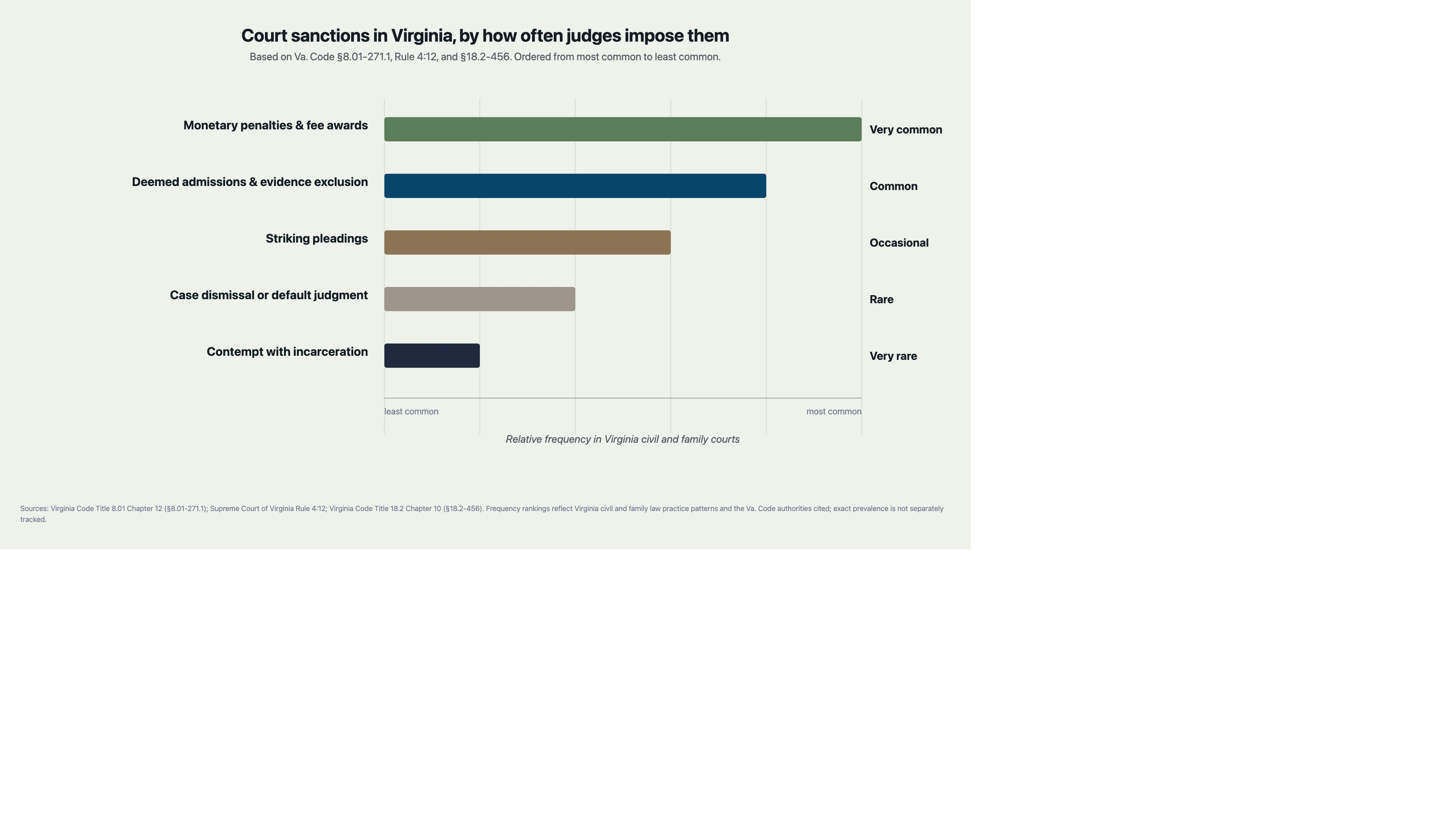
Virginia courts have broad discretion in choosing a sanction. The most common categories, drawn from Virginia Code §8.01-271.1 and Virginia Supreme Court Rule 4:12, are these five.
1. Monetary penalties and attorney’s fee awards
The most common sanction. The court orders the offending party (or their lawyer) to pay the other side’s reasonable expenses, including attorney’s fees, caused by the misconduct. Virginia Code §8.01-271.1 expressly authorizes “an order to pay to the other party or parties the amount of the reasonable expenses incurred.” This is what judges reach for first when a pleading is frivolous, a discovery request is ignored, or a deposition is missed.
2. Procedural sanctions (deemed admissions and evidence exclusion)
Under Rule 4:12, a Virginia judge can order that certain facts are “taken to be established” against the disobedient party, or can refuse to allow that party to support or oppose specific claims, defenses, or evidence. In practical terms, if you refuse to answer interrogatories about your assets in a divorce, the court can decide that your spouse’s version of those assets is simply accepted as true.
3. Striking pleadings
If the misconduct is serious enough, the court can strike all or part of a party’s pleadings, which removes their claims or defenses from the case entirely. Under §8.01-271.1, defective filings may be struck if not cured within 21 days after notice. The result is often the same as if the party never filed anything at all.
4. Case dismissal or default judgment
For the most serious or repeated violations, the court can dismiss the offending party’s case outright (if they are the plaintiff) or enter default judgment against them (if they are the defendant). After the April 1, 2018 amendments to Rule 4:12(d), Virginia judges can now impose these severe sanctions without first entering a “motion to compel” order, meaning a single, complete failure to participate in discovery can end the case.
5. Contempt of court
The most serious civil sanction. A finding of contempt under Rule 4:12 or Virginia Code §18.2-456 can carry fines, attorney’s fee awards, and in extreme cases, jail time. Civil contempt is most often used to enforce court orders in family law cases: unpaid child support, refusal to comply with a custody order, or willful violation of a protective order.
When can a Virginia court impose sanctions?
Virginia courts impose sanctions in three broad situations: discovery violations, frivolous filings, and disobedience of court orders.
Discovery violations. The most common trigger. If you fail to answer interrogatories, refuse to produce documents, skip a deposition, or stonewall an inspection request, Rule 4:12 gives the judge authority to sanction you. Under the 2018 amendments, the court no longer needs to enter a prior order compelling discovery before issuing severe sanctions. A complete failure to respond can lead directly to dismissal, default judgment, or fee awards.
Frivolous or unfounded pleadings. When an attorney signs a pleading, motion, or other paper in Virginia, that signature certifies under §8.01-271.1 that the document is “well grounded in fact and is warranted by existing law.” Filing a motion you know has no basis, or repeatedly making baseless arguments, exposes you (and potentially your attorney personally) to sanctions including reimbursing the other side’s fees.
Disobedience of court orders. If a judge enters an order to pay support, transfer property, follow a custody schedule, or attend mediation, and you willfully ignore it, the court can hold you in contempt. In family law cases, this is the lever judges use to enforce child support orders and visitation schedules without waiting for a new lawsuit.
What is a sanction in family court?
In Virginia family court, sanctions usually fall into one of two categories. The first is discovery-related: one spouse refuses to disclose financial records during the divorce or equitable distribution process, and the other side moves for sanctions under Rule 4:12. The second is enforcement-related: one parent ignores the custody or support order after the divorce is final, and the other parent files a show cause motion asking the court to hold them in contempt.
Family law sanctions are typically less severe in form (fines, attorney’s fees) but can be devastating in practice. A finding that a parent willfully violated a custody order can affect future custody determinations. A finding that a spouse hid assets during discovery can shift the equitable distribution analysis in the other spouse’s favor. This is why family law sanctions are something to take seriously even when no jail time is on the table.

What happens at a sanctions hearing in Virginia
A sanctions hearing in Virginia is a separate court proceeding where a judge decides whether to penalize a party or attorney for misconduct, and if so, which penalty to impose. The hearing is scheduled after one side files a written motion for sanctions, often styled as a “Motion for Sanctions” or a “Rule to Show Cause.” Both sides have the chance to brief the issue, attach exhibits, and argue before the judge rules.
A typical Virginia sanctions hearing follows this rough sequence:
- The moving party presents the alleged misconduct, usually with documentation: missed discovery deadlines, copies of unanswered interrogatories, transcripts of a missed deposition, or the pleading that violated Virginia Code §8.01-271.1.
- The responding party gets the chance to explain: why the conduct happened, whether it was substantially justified, and whether the other side suffered actual prejudice.
- The judge applies the relevant authority (Rule 4:12, §8.01-271.1, or §18.2-456) and decides whether a sanction is warranted, and which kind.
- The court issues a sanctions order, often from the bench, though some judges take the matter under advisement and rule by written opinion within days or weeks.
Most sanctions hearings in Virginia last 30 minutes to an hour. Discovery-based sanctions hearings tend to be the shortest because the record (interrogatories, deposition notices, prior motions to compel) is already in the court file. Contempt hearings can run longer, especially when the alleged contempt involves disputed facts or the judge is weighing incarceration.
In Stafford, Fredericksburg, and Spotsylvania circuit and J&DR courts, sanctions hearings are usually calendared on the same day as the underlying case, often as a 30-minute slot ahead of a scheduled motion or status conference. Pro se litigants frequently underestimate how quickly a sanctions hearing moves and arrive without the documentation they need to defend their conduct. Bringing the discovery history, the relevant emails, and any written explanation for missed deadlines makes a meaningful difference in how the judge rules.
If the court grants the motion, the sanctions order takes effect immediately. Monetary sanctions become an enforceable civil judgment. Procedural sanctions (deemed admissions, evidence exclusion) take effect at the next stage of the case. Severe sanctions (case dismissal, default judgment) can end the case at that hearing.
Does being sanctioned mean jail?
Usually no. Most court sanctions are civil, not criminal, and the most common penalties are monetary, paying fines or covering the other party’s attorney’s fees. You cannot be jailed for losing a discovery dispute or for filing a weak motion.
The exception is civil contempt for willful disobedience of a court order. Virginia Code §18.2-456 allows district and circuit courts to punish contempt with fines, imprisonment, or both, although jail time for civil contempt is rare and almost always reserved for cases where someone has the ability to comply with a court order but flatly refuses (for example, refusing to pay court-ordered child support when the resources are available). Even then, the jail term ends when the contemnor “purges” the contempt by complying.
What happens after the court enters a sanctions order against you?
The immediate consequence depends on which sanction was imposed. A monetary sanction becomes an enforceable judgment, collectible like any other civil judgment. A procedural sanction (deemed admissions, evidence exclusion) takes effect at the next stage of the case, often weakening your position at trial. A pleading struck, a case dismissed, or default judgment entered ends the case, often with the other side winning by default.
Attorney sanctions can also have downstream consequences. The Virginia State Bar can be notified of sanctions findings, and a pattern of sanctions can lead to disciplinary action separate from the underlying case.
| What the offending party did | Likely sanction | Authority |
|---|---|---|
| Missed a deposition or failed to answer interrogatories | Monetary sanction; reasonable expenses and attorney’s fees | Rule 4:12 |
| Filed a motion or pleading with no factual or legal basis | Monetary sanction against party or attorney personally; possible striking | Va. Code § 8.01-271.1 |
| Repeatedly refused to produce discovery despite court orders | Deemed admissions, evidence excluded, claims struck, possible dismissal | Rule 4:12(b)(2) |
| Willfully ignored a court order (support, custody, transfer of property) | Civil contempt; fines, attorney’s fees, possible incarceration until purged | Va. Code § 18.2-456 |
| Hid assets or misrepresented finances during divorce discovery | Monetary sanction, deemed admissions, adverse equitable distribution finding | Rule 4:12 + equitable distribution case law |
Can a sanctions order be appealed in Virginia?
Yes, but the standard of review is deferential. Sanctions orders are reviewed for “abuse of discretion,” which means the appellate court will only reverse if the trial judge acted unreasonably or applied the wrong legal standard. You generally need to file a notice of appeal within 30 days of the final order. If the sanction was entered before the case ended, the appeal often has to wait until the case is fully resolved (an “interlocutory” issue), unless the sanction is severe enough to qualify for immediate review.
Because the standard is so deferential, the best time to fight a sanctions motion is before the judge rules on it, not after. That means responding fully to the motion, providing context for the conduct at issue, and showing the court that the violation was either substantially justified or did not actually prejudice the other side.
How to avoid being sanctioned in a Virginia case
Most sanctions are avoidable. The patterns that get people in trouble are familiar: ignoring discovery requests in the hope they will go away, filing emotionally-driven motions without a legal basis, missing deadlines, and disobeying court orders because you disagree with them. Three habits prevent the vast majority of sanctions cases:
- Respond to discovery on time. If you cannot meet a deadline, ask for an extension before it expires. Courts are generally accommodating; what they punish is silence.
- Do not file motions you cannot support. Under §8.01-271.1, your signature on a pleading is a personal certification that the filing is grounded in fact and law. If you cannot point to either, do not file.
- Comply with court orders, even ones you plan to appeal. The proper response to an order you disagree with is to appeal it, not to ignore it. Ignoring is what gets you held in contempt.
If you are already facing a motion for sanctions, the worst thing you can do is ignore that too. The court will rule on the motion whether you respond or not, and a non-response almost guarantees a bad outcome.
Talk to a Stafford attorney about a sanctions issue
Sanctions motions are situations where having an experienced Virginia attorney involved early can change the outcome. If you have been served with a motion for sanctions, are considering filing one against the other side, or already have a sanctions order entered against you, the next step matters. As a Stafford-based family law and civil practice attorney, I help clients across Stafford, Fredericksburg, Spotsylvania, and Northern Virginia navigate sanctions issues, contempt motions, and the underlying disputes that led to them.
Contact The Law Office of Miles Franklin to schedule an initial consultation and talk through your situation.
Facing a sanctions issue in Virginia?
Sanctions motions move quickly, and the response you file in the first 21 days often shapes the outcome. Whether you have been served with a motion, are considering filing one, or already have a sanctions order entered against you, talk through the next step with a Stafford attorney.
Frequently asked questions about court sanctions in Virginia
What does it mean to be sanctioned in court?
Being sanctioned means a judge has formally imposed a penalty on you for violating court rules, ignoring discovery, filing a frivolous pleading, or disobeying a court order. In Virginia, sanctions are civil, not criminal, and most often take the form of monetary fines, attorney’s fee awards, deemed admissions, or in serious cases, striking pleadings or dismissing the case.
What are the most common court sanctions in Virginia?
The most common sanctions in Virginia courts are monetary penalties and attorney’s fee awards, deemed admissions or evidence exclusion under Rule 4:12, striking pleadings or claims, dismissal or default judgment, and findings of contempt. Monetary penalties are by far the most frequent because they are the least drastic remedy that still compensates the injured party.
Can a judge sanction you for not following a court order in Virginia?
Yes. Disobeying a court order in Virginia can expose you to a contempt finding under Virginia Code §18.2-456 or to procedural sanctions under Rule 4:12. Contempt can carry fines, attorney’s fees, and in rare cases, jail time. Family court orders for child support, custody, and visitation are the most commonly enforced through sanctions.
Does being sanctioned in court mean jail time?
No, not usually. Most court sanctions are monetary or procedural. Jail time is only on the table when a judge finds civil contempt for willful refusal to comply with a court order, and even then only when the person has the actual ability to comply. You cannot be jailed for losing a discovery dispute or for filing a weak motion.
How long does a court sanction last?
Monetary sanctions remain in effect until they are paid, the same as any civil judgment. Procedural sanctions (deemed admissions, evidence exclusion) apply for the remainder of the case. Civil contempt lasts until the contemnor “purges” the contempt by complying with the underlying order. Attorney discipline can be indefinite.
Can a sanctions order be appealed in Virginia?
Yes, but the standard of review is abuse of discretion, which is deferential to the trial judge. Notice of appeal must generally be filed within 30 days, and many sanctions orders cannot be appealed until the case is final. The best time to challenge a sanctions motion is before the court rules, not after.
What is a sanction in family court?
In Virginia family court, a sanction is most often imposed for refusing to disclose financial information during divorce discovery, or for willfully violating a custody or support order after the divorce is final. Family law sanctions are typically monetary or procedural, but a finding of willful misconduct can also influence future custody and equitable distribution decisions.
How do you avoid being sanctioned by a court?
Respond to discovery requests on time (or ask for an extension before they are due), do not file motions you cannot support with facts and law, and comply with court orders even when you plan to appeal them. Most sanctions cases come down to one of these three patterns being ignored.
Questions about your divorce?
Every situation is different. If you have questions about how Virginia law applies to yours, contact the Law Office of Miles Franklin to schedule a consultation.
Schedule a Consultation →