
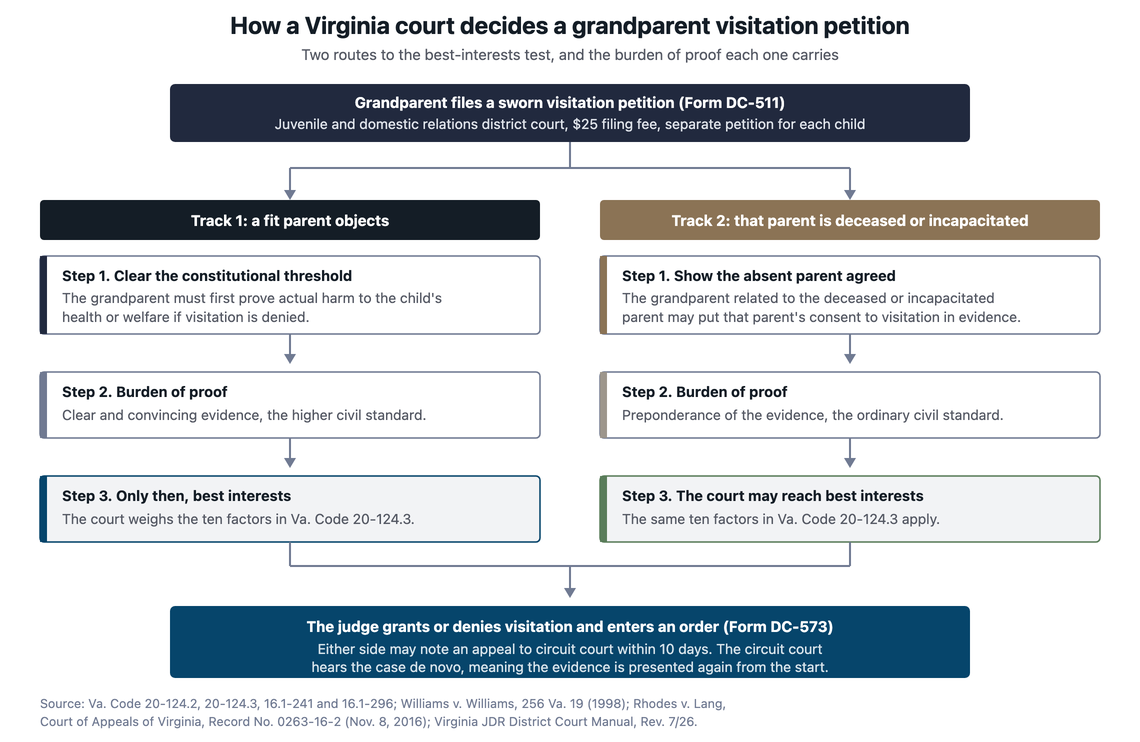
Grandparents can ask a Virginia court for visitation or custody of a grandchild, and Virginia law names them specifically. What surprises most families is how much they have to prove. When a fit parent says no, the grandparent does not simply argue that time together would be good for the child. The grandparent has to show the child will be actually harmed without it, and prove that by clear and convincing evidence, before a judge will even weigh what is in the child’s best interest.
I am Miles Franklin, and I handle custody and visitation cases for families across Stafford, Fredericksburg, Spotsylvania, and Fairfax. This guide explains what Virginia law gives grandparents, the two very different paths a petition can take, and what a 2026 change to the Code of Virginia means for a grandparent whose own child has died or become incapacitated.

TL;DR
- Virginia law lists grandparents as a “person with a legitimate interest,” so they may petition for custody or visitation in their own right.
- Against a fit parent’s objection, a grandparent must first prove actual harm to the child’s health or welfare without visitation. Best interest alone is not enough.
- Non-parents seeking custody or visitation must meet the clear and convincing evidence standard, which is higher than the ordinary civil burden.
- A 2026 addition to Va. Code § 20-124.2 lets a grandparent whose own child is deceased or incapacitated introduce that parent’s consent to visitation, proven by a preponderance of the evidence, which opens the door to the best-interests test.
- Petitions are filed in the juvenile and domestic relations district court on Form DC-511, with a $25 filing fee, and either side may appeal to circuit court within 10 days for a new hearing.
Do grandparents have visitation rights in Virginia?
Grandparents have the right to ask. They do not have an automatic right to time with a grandchild. That distinction is the whole ballgame in these cases, and it is worth being clear about it before a family spends money on a court fight.
Virginia law does recognize grandparents by name. Under Virginia Code § 20-124.1, a “person with a legitimate interest” is defined to include grandparents, step-grandparents, stepparents, former stepparents, blood relatives, and family members, provided the person has intervened in the suit or is otherwise properly before the court. The same statute is explicit that the term is to be broadly construed to accommodate the best interest of the child. It also excludes certain people, including anyone whose parental rights have been terminated and anyone convicted of specified violent offenses connected to the child’s conception.
Because grandparents fall inside that definition, they can file their own petition rather than waiting for a parent to include them in a case. Virginia Code § 16.1-241 makes that plain: the juvenile court’s authority over custody, visitation, support, control, or disposition of a child “shall not be limited to the consideration of petitions filed by a mother, father, or legal guardian but shall include petitions filed at any time by any party with a legitimate interest therein.”
So the courthouse door is open. What waits on the other side is a burden of proof built to protect parents, and that is where most grandparent cases are actually won or lost.
The standard when a fit parent objects
Start with the constitutional backdrop. In Troxel v. Granville, 530 U.S. 57 (2000), the Supreme Court of the United States held that the Due Process Clause of the Fourteenth Amendment protects the fundamental right of parents to make decisions concerning the care, custody, and control of their children, and described that interest as perhaps the oldest of the fundamental liberty interests the Court recognizes. A grandparent visitation statute cannot be applied in a way that overrides a fit parent’s judgment simply because a judge would decide differently.
Virginia’s courts built a specific test around that principle. As the Court of Appeals of Virginia restated it in Rhodes v. Lang, Record No. 0263-16-2 (Nov. 8, 2016), “in a dispute between a fit parent and a non-parent . . . the best-interests test should be applied only if the trial court first finds ‘an actual harm to the child’s health or welfare without such visitation.'” That language comes from Griffin v. Griffin, 41 Va. App. 77, 83 (2003), quoting the Supreme Court of Virginia’s decision in Williams v. Williams, 256 Va. 19, 22 (1998).
Read that sequence carefully, because the order matters. Actual harm is a gate, not a factor. A judge does not balance harm against the ten best-interests factors and see which way the scale tips. If the grandparent cannot establish actual harm to the child’s health or welfare without visitation, the court never reaches best interests at all, and the petition fails.
On top of that, Virginia Code § 20-124.2(B) sets the evidentiary bar for any non-parent. The court “shall give due regard to the primacy of the parent-child relationship but may upon a showing by clear and convincing evidence that the best interest of the child would be served thereby award custody or visitation to any other person with a legitimate interest.” Clear and convincing evidence is a demanding standard. It sits above the preponderance standard that governs most civil disputes, and it is the same kind of proof Virginia requires before a court will unsettle a parent’s decisions about their own child.
There is one important exception to the actual-harm gate, and it catches families off guard in the other direction. The gate applies to an initial determination of visitation. Once a valid order already exists, a parent who wants to cut back or end a grandparent’s court-ordered visitation cannot demand that the grandparent re-prove actual harm. That was the holding in Albert v. Ramirez, 45 Va. App. 799 (2005), and the Court of Appeals applied it again in Rhodes. Modification runs on the two-part test from Keel v. Keel, 225 Va. 606, 611 (1983): first, has there been a change in circumstances since the most recent award, and second, would a change be in the child’s best interests.
The practical lesson for grandparents is that a court order is worth far more than an informal arrangement. An agreement at the kitchen table can end the day a relationship sours. An entered order shifts the burden onto the parent who wants to change it. If you are weighing whether to file, that difference belongs in the calculation.
The 2026 change for a deceased or incapacitated parent
The hardest version of this case has always been the one where a grandparent’s own son or daughter has died, and the surviving parent then cuts contact. Under the actual-harm rule, grieving grandparents often had no realistic path to a hearing on the merits, even where the child had known them their whole life.
The General Assembly addressed that situation in 2026 by adding subsection B2 to Virginia Code § 20-124.2. The new provision says that where a grandparent has petitioned for visitation with a minor grandchild and a natural or adoptive parent of that grandchild is deceased or incapacitated, the grandparent who is related to the deceased or incapacitated parent may introduce evidence of that parent’s consent to visitation with the grandparent, in accordance with the rules of evidence. If the parent’s consent is proven by a preponderance of the evidence, the court may then determine whether grandparent visitation is in the best interest of the minor grandchild.
Two details make this meaningful. The burden is a preponderance of the evidence, not clear and convincing evidence, so it is the ordinary civil standard. And the statute borrows the definition of “incapacitated parent” from Virginia Code § 64.2-2000, which means an adult a court has found incapable of receiving and evaluating information effectively or responding to people, events, or environments to the point of lacking capacity to meet essential health and safety needs without a guardian, or to manage property and financial affairs without a conservator. That is a judicial finding, not a family opinion about someone’s condition.
What counts as evidence of consent will vary. Text messages, emails, a letter, a will or estate document, testimony from people who heard the parent say so, and a documented history of regular visits that the parent arranged can all speak to it. The point is that the deceased or incapacitated parent’s own wishes finally carry weight in the courtroom instead of dying with them.
What “best interests” means in a grandparent case
Whichever route gets a grandparent through the gate, the destination is the same. Virginia Code § 20-124.3 lists the ten factors a court must consider in determining the best interests of a child for custody or visitation. The statute also requires the judge to communicate the basis of the decision to the parties, and except in consent cases, that communication must set forth the judge’s findings on the relevant factors.
Several of those factors are written around parents. That does not make them irrelevant to a grandparent’s petition, but it does change how a grandparent should think about the evidence, as the table below shows.
| Factor under § 20-124.3 | Why it matters when a grandparent petitions |
|---|---|
| 1. The child’s age and physical and mental condition, including changing developmental needs | A toddler and a teenager have very different needs for continuity and for a predictable schedule. |
| 2. The age and physical and mental condition of each parent | Relevant where a parent’s health or capacity is part of why the grandparent stepped in. |
| 3. The relationship between each parent and each child | A strong parent-child bond raises the weight the court gives the parent’s decision. |
| 4. The needs of the child, giving due consideration to other important relationships, including siblings, peers, and extended family members | This is the factor written most directly for grandparents. Extended family appears in the text of the statute. |
| 5. The role each parent has played and will play in the child’s upbringing and care | Shows the court where day-to-day caregiving has actually come from, which is sometimes the grandparent. |
| 6. Each parent’s propensity to support the child’s contact with the other parent | A pattern of cutting off relationships can inform how the court reads the current refusal. |
| 7. Willingness and demonstrated ability to maintain a close relationship and resolve disputes | Grandparents who have kept conflict away from the child are in a much stronger position here. |
| 8. The child’s reasonable preference, if the court finds the child capable of expressing one | Depends on age, intelligence, understanding, and experience, and it is the judge’s call whether to hear it. |
| 9. Any history of family abuse, sexual abuse, child abuse, or acts of violence within the statutory lookback | Cuts both directions, and it is often the evidence that supports an actual-harm finding. |
| 10. Any other factors the court deems necessary and proper | Where the specific history of this family, and the grandparent’s actual role in it, gets told. |
Notice factor four. When the General Assembly wrote that the court must give due consideration to other important relationships of the child, including but not limited to siblings, peers, and extended family members, it put grandparents inside the best-interests analysis by name. That factor is often the anchor of a well-prepared petition.
Can a grandparent get custody, not just visitation?
Yes, and the statute treats both requests the same way. Section 20-124.2(B) allows a court to award “custody or visitation to any other person with a legitimate interest” on clear and convincing evidence that the child’s best interest would be served. A grandparent raising a grandchild full time while a parent is absent, incarcerated, hospitalized, or struggling with addiction is not an unusual client in Northern Virginia.
Custody cases and visitation cases are filed separately, though. The Virginia juvenile court manual is specific that separate petitions should be used for custody, visitation, and support regarding the same child, and that pleadings should not intermingle them. A grandparent who wants legal authority to enroll a child in school and consent to medical care is asking for custody, which is a different filing than asking for scheduled time.
It also helps to know the difference between the two kinds of custody Virginia recognizes. Section 20-124.1 defines sole custody as one person retaining responsibility for the care and control of a child with primary authority to make decisions. Joint custody covers joint legal custody, joint physical custody, or any workable combination the court finds to be in the child’s best interest. Many grandparent arrangements end up as joint legal custody with the grandparent providing the child’s primary residence, which keeps a parent involved in decisions while giving the household the authority it needs to function.
How to file a grandparent visitation petition in Virginia
The mechanics are more approachable than most families expect. Custody and visitation cases start in the juvenile and domestic relations district court, and circuit courts and juvenile courts have concurrent jurisdiction in these matters. Here is the sequence.
- File Form DC-511. The petition is sworn, and a non-attorney files it with the court’s intake officer. When an attorney files, it goes to the clerk’s office. Use a separate petition for visitation and for custody, and a separate petition for each child.
- Include the required information. The petition must state the child’s name, age, date of birth, and address, the mother’s name and address, the father’s name and address, the current custodian’s name and address, and the specific facts that bring the child within the court’s jurisdiction.
- Pay the $25 filing fee. One $25 fee covers all custody and visitation petitions a single petitioner starts at the same time. The fee goes to the clerk, not the intake officer, and no hearing is set until it is paid or the court grants in forma pauperis status. If it is not resolved within 90 days, the petition has to be refiled.
- File the DC-620 custody affidavit. This is the Uniform Child Custody Jurisdiction and Enforcement Act affidavit, and every party filing pleadings completes one.
- Expect a guardian ad litem in contested cases. The court may appoint one to represent the child under Va. Code § 16.1-266, and it can order the parties, including a petitioning person with a legitimate interest, to reimburse the cost.
- Be ready for evaluations and mediation. The judge may order a social history report or an independent mental health evaluation, and where appropriate the case is referred to mediation. Parties to a contested custody or visitation case also attend an educational seminar on the effects of separation and divorce on children.
- Know the appeal window. The judge enters the ruling on Form DC-573. Under Virginia Code § 16.1-296, an appeal to circuit court must be noted within 10 days, and the circuit court hears the case de novo, meaning the evidence is presented again from the beginning.

That de novo appeal is more useful than it sounds. A juvenile court docket moves fast, and a grandparent who was unrepresented at the first hearing gets a genuine second opportunity to put on a full case in circuit court, provided the ten-day deadline is met. Missing that deadline is one of the few mistakes in this area of law that cannot be undone.
What actually strengthens a grandparent’s case
Because the legal test turns on harm to the child rather than on fairness to the adults, the evidence that persuades a judge is rarely the evidence a family wants to talk about. Anger at a son-in-law or daughter-in-law does not move a court. Documentation of the child’s life does.
The grandparents who do best in these cases usually arrive with a concrete record. That means dates and details of the care actually provided, such as school pickups, doctor visits, overnights, and holidays. It means messages showing the relationship and showing when and how it was cut off. It means school counselors, pediatricians, coaches, and church leaders who have seen the child before and after contact ended and can describe the difference in specific terms. Where the case runs through the 2026 provision, it means anything that captures the deceased or incapacitated parent’s own wishes about the child seeing their grandparents.
Two things also matter that have nothing to do with paperwork. The first is restraint. Grandparents who keep the conflict away from the child, avoid speaking badly about the parent, and follow the existing arrangement even while they disagree with it are far more credible when they finally do testify. The second is timing. Petitions filed while a relationship is still recent and documented are stronger than petitions filed years after contact stopped, and the longer a child goes without contact, the harder it becomes to show what is lost. If you are considering this, related reading on temporary versus final custody orders, on mediation in custody proceedings, and on the guardian ad litem’s role will help you understand what the process ahead looks like.
Frequently Asked Questions
Do grandparents have visitation rights in Virginia?
Grandparents have the right to petition for visitation, not an automatic right to visitation. Virginia Code § 20-124.1 lists grandparents as a person with a legitimate interest, which lets them file in their own name. Whether they receive time with the grandchild depends on meeting the standard the courts apply when a fit parent objects.
What do grandparents have to prove to get visitation in Virginia?
Against a fit parent’s objection, a grandparent must first prove actual harm to the child’s health or welfare without visitation. Only after that finding does the court apply the best-interests test in Virginia Code § 20-124.3. Virginia Code § 20-124.2(B) also requires clear and convincing evidence before a court awards custody or visitation to a non-parent.
Can grandparents get visitation if their own child has died?
A 2026 addition to Virginia Code § 20-124.2 helps in exactly that situation. A grandparent related to a deceased or incapacitated parent may introduce evidence of that parent’s consent to visitation. If consent is proven by a preponderance of the evidence, the court may then decide whether visitation is in the grandchild’s best interest.
Where do grandparents file for visitation in Virginia?
In the juvenile and domestic relations district court, using Form DC-511. A person filing without an attorney goes through the court’s intake officer, while an attorney files with the clerk. Separate petitions are used for custody and for visitation and for each child, and the filing fee to start a case is $25.
Can a grandparent get custody of a grandchild in Virginia?
Yes. Virginia Code § 20-124.2(B) allows a court to award custody or visitation to any person with a legitimate interest on clear and convincing evidence that the child’s best interest would be served. Custody is filed as a separate petition from visitation, and grandparent arrangements often take the form of joint legal custody with the child living primarily with the grandparent.
Can a parent end a grandparent’s court-ordered visitation?
Not simply by objecting. Once a valid visitation order exists, the parent asking to change it carries the burden of showing a material change in circumstances since the last order and that a change would be in the child’s best interests. Virginia’s appellate courts have held that the actual-harm standard applies to an initial determination, not to modification of an existing order.
How long does a grandparent visitation case take in Virginia?
It depends on the court’s docket, whether a guardian ad litem is appointed, and whether evaluations or mediation are ordered. Contested cases usually involve more than one hearing. If either side appeals, the circuit court hears the matter over again from the start, which adds time but also gives an unrepresented grandparent a real second chance.
Talk with a Stafford family law attorney
Losing contact with a grandchild is one of the quieter kinds of grief, and the law’s answer to it is narrower than most families expect. That does not mean nothing can be done. It means the case has to be built carefully, around the child’s needs and a documented record, rather than around how unfair the situation feels.
If you are a grandparent in Stafford, Fredericksburg, Spotsylvania, or elsewhere in Northern Virginia trying to understand your options, I can walk you through what a petition would require in your situation and give you an honest read on it. You can learn more on the grandparents’ rights page, the custody and visitation page, or the family law practice page, and families in the Fredericksburg area can start with the Fredericksburg family law page.
Contact the Law Office of Miles Franklin at (276) 773-6102 or schedule a consultation online. Every family’s situation is different, and yours will be treated with the care and dignity it deserves.
Questions about custody or visitation?
Every situation is different. If you have questions about how Virginia law applies to yours, contact the Law Office of Miles Franklin to schedule a consultation.
Schedule a Consultation →