
Someone breaks into your home late at night. You hear glass shatter, then footsteps. You grab a weapon, confront the intruder, and in the struggle the intruder is seriously hurt or killed. By morning, you are the one being questioned by police. Whether Virginia law protects what you did comes down to a handful of rules that most people have never read, because they are not written in any statute.
Virginia recognizes self-defense and the castle doctrine through court decisions, what lawyers call common law, rather than through the Code of Virginia. That surprises people. It also means the rules have edges that are sharper than the “a man’s home is his castle” saying suggests. I am Miles Franklin, a criminal defense attorney in Stafford, and I have written this guide to walk you through how self-defense actually works in the Commonwealth: when force is justified, what changes inside your own home, and what you are facing if a claim of self-defense does not hold up.

TL;DR
- Virginia’s self-defense and castle doctrine rules come from court decisions, not statutes. There is no “castle doctrine law” to look up in the Code of Virginia.
- Self-defense requires a reasonable fear of imminent harm and force proportional to the threat, judged by the circumstances as they appeared to you.
- If you were not at fault in starting the conflict, Virginia lets you stand your ground. If you were partly at fault, you must retreat as far as safely possible before using force.
- Inside your home, the castle doctrine removes any duty to retreat and gives you the strongest legal footing, but it does not cover guests you let in.
- Deadly force is never justified to protect property alone. If a self-defense claim fails, the charges range from voluntary manslaughter up to first-degree murder.
Virginia’s self-defense rules are not in a statute
Most states that adopted “castle doctrine” or “stand your ground” laws did it by statute. Virginia never has. The rules that govern self-defense in the Commonwealth come from more than a century of court decisions. The Supreme Court of Virginia traced the castle doctrine back to English common law in Fortune v. Commonwealth in 1922, and it reaffirmed those principles as recently as Hines v. Commonwealth in 2016.
This matters for a practical reason. Statutes tend to give bright-line answers. Common law rules turn on the facts of your specific situation: who started the encounter, what you reasonably believed, how much force you used, and where it happened. Two cases that sound similar can end very differently. That is why the details below matter so much.
Justifiable and excusable self-defense: fault decides which one you get
Virginia courts recognize two distinct forms of self-defense, and the difference between them comes down to one question: were you at fault in provoking or bringing on the fight?
Justifiable self-defense applies when you were entirely without fault. You did not start the confrontation, you did not escalate it, and you used force only because you reasonably feared death or serious bodily harm. As the Supreme Court of Virginia put it in Bailey v. Commonwealth, justifiable homicide occurs where a person “without any fault on his part in provoking or bringing on the difficulty” kills another under reasonable apprehension of death or great bodily harm. When you are without fault, you have no duty to retreat. You may stand your ground and meet the attack.
Excusable self-defense applies when you were partly at fault. Maybe you threw the first insult, escalated an argument, or agreed to the fight. Virginia law still allows a self-defense claim, but only if you first retreated as far as you safely could, made your desire for peace known, and then used force out of a reasonably apparent necessity to save your own life or avoid serious harm.
The line between these two doctrines decides whether you had to retreat at all. Prosecutors know that, and fault is often the most contested issue in a self-defense trial.
The threat has to be imminent
Every Virginia self-defense claim starts with an imminent threat. You must have reasonably believed you were in immediate danger of bodily harm, right then, not at some point in the future. A vague sense that someone is dangerous is not enough. A threat to hurt you next week is not enough. The danger has to be happening or about to happen.
The standard is both subjective and objective. The jury looks at the circumstances as they reasonably appeared to you at the moment, not with the benefit of hindsight. But your belief also has to be one a reasonable person could have held. If the other person was unarmed, walking away, or already subdued, a claim that you feared for your life becomes very hard to sustain.
Timing cuts both ways. Force used too early, before any real threat existed, is not self-defense. Force used too late, after the threat has passed, is retaliation. Virginia courts treat retaliation as a new act of violence, not defense.
Your force has to match the threat
Proportionality is the second pillar. You may use no more force than reasonably appears necessary to protect yourself from the harm you perceive. A shove does not justify a shooting. An unarmed argument does not justify a knife. Deadly force is reserved for situations where you reasonably feared death or serious bodily injury, and the jury will measure your response against the threat you actually faced.
Virginia law does give you meaningful room here. Courts recognize that a person who reasonably believes an attack is coming has the right to arm himself, and no inference of malice can be drawn from that alone. The size, strength, and number of attackers matter too. An unarmed assault by someone much larger, or by several people at once, can support a reasonable fear of serious harm.
Proportionality also applies before anyone is hurt. Pointing or waving a gun to scare someone off is brandishing, a Class 1 misdemeanor under Virginia Code § 18.2-282 that carries up to 12 months in jail and a $2,500 fine. The statute has an explicit exception for justifiable or excusable self-defense, but that exception has the same requirements described above. People are regularly charged for displaying a weapon in a confrontation they helped create. If the underlying dispute involved an assault charge, the analysis overlaps with how Virginia treats domestic and general assault cases.
The castle doctrine: different rules inside your home
Inside your own home, Virginia gives you the strongest legal position you will ever have. The castle doctrine traces to the idea that the dwelling house is a hold of defense, “the castle,” and Virginia courts have applied it for over a century.

The doctrine does two separate things. First, if an intruder forces his way in, you and anyone else in the home have no duty to retreat and may use all needful force, including deadly force, to keep the aggressor out or expel him, when it is necessary to prevent a felony inside the home or a felonious attack on the people in it. Second, if you are attacked in your home or its curtilage, the area immediately surrounding it, such as your porch or yard, and you are free from fault, you have no duty to retreat and may use reasonable force, including deadly force, to stop the attacker.
The limits matter as much as the protection. The castle doctrine covers intruders, not guests. Virginia courts have held that it does not apply when the other person was peaceably present in the home with your permission, express or implied. If a dinner guest becomes violent, your right to defend yourself follows the ordinary justifiable and excusable rules, not the castle doctrine. And even inside your home, proportionality still applies: the force has to be needful, meaning reasonably necessary under the circumstances.
Is Virginia a stand your ground state?
Mostly yes, with an important condition. Virginia has no stand-your-ground statute, but the same rule comes from its courts. Since McCoy v. Commonwealth in 1919, Virginia decisions have held that a defender who is without fault “need not retreat, but is permitted to stand his ground and repel the attack by force, including deadly force, if it is necessary.”
The condition is fault. The moment you share responsibility for starting or escalating the encounter, the no-retreat rule disappears and the excusable self-defense rules take over: retreat as far as you safely can, announce your desire for peace, and use force only as a last necessity. This is the trap in most bar fights, road rage incidents, and neighbor disputes. Both sides contributed something, and that something costs the defender the right to stand his ground.
Defending other people, and the property myth
Virginia recognizes defense of others on essentially the same terms as self-defense. You may use reasonable force to protect a family member or a stranger when the person you are defending would themselves have been justified in using that force, the threat is imminent, and your response is proportional.
Property is a different story. Deadly force is never justified in Virginia to protect property alone. You may use reasonable, non-deadly force to stop someone from taking or damaging what is yours, but the law values life over property, even the property rights of an entirely innocent owner. The castle doctrine does not change this: what elevates a home intrusion is the threat to the people inside, and Virginia courts allow deadly force against an intruder only when it is necessary to prevent a felony in the home, not to protect belongings as such. Shooting at a fleeing car thief is a prosecution, not a defense.
What you are facing if a self-defense claim fails
Self-defense in a homicide case is all or nothing in one sense: if the jury accepts it, the verdict is not guilty. If the jury rejects it, the fallback positions are severe. The chart below shows the statutory confinement ranges for Virginia’s homicide offenses.
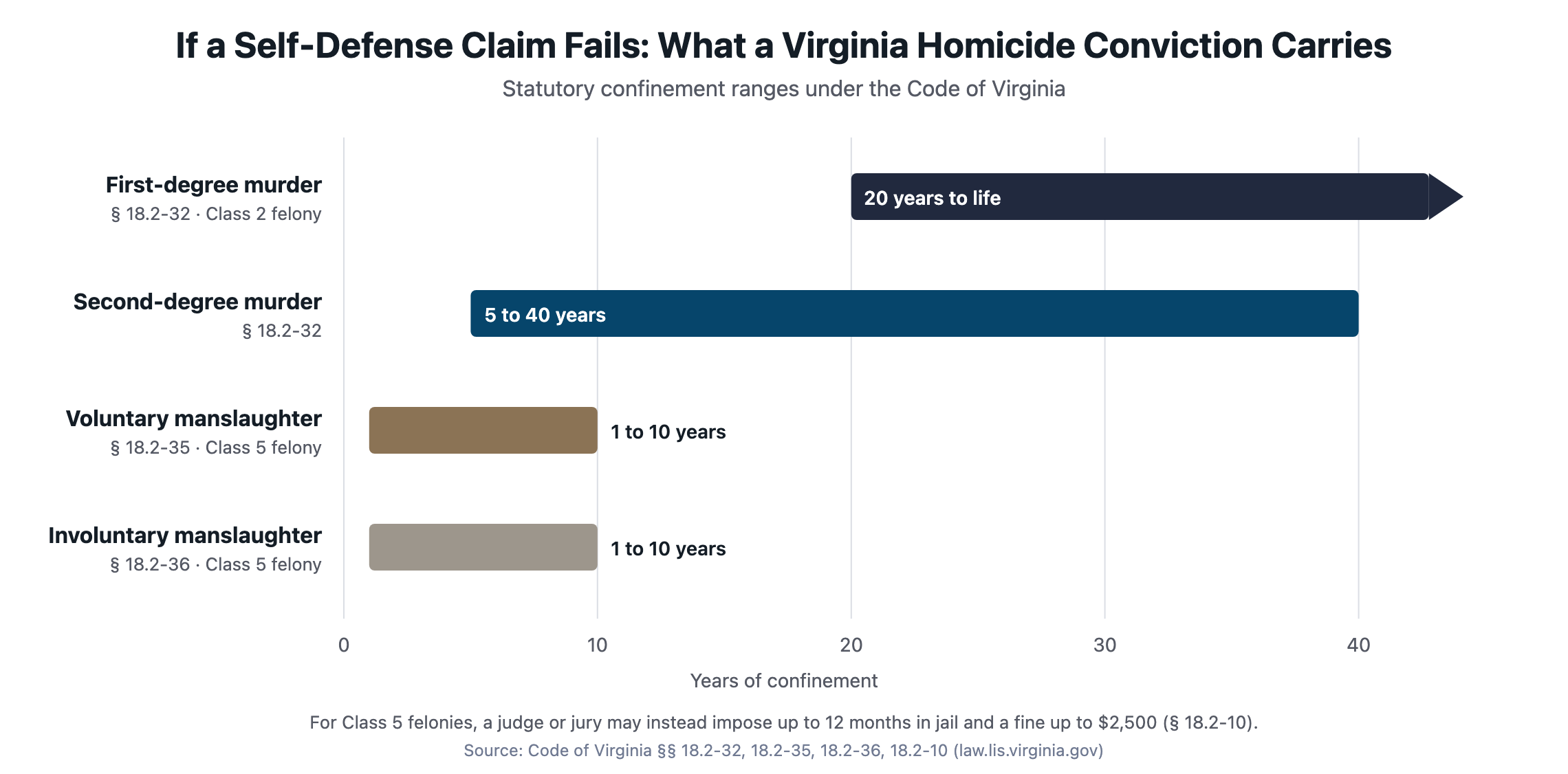
Under Virginia Code § 18.2-32, first-degree murder is a Class 2 felony punishable by 20 years to life, and second-degree murder carries 5 to 40 years. Voluntary manslaughter, a killing in the heat of passion upon reasonable provocation, is a Class 5 felony carrying 1 to 10 years. A failed self-defense case often lands here, because the same facts that almost justified the killing can reduce murder to manslaughter. If a firearm was used in the felony, Virginia Code § 18.2-53.1 adds a mandatory minimum of 3 years, consecutive to the underlying sentence. I cover how prosecutors choose among these charges in my guide to the difference between murder and manslaughter in Virginia.
How self-defense works in a Virginia courtroom
Self-defense is an affirmative defense. The Commonwealth always keeps the burden of proving guilt beyond a reasonable doubt, but the defense has to put enough evidence of self-defense before the jury to raise a reasonable doubt about whether the killing was justified or excused. In practice, that means building the case fact by fact: who was the aggressor, what the defendant knew about the attacker, the physical evidence of how the confrontation unfolded, and whether the fear was reasonable.
Juries receive instructions that track the doctrines described in this article, and the difference between receiving a justifiable instruction, an excusable instruction, or a castle doctrine instruction can decide the case. Malice, the element that separates murder from manslaughter, can be inferred from the deliberate use of a deadly weapon unless the evidence raises a reasonable doubt about it. A self-defense case is fought on exactly that ground, which is why the details a client remembers in the first days after the incident matter so much.
If you are being investigated after defending yourself, do not assume the facts speak for themselves. Talk to a lawyer before you give a statement. What you say in the first interview will follow the case to the end. You can read more about how I approach these cases on my criminal defense practice page.
Frequently asked questions
Does Virginia have a castle doctrine law?
Yes, but not as a statute. Virginia’s castle doctrine is common law, built from court decisions such as Fortune v. Commonwealth (1922) and reaffirmed in Hines v. Commonwealth (2016). It provides that a person attacked in his own home or its curtilage, if free from fault, has no duty to retreat and may use reasonable force, including deadly force, to stop the attacker.
Is Virginia a stand your ground state?
Virginia has no stand-your-ground statute, but its courts recognize the same principle for a person who is without fault. If you did not provoke or escalate the conflict, you have no duty to retreat and may stand your ground and use proportional force, including deadly force if you reasonably fear death or serious bodily harm. If you were partly at fault, you must retreat as far as safely possible before using force.
Do I have to retreat before defending myself in Virginia?
It depends on fault. A person entirely without fault has no duty to retreat, in his home or anywhere else, and may stand his ground and repel the attack. A person who helped provoke or escalate the encounter must retreat as far as safely possible and announce a desire for peace before force becomes excusable.
Can I use deadly force to protect my property in Virginia?
No. Deadly force is never justified in Virginia to protect property alone. You may use reasonable non-deadly force to protect your belongings. Deadly force against a home intruder is judged by the threat to the people inside the home, not the property.
Can I be charged for pointing a gun without firing it?
Yes. Pointing, holding, or brandishing a firearm to induce fear is a Class 1 misdemeanor under Virginia Code Section 18.2-282, punishable by up to 12 months in jail and a $2,500 fine. The statute does not apply to justifiable or excusable self-defense, but that exception requires the same imminent threat and proportionality as any other self-defense claim.
Who has to prove self-defense in a Virginia criminal case?
The Commonwealth always bears the burden of proving guilt beyond a reasonable doubt. The defendant raising self-defense must introduce enough evidence of it to create a reasonable doubt about whether the act was justified or excused. That evidence can come from any source in the case, including the prosecution’s own witnesses.
Talk with a Virginia criminal defense attorney
Self-defense cases are won and lost on details: who was at fault, what you reasonably believed, and whether your response matched the threat. If you have been charged, or you are being questioned about an incident where you defended yourself or your family, get counsel involved early. I defend clients in Stafford, Fredericksburg, Spotsylvania, Fairfax, and across Northern Virginia, and I will make sure your side of the story is built on the evidence and the law, not on assumptions.
If you have questions about a self-defense or criminal case in Virginia, contact the Law Office of Miles Franklin at (276) 773-6102 or schedule a consultation online. Every situation is different, and I will treat yours with the care and dignity it deserves.
Facing criminal charges?
Every situation is different. If you have questions about how Virginia law applies to yours, contact the Law Office of Miles Franklin to schedule a consultation.
Schedule a Consultation →