
Most Virginia parents put off estate planning because it feels like a document about money, and the money can wait. It is not a document about money. For a parent with a child under 18, the central question is who steps in, how fast, and under whose supervision. Virginia answers that question for you if you do not answer it yourself, and the answer the Code supplies is slower, more expensive, and less specific than the one you would have chosen. This article walks through what a will actually controls for a parent, the six-month clock that quietly voids a guardian appointment, the standby guardian designation that covers the situations a will cannot reach, and the age your child receives whatever you leave behind.

What Virginia decides for you if you die without a will
Intestacy is not the absence of a plan. It is a plan the General Assembly wrote, applied to every Virginian who did not write one, and it makes no allowance for the specifics of your family.
Start with the children. Under Va. Code § 64.2-1700, the parents of an unmarried minor are joint natural guardians of the person of that child, and on the death of either parent the survivor becomes the natural guardian. So if one parent dies, nothing dramatic happens to custody. The risk sits in the case most parents do not want to picture: both parents gone, or a single parent who was the only legal parent. Then there is no natural guardian, and § 64.2-1702 puts the appointment in the hands of the circuit court or the circuit court clerk of the county or city where the minor resides.
That court knows nothing about your family beyond what the people in front of it say. If two relatives both believe they should raise your children, the court sorts it out on the record it is given, on its own timeline, while your children wait. A named guardian in a will does not eliminate the court’s role, but it tells the court exactly what you wanted and shifts the burden onto anyone who disagrees.
Then the property. Section 64.2-200 sends an intestate estate to the surviving spouse, unless the decedent is survived by children one or more of whom are not children of that surviving spouse. In that blended-family case the split is two-thirds to the children and one-third to the surviving spouse. That result surprises people constantly, in both directions: a second spouse expecting the house, and children from a first marriage expecting nothing.
| The question | The default answer | Authority |
|---|---|---|
| Who raises the children | The surviving parent, as natural guardian. If there is no surviving parent, the circuit court or clerk where the child lives appoints someone. | § 64.2-1700; § 64.2-1702 |
| Who receives your property | The surviving spouse, unless a child of yours is not also that spouse’s child. Then two-thirds goes to the children and one-third to the spouse. | § 64.2-200 |
| When the child receives it | Outright, at 18, with no conditions and no oversight after that date. | § 64.2-1919 |
| Who manages it until then | A guardian of the estate appointed by the court, who takes an oath and generally must post a bond with surety. | § 64.2-1704; § 64.2-1800 |
| Who speaks for you medically | No one you selected. Nothing in intestacy addresses medical decisions, which is a separate document entirely. | § 54.1-2983 |
Naming a guardian in your will, and the six-month clock
Virginia gives parents a direct grant of authority here. Under § 64.2-1701(A), every parent may by will appoint a guardian of the person of a minor child and a guardian for the estate that the parent leaves to that child. Two appointments, one document, and they do not have to be the same person.
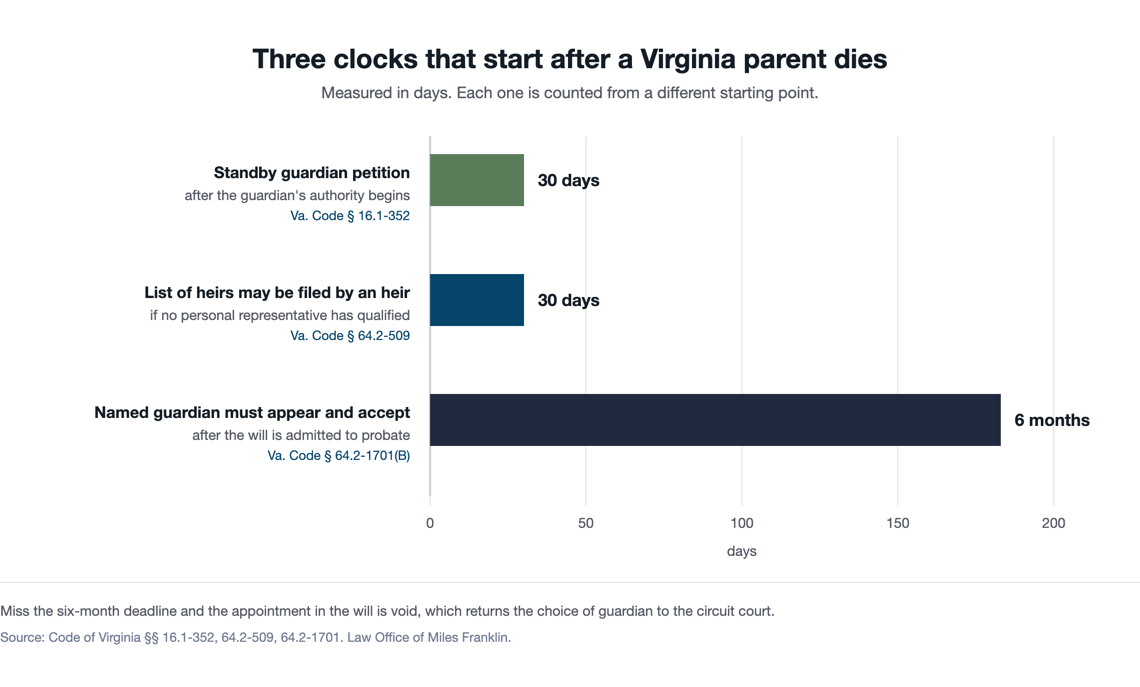
Subsection B is the part that gets missed. The appointment is void if the guardian renounces it, or if the guardian fails to appear in the court where the will was admitted to probate within six months after probate to accept the guardianship and give any bond required by § 64.2-1704. Six months sounds generous until you consider the circumstances. The person you named is grieving, possibly living in another state, possibly caring for your children already, and has no reason to know that a courthouse appearance is a condition of the authority you handed them.
The fix costs nothing. Tell the person you are naming, in advance, that they are named, and tell them what has to happen after a probate: appear in the circuit court where the will was probated, accept, and post bond if bond is required. Write it down and give them a copy along with a copy of the will. I also name an alternate in every parent’s will, because the first choice can decline, move, or predecease you.
The will itself has to be valid before any of this matters. Section 64.2-403 requires a writing signed by the testator, and where the will is not wholly in the testator’s handwriting, the signature must be made or acknowledged in the presence of at least two competent witnesses present at the same time who subscribe in the testator’s presence. A handwritten will is valid without witnesses at signing, but at probate it has to be proved by at least two disinterested witnesses who can identify the handwriting, which is a problem your family inherits. Virginia does have a repair provision in § 64.2-404 for documents not executed correctly, but it requires clear and convincing evidence of intent, which means litigation. Signing correctly the first time, with the self-proving affidavit allowed by § 64.2-452, is far cheaper than proving intent later.
Guardian of the person and guardian of the estate are two different jobs
Parents tend to hear the word guardian and picture one person doing everything. Virginia splits the role, and understanding the split is what lets you match each job to the right person.
The guardian of the person raises the child. That is daily care, school, medical decisions, where the child lives. The guardian of the estate handles the money. Under § 64.2-1800, the guardian of a minor’s estate has possession, care, and management of the estate and provides for the minor’s health, education, maintenance, and support out of income, reaching the principal if income is not enough.
The oversight is different too. Section 64.2-1704 requires a guardian to take an oath to faithfully perform the duties of the office, and a guardian for the estate of a minor must provide surety on the bond unless surety is waived by statute or by the will. Bond with surety is an annual cost paid out of the child’s money, and it is a common reason parents choose to leave assets in trust instead, since a trustee named in a properly drafted trust is not operating under the same court bond requirement.
Your sister may be the right person to raise your children and the wrong person to manage a life insurance payout, or the reverse. Naming different people for the two roles is not a statement about anyone’s character. It is a reasonable division of labor, and it also builds in a check, since the person spending the money is not the same person accounting for it.

The standby guardian, the piece most Virginia parents miss
A will has one fatal limitation for a parent: it does nothing until you die. A stroke, a serious accident, a long hospitalization, or a detention that separates you from your children leaves your named guardian holding a document with no legal force yet.
Virginia solved this in Title 16.1. Under § 16.1-349, a standby guardian is a person designated in writing or approved by the court to temporarily assume the duties of guardian of the person or of the property of a minor child, on behalf of or in conjunction with a qualified parent, upon a triggering event. That last phrase matters. The standby guardian can act alongside you, not only in place of you.
Section 16.1-352 lets a parent execute the designation without going to court first. The writing has to state the child’s name, address, and birthdate, the triggering event, and the name and address of the standby guardian or alternate, and it must be signed by the parent. Another adult may sign for a parent who is physically unable, at the parent’s express request and in the parent’s presence, but the designated standby guardian may not be the one to sign. Authority then commences when the triggering event occurs and the standby guardian receives the specific proof the statute calls for.
There is a deadline attached. A petition for court approval must be filed as soon as practicable after the triggering event, and in no event later than 30 days after the parent’s authority-granting event puts the standby guardian in place. A parent can also seek court approval in advance under § 16.1-350, which produces an order under § 16.1-351 that sits ready and takes effect on the triggering event.
| Triggering event | What the standby guardian must receive before acting |
|---|---|
| Death of the parent | A certificate of death of the parent. |
| Incompetence of the parent | A determination of incompetence. |
| Debilitating illness, disease, or injury | A determination of debilitation from the attending physician, plus the parent’s written consent to the authority commencing. |
| Detention, incarceration, or deportation connected to an immigration action | Evidence of the detention, incarceration, or deportation. |
| In every case | A petition for court approval, filed as soon as practicable and no later than 30 days after the authority commences. |
Money: the age your child actually receives what you leave
This is the question that changes the most minds. Ask a parent what age a child should receive a life insurance payout and almost no one says 18. Virginia says 18 unless the plan says otherwise.
The default sits in the Virginia Uniform Transfers to Minors Act. Under § 64.2-1919, a custodian transfers the custodial property to the minor on the minor’s attainment of 18 years of age, unless the transfer was made under subsection D or E of § 64.2-1908, in which case the age is 21 or 25. Those subsections are mechanical: a transferor gets the later age by including the parenthetical “(21)” or, for transfers made on or after July 1, 2019, “(25)” in the transfer. A missing parenthetical is a nineteen-year-old with a check.
A will can create the custodianship directly. Section 64.2-1904 lets a personal representative or trustee make an irrevocable transfer to a custodian for the benefit of a minor as authorized in the governing will or trust, so the mechanism is built into the estate plan rather than improvised afterward.
A trust does something a custodianship cannot: it lets you choose the schedule and the conditions. Distributions for health, education, and support during the minority years, then a staged release at ages you pick, with a trustee who has actual discretion. If you want a comparison of the two main structures, I wrote about that in will versus trust in Virginia and about probate avoidance in how a living trust protects a Stafford family.
One more figure worth knowing. Under § 8.01-606, when a fund or property owed to a person under a disability does not exceed $50,000, a court may direct payment without a fiduciary being appointed, to a person the court considers capable of handling it, to be used solely for the education, maintenance, and support of that person. That is a useful safety valve for small amounts. It is not a plan for a life insurance policy.
The five documents a Virginia parent with minor children needs
An estate plan for a parent is not a single instrument. It is a small set of documents, each covering a different failure mode, and the set is short enough to finish in one sitting.
The will is the anchor. It names the guardian of the person under § 64.2-1701, names the guardian of the child’s estate, directs where property goes, and can create the trust or the custodianship that controls timing. Signed with two witnesses under § 64.2-403 and made self-proving under § 64.2-452, it is ready for probate without hunting down witnesses years later.
The standby guardian designation is the document that works while you are alive, and for a parent it is the one that closes the gap between a hospital admission and a probate. The advance medical directive under § 54.1-2983 is the next piece. Any adult capable of making an informed decision may make a written directive addressing any or all forms of health care, and it must be signed by the declarant in the presence of two subscribing witnesses. It names the person who speaks for you, and it tells that person what you actually want, which spares them from guessing.
The durable power of attorney covers the money side of the same problem. Under § 64.2-1602 a power of attorney created under Virginia’s Uniform Power of Attorney Act is durable unless it expressly provides that it terminates on the incapacity of the principal, which is the opposite of what most people assume. For a household with children, this is the document that lets someone keep paying the mortgage, keep the health insurance active, and handle the school and benefits paperwork during a hospitalization. Without it, the alternative is a court proceeding at the worst possible moment.
| Document | What it controls | When it operates | Authority |
|---|---|---|---|
| Will | Guardian of the person, guardian of the estate, who receives property | At death, after probate | § 64.2-403; § 64.2-1701 |
| Trust or UTMA custodianship in the will | The age and conditions on which a child receives money | At death, then for years afterward | § 64.2-1904; § 64.2-1919 |
| Standby guardian designation | Who cares for the children during incapacity, debilitation, or detention | On a triggering event, while you are alive | § 16.1-352 |
| Advance medical directive | Who makes your health care decisions and what treatment you want | When you cannot make an informed decision | § 54.1-2983 |
| Durable power of attorney | Who pays bills and manages property for you | Immediately or on incapacity, as drafted | § 64.2-1602 |
One item sits outside all five. Beneficiary designations on life insurance and retirement accounts pass outside the will entirely, and naming a minor child directly as beneficiary is how families end up in a guardianship proceeding they did not expect. That trap and how to avoid it is covered in more depth in my post on how beneficiary designations affect an estate plan.
Blended families, single parents, and the situations that need more care
The standard set works for most families. A few situations need a closer look, and all of them are common in the Stafford and Fredericksburg area.
Blended families feel the intestacy rule hardest. Section 64.2-200 splits an intestate estate two-thirds to the children and one-third to the surviving spouse whenever any child of the decedent is not also a child of that spouse. A house held solely in one spouse’s name can end up fractionally owned by stepchildren and a surviving spouse who now have to agree on what happens to it. A will, and often a trust, is how that is prevented.
Single parents carry a different risk. If you are the only legal parent, there is no surviving natural guardian under § 64.2-1700, so the guardian named in your will is the only signal a court has. If the other parent is living but uninvolved, understand that your will does not terminate anyone’s parental rights; it states your preference, and the court weighs it.
Then there is the child who is old enough to speak. Under § 64.2-1703, a minor who is at least 14 may nominate a guardian, in the presence of the court or clerk or in a writing acknowledged before an officer qualified to take acknowledgments, and that nominee is appointed if the court or clerk finds the person suitable and competent. Parents of teenagers should know that the teenager gets a voice. Talking to a 15-year-old about who they would want is not morbid. It prevents a conflict later.
Extended family situations deserve a mention as well. Grandparents and other relatives who are already involved in raising a child have a defined status in Virginia custody law, which I covered in detail in my article on grandparents’ rights in Virginia custody cases.

Which Virginia court handles which piece
Parents are often surprised that this spreads across two courthouses. Probate and guardianship of a minor are circuit court matters. Standby guardianship and custody disputes are juvenile and domestic relations district court matters. In Stafford County both share the same address, which softens the practical impact, but the filings are separate and go to different clerks.
Probate jurisdiction sits with the circuit courts under § 64.2-443, with venue in the county or city where the decedent resided. Under § 64.2-444, the clerk of the circuit court or a duly qualified deputy may admit wills to probate, appoint and qualify executors and administrators, and take the required bonds, with the same effect as the court itself. In practice, an uncontested probate is an appointment with the clerk, not a hearing before a judge.
Two administrative details catch families off guard. A list of heirs under oath is filed at qualification or when the will is presented for probate, and if no personal representative has qualified within 30 days after the death, any heir at law may file it under § 64.2-509. And there is a state probate tax under § 58.1-1712 of 10 cents for every $100 of value or fraction of $100, which does not apply to estates of $15,000 or less.
| What you are doing | Court | Authority |
|---|---|---|
| Probate the will and qualify the executor | Stafford County Circuit Court clerk, 1300 Courthouse Road, Stafford, VA 22555, (540) 658-8750 | § 64.2-443; § 64.2-444 |
| Accept an appointment as the guardian named in a will | Same circuit court where the will was probated, within six months of probate | § 64.2-1701(B) |
| Have a guardian appointed when no will names one | Circuit court or clerk of the county or city where the minor resides | § 64.2-1702 |
| Get court approval of a standby guardian | Stafford County Juvenile and Domestic Relations District Court, 1300 Courthouse Road, Stafford, VA 22555, (540) 658-8775 | § 16.1-350; § 16.1-352 |
| Resolve a custody dispute over the child | Juvenile and domestic relations district court | § 16.1-241 |
How to put this in place
The work is smaller than it feels. Most parents finish it in two short meetings, and the hard part is the conversation, not the drafting.
Start by picking people rather than documents. One person to raise the children, an alternate, one person to manage money for them, and one person to speak for you medically. Write the names down before anything else, because that decision is what stalls the process.
Then ask what would be sitting there. Life insurance, retirement accounts, home equity, and any account with a beneficiary designation. Those numbers decide whether a straightforward custodianship is enough or a trust is worth the additional drafting.
Ask the people you picked. A guardian who learns of the appointment for the first time at a funeral is a guardian who may decline it. The six-month acceptance requirement in § 64.2-1701(B) makes that conversation a practical necessity, not a courtesy.
Then sign correctly and store the originals where they can be found. Two witnesses at the same time, a notarized self-proving affidavit, and a copy to your named guardian along with a note about the courthouse step. Revisit the plan when a child is born, a marriage or divorce changes the family, or the named guardian moves out of state. Estate planning for parents in Stafford, Fredericksburg, and Spotsylvania is not a document you buy once. It is a decision you keep current.
| Section | What it governs |
|---|---|
| § 64.2-403 | Execution of wills, including the two-witness requirement |
| § 64.2-452 | Self-proved wills and the affidavit of the attesting witnesses |
| § 64.2-200 | Intestate succession, including the blended-family split |
| § 64.2-1700 | Parents as natural guardians of a minor child |
| § 64.2-1701 | Testamentary guardians and the six-month acceptance requirement |
| § 64.2-1702 | Court appointment of a guardian when no will names one |
| § 64.2-1703 | Nomination of a guardian by a minor at least 14 years old |
| § 64.2-1704 | Guardian’s oath and bond, including surety on the estate guardian’s bond |
| § 64.2-1919 | Age at which a custodianship terminates |
| § 16.1-352 | Written designation of a standby guardian by a parent |
| § 54.1-2983 | Advance medical directives |
| § 64.2-1602 | Durability of a power of attorney |
Talk with a Virginia estate planning attorney
If you have children under 18 and no plan in place, or a will written before your family looked like it does now, I can walk you through the guardian, the money, and the documents that operate while you are alive. Call (276) 773-6102 or send a few details through the form below and I will get back to you.
Frequently asked questions about estate planning for Virginia parents
Can I name a guardian for my children without a will in Virginia?
Not for the appointment that operates at death. Section 64.2-1701 ties that appointment to a will. You can, separately and without a will, execute a standby guardian designation under § 16.1-352, which covers incapacity, debilitation, and immigration detention while you are living. Most parents need both, because each one reaches a situation the other does not.
What happens if the guardian I named does not want the job?
The appointment is void if the person renounces it or fails to appear in the probate court within six months after probate to accept and post any required bond, under § 64.2-1701(B). The court then appoints a guardian under § 64.2-1702. Naming an alternate in the will, and confirming with both people in advance, is the practical protection.
At what age does my child get the money if I do nothing?
Eighteen. Under § 64.2-1919 a custodianship ends at 18 unless the transfer specifically designated 21 or 25 using the mechanism in § 64.2-1908(D) or (E). A trust is the tool for anything more tailored, since it lets you set both the ages and the conditions.
Do I need a trust, or is a will enough?
It depends on the amount and on how much control you want over timing. A will with a testamentary trust or a custodianship handles most families with a mortgage and a term life policy. Larger amounts, a child with special needs, or a desire to stage distributions past 25 point toward a trust. My comparison of wills and trusts in Virginia covers the tradeoffs in detail.
Is a handwritten will valid in Virginia?
Yes, if it is wholly in your handwriting and signed by you. The difficulty comes at probate, where § 64.2-403(B) requires the handwriting and signature to be proved by at least two disinterested witnesses. That is a burden your family carries at the worst possible time, and it is avoidable.
Does naming a guardian override the other parent’s rights?
No. A surviving parent remains the natural guardian under § 64.2-1700. A guardian named in your will matters when there is no surviving parent, or when the surviving parent’s situation is itself before a court. The will states your preference and gives the court evidence of it.
How much does probate cost in Virginia?
The state probate tax under § 58.1-1712 is 10 cents per $100 of value or fraction of $100, and it does not apply to estates of $15,000 or less. Localities may impose an additional probate tax, and clerk recording fees apply separately, so the total varies by locality and by the size of the estate.
If you have minor children and no plan, or a plan written before your family changed, call (276) 773-6102 or use the form below to schedule a consultation. You can also read more about my estate planning practice or guardianships in Virginia.
Questions about your estate plan?
Every situation is different. If you have questions about how Virginia law applies to yours, contact the Law Office of Miles Franklin to schedule a consultation.
Schedule a Consultation →