
Most people walking into a Virginia divorce assume the property gets split down the middle. That is not what the law says, and the gap between the assumption and the statute is where a great deal of money quietly changes hands. Virginia divides marital property by equitable distribution, which means a judge weighs eleven statutory factors instead of applying a fixed percentage. Some cases land close to even. Plenty do not. Long before a judge gets to any percentage, the court has to sort every asset and every debt into categories, and that sorting step decides more outcomes than the division itself. This article walks through how Va. Code § 20-107.3 actually operates: what is marital, what stays separate, how separate property loses its protection, how retirement gets divided, and what a judge has the power to order.
Equitable distribution is not a 50/50 split
Nine states divide marital property as community property, where each spouse owns an undivided one-half interest in what the marriage produced. Virginia is not one of them. Under § 20-107.3 a Virginia circuit court decides what a fair division looks like on the specific record in front of it, and the statute never mentions equality as a starting point or a target.
That distinction has a practical consequence people rarely anticipate. In a community property state, the arguing tends to be about what is community and what is not. In Virginia, both fights happen: first over classification, then over how the marital pot gets divided. A spouse can win the classification argument, establishing that a large account is marital, and still receive well under half of it because the factors in subsection E point the other way.
Subsection B of the statute contains a sentence worth reading twice. Both spouses are deemed to have rights and interests in the marital property, but those interests “shall not attach to the legal title of such property and are only to be used as a consideration in determining a monetary award.” Marital classification is not co-ownership. It is a fact the court uses to calculate what one spouse owes the other.

Also worth knowing: nothing in § 20-107.3 happens automatically. Subsection A opens with the phrase “upon request of either party.” If neither spouse asks the court to determine title, ownership, value, and classification, the court does not go looking. Property division is a remedy that has to be requested and proven, which is a large part of why uncontested divorces in Virginia so often route around it entirely through a signed agreement.
The three questions a Virginia judge answers, in order
Equitable distribution runs as a sequence, and each step depends on the one before it. Skipping ahead to “what percentage do I get” is the most common way people misjudge their own case, because the answer is usually determined two steps earlier.
Classify. Every asset and every debt gets a label: separate, marital, or part separate and part marital. This is where the largest swings happen. An account that started before the marriage and never got touched is off the table completely. The same account, with paychecks deposited into it for twelve years, may be entirely marital.
Value. The court finds the ownership and value of everything classified, using the valuation rules in subsection A. Value fights are appraisal fights: houses, closely held businesses, pensions that have not started paying yet.
Divide. Only now does the court apply the eleven factors and decide the amount of any transfer of jointly owned property, the amount of any monetary award, and the apportionment of marital debt.
One more ordering rule sits in subsection F. The court determines a monetary award “without regard to maintenance and support,” then turns to spousal and child support afterward. Property division comes first and support is calculated around it, not the reverse. That sequencing is why a large property award can reshape a support case, and why arguing them as a single bundle tends to go badly.
Separate, marital, or part of each
Subdivision (A)(1) defines separate property in four categories, and the second one surprises people most often. Property acquired during the marriage by bequest, devise, descent, survivorship, or gift is separate, but only if the gift came “from a source other than the other party.” A wedding gift from a parent to one spouse stays separate. A gift from one spouse to the other does not.
Marital property under (A)(2) is broader than most expectations. It covers everything titled in both names, everything classified as marital under the tracing rules, and all other property acquired by either party during the marriage that is not separate. Then comes the presumption that decides close cases: all property, including the portion of any pension or deferred compensation plan, acquired during the marriage and before the last separation is presumed marital “in the absence of satisfactory evidence that it is separate property.”
| Category | What falls in it | The controlling rule |
|---|---|---|
| Separate property | Owned before the marriage; received by bequest, devise, descent, survivorship, or gift from anyone other than the spouse; acquired in exchange for or from the proceeds of separate property and kept that way | (A)(1). The exchange category only holds if the replacement asset “is maintained as separate property” |
| Marital property | Titled in both names; anything acquired by either spouse during the marriage that is not separate; the marital share of retirement plans | (A)(2). Presumed marital absent satisfactory evidence to the contrary, and presumed jointly owned absent a deed, title, or other clear indicia |
| Part separate, part marital | A premarital house paid down with marital paychecks; a separate business grown by a spouse’s labor; a retirement plan that began before the wedding | (A)(3). Marital only to the extent of the increase attributable to marital contributions |
| Separate debt | Incurred before the marriage, or after the date of the last separation | (A)(4). But a party who proves by a preponderance that the debt was “incurred for the benefit of the marriage or family” can have it designated marital |
| Marital debt | Incurred jointly before separation whether before or after the wedding; incurred in either name after the wedding and before separation | (A)(5). A debt used for a nonmarital purpose can be carved into marital and separate portions |
Notice how (A)(4) and (A)(5) do not mirror each other. Joint debt incurred before the marriage is marital debt, which catches couples who financed a wedding or a house together while engaged. Individual debt incurred before the marriage is separate. The signature on the account at the time the debt was created, not the calendar, does most of the classifying.
The two dates that quietly decide your case
Two dates run through the entire statute. The date of marriage opens the window in which acquisitions are presumed marital. The date of the last separation closes it, and the statute is careful about what counts: separation matters “if at such time or thereafter at least one of the parties intends that the separation be permanent.” Intent by one spouse is enough, and it can be formed after the physical separation began.
Then the statute does something people find genuinely counterintuitive. It values property and debt on different dates. Marital property is valued “as of the date of the evidentiary hearing on the evaluation issue.” Marital debt is measured “as of the date of the last separation,” with the court also finding how much each debt increased or decreased between separation and the hearing.
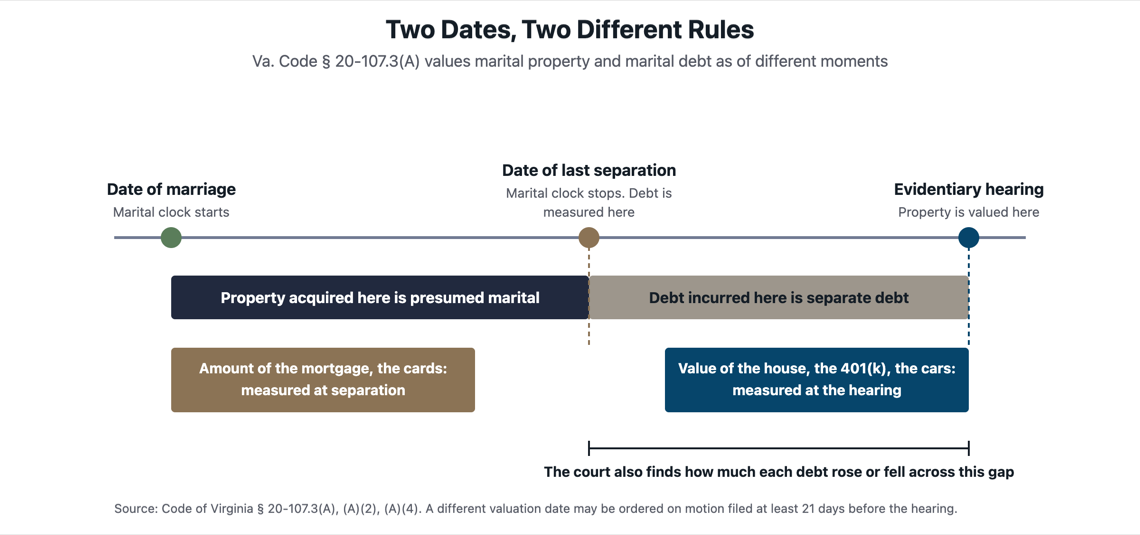
The consequences are real. If a retirement account grows substantially during a long-running case, the marital share is valued at the hearing, so both spouses ride the market. If one spouse runs up a credit card after separation, that balance is separate debt under (A)(4) and the increase is documented rather than absorbed. If a house loses value while the case is pending, the loss is shared because the appraisal date is the hearing, not the separation.
A party who does not want the default valuation date has a narrow window. Subsection A permits the court, “upon motion of either party made no less than 21 days before the evidentiary hearing,” to order a different valuation date for good cause. That is a deadline, not a suggestion, and it is one of the few hard filing clocks in the section.
How separate property turns into marital property
Separate property is not permanently protected. Subdivision (A)(3) contains five distinct commingling rules, and each one describes a way ownership dissolves into the marital pot. The common thread is the same in all five: the contributed property retains its original classification only “to the extent the contributed property is retraceable by a preponderance of the evidence and was not a gift.”
Tracing is a documentary exercise, not a memory exercise. It means statements, deeds, closing documents, and a chain that a judge can follow from the original separate dollar to the asset sitting in front of the court. A spouse who deposited an inheritance into the joint checking account in 2014 and spent the next decade running household expenses through that account has, in practical terms, no traceable inheritance left.
| Subdivision | The situation | Result |
|---|---|---|
| 3 d | One category of property is contributed to another and the contributed property loses its identity | The contribution transmutes to the category that received it, unless traced |
| 3 e | Marital and separate property are combined into a newly acquired asset | The whole new asset is deemed marital, unless traced |
| 3 f | Separate property is retitled in the joint names of the parties | Deemed transmuted to marital, unless traced |
| 3 g | One spouse’s separate property is commingled into the other’s separate property, or both spouses’ separate property funds a new asset | Each party is reimbursed the value of the contributed property in the award |
| 3 h | Separate property is commingled with, conveyed into, or retitled into joint ownership | No presumption of gift arises. The retitling alone does not prove intent to give |
Subdivision 3 h deserves a note, because it corrects an assumption that used to cost people money. Putting a spouse’s name on a deed does not create a presumption that half of it was a gift. The retitling still transmutes the asset to marital under 3 f, but the separate contribution can be traced back out, and the burden is preponderance of the evidence rather than something higher. Documentation at the closing table is what makes that argument winnable years later.
The increase-in-value rule and who has to prove what
Some of the largest classification fights in Virginia involve an asset nobody disputes was separate at the start. A house bought before the wedding. A business a spouse founded in law school. The question is what happened to it during the marriage.
The rule in (A)(1) and (A)(3)(a) has two halves. Income from separate property during the marriage stays separate “if not attributable to the personal effort of either party.” An increase in the value of separate property stays separate unless marital property or personal efforts contributed to the increase, and then only to the extent of the increase attributable to those contributions. The statute sets a real threshold: the personal efforts “must be significant and result in substantial appreciation of the separate property.”

“Personal effort” is defined in the statute rather than left to argument. It means “labor, effort, inventiveness, physical or intellectual skill, creativity, or managerial, promotional or marketing activity applied directly to the separate property.” A rental property that appreciated because the Fredericksburg market rose is a different case from a rental property that appreciated because one spouse spent weekends renovating it.
The burden shifts in two steps, and the order matters. The nonowning spouse first has to prove both that contributions of marital property or personal effort were made and that the separate property increased in value. Once that is established, the burden moves to the owning spouse to prove that the increase, or some portion of it, was not caused by those contributions. A nonowning spouse who cannot clear the first hurdle never gets the benefit of the second.
The eleven factors that set the numbers
Subsection E governs three things at once: the amount of any division or transfer of jointly owned marital property, the amount of any monetary award, and the apportionment of marital debts. The same eleven factors drive all three, which is why property and debt tend to move together in a ruling and why arguing about an asset in isolation from the loan against it rarely works.
The statute also tells the court what the factors decide: not only the amount but “the method of payment.” A judge weighing factor 8, the liquid or nonliquid character of the marital property, is often deciding whether a monetary award gets paid at once or in fixed installments over several years.
| # | Factor | What it usually means in practice |
|---|---|---|
| 1 | Monetary and nonmonetary contributions to the well-being of the family | Homemaking, caregiving, and supporting a spouse’s career count here, not just paychecks |
| 2 | Contributions to the acquisition, care, and maintenance of the marital property | Who bought it, who maintained it, who paid the note |
| 3 | Duration of the marriage | Short marriages tend toward returning people to their starting positions |
| 4 | Ages and physical and mental condition of the parties | Health and earning horizon, especially near retirement age |
| 5 | Circumstances that contributed to the dissolution, specifically including grounds under § 20-91(A)(1), (3), or (6) or § 20-95 | The fault factor. Limited to adultery and related grounds, felony confinement, and cruelty or desertion |
| 6 | How and when specific items were acquired | Timing relative to the marriage and the separation |
| 7 | Debts and liabilities of each spouse, their basis, and the property securing them | Debt is analyzed alongside the asset it encumbers, not separately |
| 8 | Liquid or nonliquid character of the marital property | An award someone cannot actually pay is not a workable award |
| 9 | Tax consequences to each party | Retirement transfers, capital gains, and filing status |
| 10 | Use or expenditure of marital property for a nonmarital purpose, or dissipation | Only when done in anticipation of divorce or separation, or after separation |
| 11 | Any other factor the court finds necessary to reach a fair and equitable award | The catch-all that lets unusual facts matter |
Factor 5 is narrower than its reputation. It reaches the fault grounds in § 20-91(A)(1), (3), and (6) and the bed-and-board grounds in § 20-95. It does not reach subdivision (A)(9), the no-fault separation ground. A spouse who behaved badly in ways that do not amount to a statutory ground for divorce has not handed the other side a property argument, and a spouse in a straightforward one-year separation case has no fault factor to run at all.
What the court can order, and what it cannot
Virginia limits a judge’s power over titled property more tightly than most people expect, and understanding those limits is what makes a settlement position realistic. Subsection C states the boundary plainly: except for retirement benefits under subsection G, the court “shall have no authority to order the division or transfer of separate property or marital property, or separate or marital debt, which is not jointly owned or owed.”
Marital property titled in one spouse’s name alone therefore cannot be handed to the other spouse. It gets counted, valued, and then addressed through a monetary award under subsection D instead. This is the mechanism that resolves the most common worry people bring to a first meeting. A solely titled brokerage account is not going to be split in half by the court, but its marital value is going to show up in what the account holder owes.
| Power | Source | Limit |
|---|---|---|
| Transfer or divide jointly owned marital property | Subsection C | Only jointly owned or jointly owed items. Must be based on the subsection E factors |
| Order a sale, private or public | Subsection C | Available “without the necessity for partition,” so no separate partition suit is required |
| Return separate property held by the other spouse | Subsection C | Only on a finding that it is in that spouse’s possession or control |
| Grant a monetary award | Subsection D | Lump sum or fixed payments over time. It is a judgment, but the clerk does not docket it unless the decree so directs |
| Direct payment of retirement benefits | Subsection G | No more than 50 percent of the marital share of the cash benefits actually received, payable only as benefits become payable |
| Enforce after the decree | Subsection K | Set transfer deadlines, hold a party in contempt, appoint a special commissioner to sign, and conform a retirement order to qualify |
Two enforcement details are worth carrying forward. Any order transferring real property between the parties has to be recorded and indexed in the grantor and grantee indexes of the circuit court clerk’s office where the land sits. And a spouse ordered to pay a monetary award may satisfy it “by conveyance of property, subject to the approval of the court,” which quietly turns many awards into a negotiated exchange of assets rather than a cash payment. Judgment interest under § 8.01-382 applies unless the court orders otherwise.
Retirement accounts and the 50 percent rule almost everyone misstates
Retirement is frequently the largest marital asset in the file, larger than the equity in the house, and the rule that governs it is the most commonly garbled sentence in Virginia family law. Subsection G does not say a spouse gets half the pension. It says that no direct payment ordered by the court “shall exceed 50 percent of the marital share of the cash benefits actually received by the party against whom such award is made.”
Three qualifiers in that sentence do real work. It is 50 percent of the marital share, not of the whole benefit. It applies to benefits actually received, so a court cannot order payment of money that never arrives. And it caps the direct payment remedy under subsection G, which sits alongside the monetary award under subsection D rather than replacing it.
The statute defines the marital share as “that portion of the total interest, the right to which was earned during the marriage and before the last separation of the parties.” For a defined benefit pension, that is a fraction: service earned during the marriage over total service earned across the career.
Subsection G also lets the court order a party to name a spouse or former spouse as irrevocable beneficiary of a survivor benefit or annuity plan, and to decide which party bears the cost of maintaining it. Life insurance is excluded from that power except as § 20-107.1:1 permits. Survivor benefits are easy to overlook in a settlement and effectively impossible to add after the fact, which makes them a standing item on any retirement checklist.
Military pensions, VRS, and Social Security
In the Stafford and Fredericksburg area, a large share of divorce files involve a federal or state retirement system rather than an ordinary employer plan. Each system adds its own layer on top of § 20-107.3, and the layers are not interchangeable.
Military retired pay is governed by the federal Uniformed Services Former Spouses’ Protection Act, which § 20-107.3(G)(1) incorporates by reference. Two federal numbers matter. Under 10 U.S.C. § 1408(e)(1), total payments under all court orders may not exceed 50 percent of disposable retired pay, rising to 65 percent when support garnishments are combined. And § 1408(d)(2) contains the widely misunderstood “10/10 rule”: the finance center will not pay the property-division share directly to a former spouse unless the marriage lasted at least 10 years overlapping at least 10 years of creditable service. That rule limits who pays, not whether the pension is divisible. A Virginia court can still treat the marital share as marital property in a shorter marriage, and payment then comes from the retiree instead of the government.
| System | Instrument required | The detail that trips people up |
|---|---|---|
| Private employer plan (401(k), pension) | Qualified domestic relations order | Subsection K(4) lets the court modify an order later solely to make it qualify, which is the safety valve when a plan rejects the language |
| Military retired pay | Court order meeting USFSPA requirements | 50 percent cap on disposable retired pay, 65 percent with support; direct payment requires 10 years of marriage overlapping 10 years of service |
| Virginia Retirement System, defined benefit | VRS Approved Domestic Relations Order on the mandatory VRS form | A defined benefit account cannot be divided until the member retires, except in the case of a refund |
| Virginia Retirement System, defined contribution | VRS ADRO on the plan-specific form | Can be divided at the time of divorce with no penalty, even if the member is still working or under 59 1/2 |
| Social Security retirement | None. It cannot be divided | Federal law makes benefits non-transferable and non-assignable, so no state decree reaches them |
The Virginia Retirement System is strict in a way that catches drafters off guard. VRS forms became mandatory on January 1, 2020, you must use them, and you may not alter them. VRS calculates the marital share as months of service credit earned during the marriage up to the date of last separation divided by total career service credit, which tracks the statutory definition closely. Social Security sits outside all of this: 42 U.S.C. § 407(a) makes the right to future payments neither transferable nor assignable, so a Virginia decree cannot divide a Social Security benefit no matter how long the marriage lasted.
Virginia divides what you owe, too
Debt gets less attention than assets and causes at least as much trouble after the decree. Subsection A requires the court to determine the nature of all debts and classify each as separate or marital, and subsection C gives the court authority to apportion and order payment of the parties’ debts incurred before the dissolution, using the same subsection E factors.
The classification rules turn on whose name is on the obligation and when it was created. Joint debt incurred before the last separation is marital whether it predates the wedding or not. Individual debt incurred after the wedding and before separation is marital. Individual debt incurred before the wedding, and any debt incurred after separation, is separate.
| When and how it was incurred | Classification | The available argument |
|---|---|---|
| Joint account, before the marriage | Marital debt | Can be carved into marital and separate parts if the proceeds went to a nonmarital purpose |
| Joint account, during the marriage | Marital debt | Same nonmarital-purpose carve-out |
| One name only, before the marriage | Separate debt | Can become marital on proof it was incurred for the benefit of the marriage or family |
| One name only, during the marriage | Marital debt | Nonmarital-purpose carve-out applies |
| Either name, after the last separation | Separate debt | Benefit-of-the-family argument is still available, and is how post-separation mortgage payments get addressed |
One limitation matters for planning. A Virginia decree binds the spouses to each other; it does not bind the lender. An order making one spouse responsible for a jointly held card or mortgage does not remove the other spouse’s name from the contract, and the creditor can still pursue whoever signed. Refinancing, closing accounts, and removing authorized users are the steps that actually solve the problem, and they belong in the agreement with deadlines attached.
The marital home: buy out, sell, or transfer
The house is usually both the largest asset and the one with the most feeling attached, and Virginia gives the court three tools for it under subsection C. A judge may transfer the property or an interest in it to one party. A judge may permit one party to purchase the other’s interest and direct how the proceeds are allocated, on the condition that the buying party “agrees to assume any indebtedness secured by the property.” Or a judge may order a sale, either privately through an agent the court designates or by public sale.
That last option carries a phrase worth knowing: the sale may be ordered “without the necessity for partition.” Co-owners of Virginia real estate ordinarily have to bring a partition suit under Va. Code § 8.01-81 to force a sale. Inside a divorce, the circuit court can reach the same result within the existing case, which saves a separate filing and a second round of fees.

Title form changes at the decree as well. Under Va. Code § 20-111, a divorce from the bond of matrimony extinguishes all contingent rights of either spouse in the other’s real and personal property, including the right of survivorship. An estate held by the entirety “shall thereupon be converted into a tenancy in common.” Spouses can hold property as tenants by the entirety only while they are married, per § 55.1-136, and that protection from separate creditors ends with the marriage.
The same statute reaches beneficiary designations. Section 20-111.1 revokes a revocable beneficiary designation naming a former spouse on entry of the divorce decree, and the death benefit is paid as if the former spouse had predeceased. But the section does not apply to trusts, it can be preempted by federal law on employer plans, and every Virginia decree since July 1, 2012 has to carry a bold-print warning telling the parties to update their designations themselves. Treat the statute as a backstop, not as the plan.
Dissipation: spending marital money on the way out
Factor 10 addresses money that is gone by the time the case is heard. It directs the court to consider “the use or expenditure of marital property by either of the parties for a nonmarital separate purpose or the dissipation of such funds, when such was done in anticipation of divorce or separation or after the last separation of the parties.”
The timing clause is the whole factor. Marital money spent badly in year six of a marriage nobody was planning to end is not dissipation. The same spending three weeks before a spouse files, or in the months after separation, is squarely within factor 10. What follows is not a criminal finding; the court simply treats the missing funds as though they were still available and adjusts the award accordingly.
Proving it requires records, which is why account statements from the months around separation are among the first documents worth gathering. Large cash withdrawals, transfers to relatives, unusual purchases, and new accounts opened shortly before a filing are the ordinary fact patterns. The mirror image also matters: a spouse whose spending is going to be questioned is far better off with contemporaneous documentation of what the money paid for than with an explanation constructed a year later.
Protecting the estate while the case is pending
Property division happens at the end of a case, but the assets have to survive until then. Va. Code § 20-103 gives the circuit court broad authority to enter orders while the suit is pending, and several of its clauses are aimed directly at preserving what will later be divided.
| Relief | What it does |
|---|---|
| Preserve the estate | Orders either spouse to preserve their estate “so that it be forthcoming to meet any decree which may be made in the suit” |
| Security to abide the decree | Compels a spouse to post security to ensure compliance with the eventual ruling |
| Payment of joint debts | Orders a party to pay secured or unsecured debts incurred jointly or by either party while the case runs |
| Exclusive use of the residence | Grants one spouse exclusive use and possession of the family residence during the suit |
| Maintain life insurance | Compels a party to keep an existing policy in force and to name a specified beneficiary, and allocates the premium |
| Exclusion from the dwelling | On a showing of reasonable apprehension of physical harm, excludes a family or household member from a jointly owned or rented dwelling |
Two guardrails apply to everything on that list. Awards under subsection A are paid “from the post-separation income of the obligor unless the court, for good cause shown, orders otherwise,” so a pendente lite order is not meant to be funded by liquidating the marital estate. And subsection J states that an order entered under the section “shall have no presumptive effect and shall not be determinative when adjudicating the underlying cause.” A favorable temporary order predicts nothing about the final division.
For pendente lite spousal support specifically, the statute now carries a presumptive formula: the difference between 26 percent of the payor’s monthly gross income and 58 percent of the payee’s where the parties have minor children in common, and 27 percent against 50 percent where they do not. The formula applies only when combined monthly gross income does not exceed $10,000, and the court may deviate for good cause.
Where a Stafford area property case is heard
Equitable distribution is circuit court work. Va. Code § 20-96 gives circuit courts jurisdiction over divorce suits and directs that they be heard “as equitable claims.” A juvenile and domestic relations district court can enter custody and support orders, but it has no authority to divide marital property, which is why a property case cannot be resolved in the courthouse where a support case may already be pending.
Local practice differs enough between the three courthouses in the region to affect scheduling, and property cases tend to involve contested motions.
| Circuit court | Clerk’s office | Civil motion practice |
|---|---|---|
| Stafford | 1300 Courthouse Road, Stafford, VA 22555. (540) 658-8750 | Motion days the 1st and 3rd Mondays, civil at 11:00 a.m. Originals filed with the clerk seven days in advance; motions over 20 minutes scheduled through chambers |
| Fredericksburg | 701 Princess Anne Street, Suite 100, Fredericksburg, VA 22401. (540) 372-1066 | Notice of civil motions due in the clerk’s office by noon on the Wednesday of the week preceding the hearing week. Term day praecipes due 12 days ahead |
| Spotsylvania | 9107 Judicial Center Lane, Spotsylvania, VA 22553. (540) 507-7600 | Motion days the 1st and 3rd Mondays for Courtroom 2 and the 2nd and 4th for Courtroom 1, at 9:00 a.m. Originals seven days ahead; over 30 minutes through chambers |
Subsection L of § 20-107.3 adds a useful post-decree option. If neither party still lives in the city or county whose circuit court entered the decree, the court may transfer authority to make additional enforcement orders to the circuit court where either party now resides. Enforcement does not have to follow people back to a courthouse none of them live near anymore.
An agreement is almost always cheaper than a ruling
Nothing in § 20-107.3 forces a judge to decide any of this. Subsection I preserves the parties’ ability to settle, and Va. Code § 20-109.1 lets the court affirm, ratify, and incorporate a valid agreement into the decree, at which point it “shall be deemed for all purposes to be a term of the decree” and is enforceable as part of it. That combination is what makes a well-drafted property settlement agreement both flexible and enforceable.
Section 20-155 lets married people contract with each other on the same terms as prospective spouses under the Premarital Agreement Act, effective immediately on execution. It also contains a trap: “a reconciliation of the parties after the signing of a separation or property settlement agreement shall abrogate such agreement unless otherwise expressly set forth in the agreement.” Couples who sign, reconcile, and separate again a year later often discover the agreement evaporated, which is avoidable with one sentence at drafting.
| Item | Why it belongs in the agreement |
|---|---|
| The date of separation | It sets the marital window and the debt measurement date, and litigating it later is expensive |
| Classification of the disputed assets | Agreeing that an inheritance is separate is far cheaper than tracing it through a decade of statements |
| Retirement, with the instrument named | The QDRO or VRS ADRO has to be drafted, entered, and accepted, not just promised |
| Survivor benefits | Almost impossible to add after the decree, and easy to overlook before it |
| Refinance and account-closing deadlines | The decree binds the spouses; only refinancing binds the lender |
| Beneficiary designations | § 20-111.1 is a backstop with real exceptions, so update the forms directly |
| A survival clause covering reconciliation | § 20-155 abrogates the agreement on reconciliation unless the agreement says otherwise |
Miles Franklin handles property division as part of his Virginia divorce practice, and the analysis frequently runs alongside spousal support and custody questions in the same case. For couples who agree on the terms, the uncontested divorce process is often the right container for a negotiated division, and the broader family law overview explains how the pieces connect.
Talk through your property division before you sign anything
Classification is decided by documents, and the window for gathering them narrows as a case moves. If you are separated or considering it, a review of what you own, what you owe, and how each item is likely to be classified will tell you far more about your outcome than any percentage will. Miles Franklin represents clients throughout Stafford, Fredericksburg, Spotsylvania, and Fairfax.
Call (276) 773-6102 or use the form below to schedule a consultation.
Frequently asked questions about property division in Virginia
Is Virginia a 50/50 state for property division?
No. Virginia is an equitable distribution state under Va. Code § 20-107.3, not a community property state. There is no statutory presumption of an equal split. The court classifies property first, then divides only the marital portion after weighing eleven factors including each spouse’s monetary and nonmonetary contributions, the length of the marriage, the fault grounds listed in factor 5, and the tax and liquidity consequences. Some divisions land near even and many do not.
Can a Virginia court take half of my 401(k) if the account is in my name only?
A court cannot transfer a solely titled account to your spouse, because subsection C limits division to property that is jointly owned. Retirement is the exception carved out in subsection G. The court may order direct payment of a percentage of the marital share, capped at 50 percent of the marital share of the cash benefits actually received. The marital share is only what was earned during the marriage and before the last separation, so contributions from before the wedding and after separation are not in the calculation.
Does an inheritance get divided in a Virginia divorce?
An inheritance received during the marriage is separate property under § 20-107.3(A)(1) because it came by bequest, devise, or descent from a source other than your spouse. It stays separate only if it stays identifiable. If the money went into a joint account, funded a jointly titled purchase, or was retitled into both names, it is presumed to have transmuted to marital property, and you keep separate credit only to the extent you can trace it by a preponderance of the evidence. No presumption of gift arises from the retitling itself.
What happens to the house in a Virginia divorce?
For a jointly owned marital home, subsection C gives the court three options: transfer it to one spouse, let one spouse buy out the other’s interest and allocate the proceeds provided the buyer assumes the secured debt, or order a private or public sale without requiring a separate partition suit. Whichever route the case takes, entry of the divorce decree converts a tenancy by the entirety into a tenancy in common under § 20-111 and extinguishes the right of survivorship.
How is credit card debt handled in a Virginia divorce?
Debt is classified the same way property is. A card in joint names is marital debt if the balance was incurred before the last separation, even if the account predates the marriage. A card in one name is marital debt if the balance was incurred after the wedding and before separation. Balances run up after separation are separate debt. A spouse can still argue that a separate debt was incurred for the benefit of the marriage or family, or that a marital debt funded a nonmarital purpose and should be split.
Does adultery change how property is divided in Virginia?
It can, but only through factor 5 of subsection E, which reaches the circumstances that contributed to the dissolution “specifically including any ground for divorce under the provisions of subdivision A (1), (3) or (6) of § 20-91 or § 20-95.” Subdivision A(1) covers adultery occurring before the last separation, along with sodomy or buggery committed outside the marriage. Fault is one factor among eleven, not an override, and conduct that does not amount to a statutory ground does not enter the analysis at all.
How long after separation do I have to file for divorce in Virginia?
There is no deadline to file, but there is a waiting period before a no-fault divorce can be granted. Under § 20-91(A)(9)(a) the parties must live separate and apart without cohabitation and without interruption for one year, reduced to six months if they have entered into a separation agreement and have no minor children born to or adopted by them. Waiting does have a cost in a property case, because marital property is valued at the evidentiary hearing rather than at separation.
Property division is the part of a Virginia divorce that follows people the longest, because the classification decisions are effectively permanent. Subsection D closes that door explicitly: marital property that has been considered or ordered transferred in granting a monetary award “shall not thereafter be the subject of a suit between the same parties to transfer title or possession of such property.” Getting the inventory and the classification right the first time is the whole exercise.
Questions about your divorce?
Every situation is different. If you have questions about how Virginia law applies to yours, contact the Law Office of Miles Franklin to schedule a consultation.
Schedule a Consultation →