
A military divorce in Virginia is a Virginia divorce. The same grounds, the same waiting periods, and the same equitable distribution statute apply. What changes is the layer of federal law sitting on top of it. That layer decides where a service member can be sued, whether the case can be paused for duty, and how retired pay gets divided. It also decides which benefits a former spouse keeps and what happens to a custody order when a parent deploys. Each of those questions has a specific statutory answer, and some of the most repeated rules of thumb about military divorce, like the 10/10 rule, are widely misunderstood. This guide walks through the Virginia Code and the federal statutes that control a military divorce filed in a Virginia court, in the order the issues usually come up.
What makes a military divorce different in Virginia
Nothing in Virginia law creates a separate kind of divorce for military families. The grounds in § 20-91 are the same for everyone, including the no-fault ground that requires living separate and apart for one year, or six months when the spouses have a separation agreement and no minor children. The Circuit Court still classifies and divides property, still sets support, and still decides custody on the child’s best interests.
The difference is that a military family’s biggest assets and most pressing problems are often governed by federal statutes that a Virginia judge must follow. Retired pay is a federal benefit paid by a federal finance office. Health coverage and the Survivor Benefit Plan run on federal eligibility rules. A spouse who is deployed or training has federal procedural protections in any civil case, including a divorce. Getting the Virginia side right and missing the federal side can produce a decree that looks complete on paper and does not work when it reaches the agency that has to honor it.

Military families also move. A couple might have married in another state, lived at three duty stations, and separated while one spouse was assigned overseas. That history matters for two separate questions that people often blur together: whether a Virginia court can grant the divorce at all, and whether a Virginia court can divide the military pension. The answers come from different statutes, and they are not always the same.
Where you can file: Virginia residency rules for service members
Under Va. Code § 20-97, one spouse must have been an actual bona fide resident and domiciliary of Virginia for at least six months before the divorce is filed. The statute then adds three rules written for service members and, in one case, federal civilian employees.
First, a member of the Armed Forces who has been stationed or resided in Virginia and lived here for six months or more before filing is presumed to be domiciled here and a bona fide resident. Second, being stationed in Virginia includes living on a ship home-ported in Virginia, or on a base in Virginia under exclusive federal jurisdiction. Third, a service member or federal civilian employee who is stationed overseas, or has just returned from an overseas assignment, is treated as a Virginia resident if they lived in Virginia for the six months before that assignment began. The statute also confirms that once a couple separates, either spouse may establish a separate domicile.
Venue, meaning which Virginia Circuit Court hears the case, is a separate question governed by § 8.01-261. In general, a divorce is filed where the couple last lived together, where the defendant lives, or in some situations where the plaintiff lives. A family in Stafford, Fredericksburg, or Spotsylvania will usually file in that locality’s Circuit Court.
| Question | Controlling law | What it requires |
|---|---|---|
| Can a Virginia court grant the divorce? | Va. Code § 20-97 | One spouse resident and domiciled in Virginia for six months before filing. A service member stationed or living in Virginia for six months is presumed to qualify. |
| Can a Virginia court divide military retired pay? | 10 U.S.C. § 1408(c)(4) | The service member resides in Virginia for a reason other than military assignment, is domiciled in Virginia, or consents to the court’s jurisdiction. |
| Which Virginia court hears it? | Va. Code § 8.01-261 | Generally where the spouses last lived together, where the defendant lives, or in some cases where the plaintiff lives. |
Sources: Code of Virginia §§ 20-97 and 8.01-261; 10 U.S.C. § 1408(c)(4).
The table shows why the second row catches people off guard. A service member assigned to a Virginia installation can be divorced in Virginia under the six-month presumption. Yet a Virginia court may still lack the power to divide that service member’s retired pay if their legal domicile is another state and they do not consent. In that situation the pension question may have to be decided in the service member’s home state, or the service member may consent to the Virginia court’s jurisdiction. Whether a particular step in the case amounts to consent should be settled early. Sorting this out before filing avoids a decree that divides everything except the largest asset.
Serving a spouse on active duty: the SCRA stay and default protections
The Servicemembers Civil Relief Act is federal law that applies to civil cases in every state, and a divorce is a civil case. Two of its provisions come up constantly.
The first is the stay. Under 50 U.S.C. § 3932, a service member who is in military service, or within 90 days after release from it, and who has received notice of the case can apply to pause it. The court must grant a stay of at least 90 days when the application includes two written statements. The first explains how current duty materially affects the service member’s ability to appear and gives a date when they will be available. The second comes from the commanding officer and states that current duty prevents appearance and that military leave is not authorized.
The statute expressly covers child custody proceedings. Asking for a stay is not an appearance for jurisdictional purposes and does not waive any defense, including a challenge to personal jurisdiction. Additional stays can be requested if duty continues to prevent appearance.
The second is protection against default. Under 50 U.S.C. § 3931, before a court enters a judgment against a defendant who has not appeared, the plaintiff must file an affidavit stating whether the defendant is in military service, or that the plaintiff cannot determine whether they are. If it appears the defendant is in military service, the court may not enter judgment until it appoints an attorney to represent that defendant.
Under § 3931(g), a default judgment can also be reopened. The judgment must have been entered during service or within 60 days after release, and the application must be filed within 90 days after release. The service member must show that military service materially affected their ability to defend and that they have a meritorious or legal defense.
Virginia builds the same check into its affidavit procedure. Under § 20-106, an affidavit used to prove a no-fault divorce must verify the military status of the opposing party and whether that party has answered or waived their rights under the Servicemembers Civil Relief Act.
| Protection | Who it applies to | What it does |
|---|---|---|
| Stay of proceedings, § 3932 | A service member in military service, or within 90 days after release, who has notice of the case | Pauses the case for at least 90 days on a proper application with a commanding officer’s letter. Covers custody cases. Not a waiver of defenses. |
| Additional stay, § 3932(d) | The same service member, when duty still prevents appearance | Allows a further stay request based on continuing military duty. |
| Military status affidavit, § 3931(b)(1) | Required of the plaintiff when the defendant has not appeared | The court needs a sworn statement, or a declaration under penalty of perjury, on whether the defendant is in military service before a default judgment. |
| Appointed attorney, § 3931(b)(2) | A defendant who appears to be in military service and has not appeared | No judgment until the court appoints an attorney for the service member. |
Source: 50 U.S.C. §§ 3931 and 3932.
For the spouse who is not in the military, the practical lesson is that a divorce against a deployed spouse can move on the military’s timeline, not the court’s ordinary one, if the service member applies for a stay. For the service member, the stay is a shield, not an obligation. Some service members would rather resolve the case by agreement and sign a separation agreement than leave a divorce hanging over a deployment. Under § 20-91(A)(9), a signed agreement also shortens the no-fault separation period to six months when there are no minor children.
Dividing military retired pay under the USFSPA
For a military family near retirement, the retired pay can be the largest marital asset. Virginia divides it through its ordinary equitable distribution statute, § 20-107.3, which is covered in depth in the guide to property division in a Virginia divorce. Subsection G(1) lets the court award a percentage of the marital share of a pension, whether vested or not, and defines the marital share as the portion earned during the marriage and before the last separation. It caps any award at 50 percent of the marital share of the cash benefits actually received, and it states that any determination of military retirement benefits must follow the federal Uniformed Services Former Spouses’ Protection Act, 10 U.S.C. § 1408.
The federal statute shapes the number in three important ways. First, a state court divides disposable retired pay, not the gross figure. Disposable retired pay excludes, among other things, amounts owed back to the government for overpayments, any retired pay waived in order to receive VA disability compensation, and Survivor Benefit Plan premiums for a former spouse annuity. That waiver point is where military divorce overlaps with veterans’ benefits, and the interaction between retired pay and disability pay is explained in the article on receiving military retirement and disability pay together.
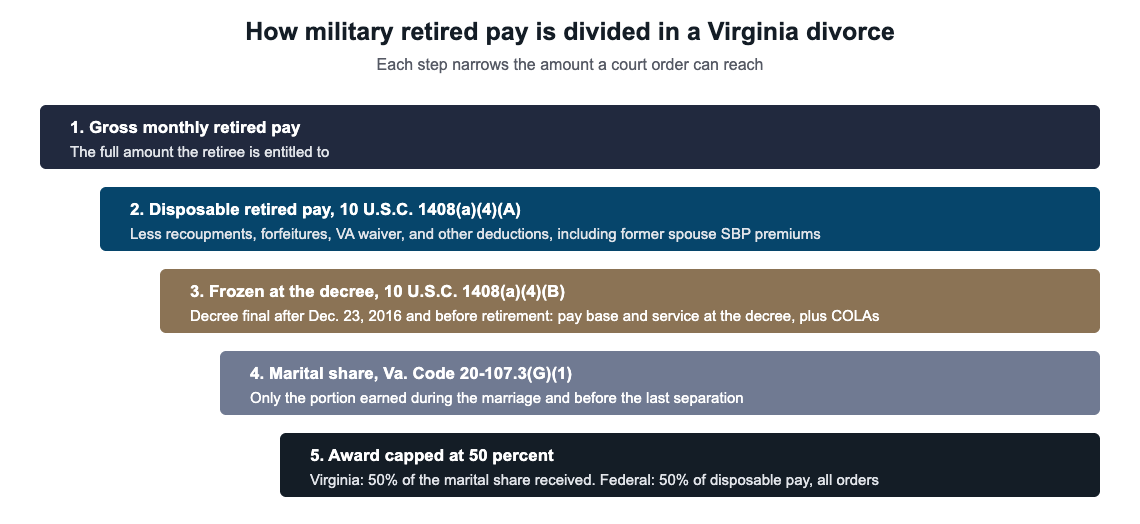
Second, for any divorce decree that became final after December 23, 2016, federal law freezes the benefit that can be divided when the divorce happens before the service member retires. Under § 1408(a)(4)(B), disposable retired pay is calculated using the service member’s retired pay base and years of service on the date of the decree, increased only by later cost-of-living adjustments. Promotions and additional years of service after the divorce belong to the service member. A settlement or order that ignores this rule may describe a share the finance office will not pay. For a Reserve or Guard member, the same freeze applies using creditable retirement points at the date of the decree.
Third, the federal finance office will not pay more than 50 percent of disposable retired pay under all property division orders combined, under § 1408(e)(1). That cap is separate from Virginia’s own 50 percent cap on the marital share. A court cannot order a service member to retire at a particular time to start payments. Payments end under the terms of the order, but no later than the death of either the service member or the former spouse.
Thrift Savings Plan accounts, civilian 401(k) accounts, and other defined contribution plans are divided by separate court orders, not by a USFSPA order. The different kinds of orders used for each are explained in the article on court orders used to divide retirement accounts.
| Rule | What it says | Source |
|---|---|---|
| What can be divided | Disposable retired pay: gross retired pay less recoupments, court-martial forfeitures, pay waived for VA compensation, and other listed deductions, such as Survivor Benefit Plan premiums for a former spouse annuity | 10 U.S.C. § 1408(a)(4)(A) |
| Divorce before retirement | For decrees final after December 23, 2016, the pay base and years of service on the decree date, plus later cost-of-living adjustments | 10 U.S.C. § 1408(a)(4)(B) |
| Which portion | The marital share, earned during the marriage and before the last separation | Va. Code § 20-107.3(G)(1) |
| Virginia cap | No more than 50 percent of the marital share of the cash benefits actually received | Va. Code § 20-107.3(G)(1) |
| Federal cap | No more than 50 percent of disposable retired pay under all property division orders combined | 10 U.S.C. § 1408(e)(1) |
| Retirement timing | A court cannot order the service member to retire to start payments | 10 U.S.C. § 1408(c)(3) |
| When payments end | Under the order’s terms, but no later than the death of the service member or the former spouse | 10 U.S.C. § 1408(d)(4) |
Sources: 10 U.S.C. § 1408; Code of Virginia § 20-107.3.
The 10/10 rule is a payment rule, not an eligibility rule
Ask almost anyone about military divorce and they will mention the 10/10 rule, usually described as a rule that a spouse must be married for ten years to get any of the pension. That is not what the statute says. Under 10 U.S.C. § 1408(d)(2), if the marriage did not last at least 10 years during which the service member performed at least 10 years of creditable service, the federal finance office will not make direct payments of the property share to the former spouse.
Nothing in that subsection prevents a Virginia court from awarding a share of the retired pay after a shorter marriage. Virginia’s statute measures the marital share by what was earned during the marriage, not by any minimum length. When the 10/10 overlap is not met, the award is still enforceable, but the service member pays it directly instead of the agency, which changes how the order should be written and how it is enforced if payments stop.
A hypothetical shows the difference. Suppose a couple divorces after 12 years of marriage, and the service member was on active duty for 8 of those years. The overlap is under 10 years, so the finance office will not send the former spouse’s property share directly. A Virginia court can still award a share of the retired pay earned during those 8 years, and the order should then spell out how and when the service member pays it once retirement begins.
The limit also applies only to the property division. Child support and spousal support can be paid from retired pay through the finance office under § 1408(d)(1) regardless of how long the marriage lasted.
The chart puts the four thresholds side by side because they are so often confused. Only the last two are about whether a former spouse keeps a benefit in their own right, and both depend on a 20-year marriage and a 20-year career. The first two are about the pension, and only one of them has a minimum at all.
Survivor Benefit Plan and TRICARE after the decree
Military retired pay stops when the retiree dies. A former spouse who is receiving a share of it loses that income at the same moment unless the decree also deals with the Survivor Benefit Plan. Virginia gives the court the tool to do that. Under § 20-107.3(G)(2), to the extent federal law allows, the court may order a party to designate a spouse or former spouse as the irrevocable beneficiary of all or part of a survivor benefit or annuity plan. Federal law, at 10 U.S.C. § 1450(f)(4), likewise permits a court order requiring former spouse coverage.
The deadline is the part people miss. Suppose the service member is ordered to elect former spouse coverage and does not. Under § 1450(f)(3), the election can be deemed made, but only if the finance office receives a written request from the former spouse, with the court order, within one year of the date of the order. A former spouse who waits past that year can lose the coverage even though the decree awarded it. Because SBP elections generally cannot be changed or revoked once made, the terms are worth getting right the first time.

Health coverage is decided entirely by federal eligibility rules, and a Virginia judge cannot extend it by order. Under 10 U.S.C. § 1072(2)(F), an unremarried former spouse keeps TRICARE eligibility as a dependent if two things are true. On the date of the final decree, the couple had been married at least 20 years, overlapping at least 20 years of creditable service. And the former spouse has no employer-sponsored health plan. This is the 20/20/20 rule.
When the marriage lasted at least 20 years and the service member served at least 20 years, but the overlap was at least 15 years and less than 20, § 1072(2)(H) provides eligibility for only one year after the final decree. This is the 20/20/15 rule. Because both rules are measured on the date of the final decree, the timing of a divorce near a 20-year anniversary can change a former spouse’s health coverage. That is a reason to plan the timing of the final decree with care, not a reason to delay a case that needs to move.
Child support and spousal support on a military income
Child support for military families uses the same Virginia guidelines as every other family, explained in detail in the guide to how child support is calculated in Virginia. The definition of gross income in § 20-108.2(C) is broad: all income from all sources, including but not limited to salaries, wages, bonuses, pensions, disability insurance benefits, and veterans’ benefits.
A service member’s Leave and Earnings Statement shows base pay alongside several allowances, some of which are not taxed. Because the Virginia definition is written as an open list rather than a closed one, tax-free allowances such as housing and food allowances can be argued to be part of gross income in a Virginia support case. How a particular allowance is treated is a question to raise early with the actual statements in hand, because the difference can be substantial. Spousal support follows the factors in § 20-107.1, covered in the article on how Virginia courts decide spousal support, and the same income questions arise there.
| Document | Why it matters |
|---|---|
| Recent Leave and Earnings Statements | Show base pay and each allowance for the support calculation under § 20-108.2. |
| Current orders and assignment history | Support the § 20-97 residency presumption and the § 1408(c)(4) domicile analysis. |
| Service history, or a points statement for Guard and Reserve members | Establish creditable service during the marriage for the marital share, the 10/10 overlap, and the TRICARE tests. |
| Marriage certificate and date of separation | Fix the start and end of the marital share and the overlap periods. |
| Any VA disability rating decision | Shows whether retired pay is being waived, which reduces disposable retired pay. |
| Survivor Benefit Plan election records | Show current coverage and whether a former spouse election is needed within the one-year window. |
Sources: Va. Code §§ 20-97 and 20-108.2; 10 U.S.C. §§ 1072, 1408, and 1450.
None of these documents is exotic, but they are scattered across personnel systems, finance systems, and the VA. Collecting them before the first negotiation keeps a settlement from being built on estimates that later turn out to be wrong.
Custody when a parent deploys
Custody in a military family is decided on the child’s best interests under the same factors as any other Virginia case, set out in § 20-124.3. Virginia adds a separate chapter for deployment, the Virginia Military Parents Equal Protection Act, beginning at § 20-124.7. It defines deployment as complying with orders to report for combat operations or other active service where the parent must go unaccompanied by any family member. It covers the Army, Navy, Air Force, Marine Corps, Coast Guard, Space Force, National Guard, and reserve components.
The core protection is in § 20-124.8. Any order that limits a deploying parent’s existing custody or visitation because of the deployment must say that the deployment is the basis and must be entered as a temporary order. The same order requires the parent who is not deploying to give the court 30 days’ advance written notice of any change of address or telephone number.

The deploying parent can also ask the court to delegate all or part of their visitation to a family member, including a stepparent. That person must have a close and substantial relationship with the child, and the court must find the delegation is in the child’s best interests. That delegation does not give the family member an independent right to visitation, and it ends automatically when the deploying parent returns. The returning parent must give written notice of the return to the family member whose visitation is ending.
The return is where the statute is most protective. When a parent returns from deployment and asks the court to review the temporary order, § 20-124.8(C) requires a hearing that takes precedence on the docket and is set within 30 days of the motion. At that hearing, the parent who did not deploy carries the burden of showing that putting the pre-deployment order back in place is no longer in the child’s best interests. Separately, § 20-108 entitles a service member who files, or is a party to, a petition to modify custody, visitation, or support based on a change in circumstances caused by a parent’s deployment to have it expedited on the docket. Parents who reach agreement on their own can also build a deployment schedule into a written parenting plan.
Deployment can also affect how a case is scheduled, because the SCRA stay in § 3932 expressly reaches custody proceedings. A deployed parent facing a custody filing can ask for the federal stay, and if a custody or visitation order already exists, § 20-124.8 requires any deployment-based limit on it to be temporary.
Talk with a Virginia family law attorney about your military divorce
Military divorces turn on details: domicile, dates of service, the date of the decree, and the one-year Survivor Benefit Plan deadline that follows it. Miles Franklin represents families in Stafford, Fredericksburg, Spotsylvania, and the surrounding counties, including service members and military spouses. Bring your Leave and Earnings Statements and your orders to the first meeting so the advice fits your actual numbers.
Or call (276) 773-6102.
Frequently Asked Questions About Military Divorce in Virginia
Can I file for divorce in Virginia if my spouse or I am stationed here?
Usually, yes. Under § 20-97, a service member who has been stationed or lived in Virginia for six months or more before filing is presumed to be a Virginia resident and domiciliary for divorce purposes. Living on a Virginia-ported ship or a federal installation in Virginia counts.
What is the 10/10 rule in a military divorce?
Under 10 U.S.C. § 1408(d)(2), the finance office pays a former spouse’s property share of retired pay directly only if the marriage lasted at least 10 years during at least 10 years of creditable service. It does not stop a Virginia court from dividing retired pay after a shorter marriage; the service member then pays the share directly.
Can a military divorce happen while my spouse is deployed?
Yes, but a service member on duty can ask for a stay of at least 90 days under 50 U.S.C. § 3932 with a commanding officer’s letter, and no default judgment can be entered until the court appoints an attorney for a service member who has not appeared.
How much of a military pension can a former spouse receive in Virginia?
Virginia caps an award at 50 percent of the marital share of the benefits actually received under § 20-107.3(G)(1), and federal law caps all property division payments at 50 percent of disposable retired pay. For decrees final after December 23, 2016 that are entered before the service member retires, the divisible amount is frozen at the pay base and years of service on the decree date, plus later cost-of-living adjustments.
Does a former military spouse keep TRICARE after a Virginia divorce?
Only under federal rules. An unremarried former spouse without an employer health plan keeps TRICARE if the marriage lasted at least 20 years overlapping at least 20 years of service. If the marriage lasted at least 20 years and the service member served at least 20 years, but only 15 to 19 of those years overlapped, coverage lasts one year after the final decree.
What happens to custody when a Virginia parent deploys?
Under § 20-124.8, any order limiting a deploying parent’s previously ordered custody or visitation because of the deployment must be temporary. When the returning parent files a motion, the court must set a hearing within 30 days, and the other parent must show that restoring the earlier order is no longer in the child’s best interests.
Questions about your divorce?
Every situation is different. If you have questions about how Virginia law applies to yours, contact the Law Office of Miles Franklin to schedule a consultation.
Schedule a Consultation →