
Child support in Virginia is not a negotiation, and it is not a judge’s impression of what seems fair. It is an arithmetic problem the General Assembly wrote down. Two statutes carry almost all of the weight. Va. Code § 20-108.2 contains a schedule that converts the parents’ combined monthly gross income and the number of children into a dollar figure, and Va. Code § 20-108.1 makes that figure a rebuttable presumption that a judge can depart from only by writing down the guideline number, the number actually ordered, and the reason for the difference. Parents who come into the office expecting to argue about what the other one spends money on are usually surprised by how little of the calculation is open to argument, and how much of the outcome turns on three inputs: income, overnight time, and who pays for health coverage and child care.
Virginia uses one formula, and the court has to start with it
Section 20-108.1(B) says there is a rebuttable presumption in any judicial or administrative child support proceeding, including split custody and shared custody cases, that the amount produced by the § 20-108.2 guidelines is the correct amount. That presumption applies in juvenile and domestic relations district court, in circuit court, and in the administrative process run by the Division of Child Support Enforcement. It is the same math in all three places.
Rebutting the presumption is possible, but the statute makes it deliberately visible. The court has to make written findings in the order that applying the guidelines would be unjust or inappropriate in that particular case. Those findings have to state the amount that the guidelines would have required, give a justification for why the order differs, and rest on relevant evidence about one or more of the 15 factors listed in the statute. A judge who simply prefers a different number and does not write out that reasoning has entered an order that will not survive appeal.
The other thing § 20-108.1(B) does is fix the start date. Liability for support is determined retroactively from the date the proceeding was commenced by filing, provided the person who filed exercised due diligence in getting the other parent served. If a Department of Social Services order directing payment was delivered to the sheriff or a process server before that, the earlier date controls. This matters more than most parents expect. Waiting six months to file does not preserve six months of support; it forfeits it.
Worth naming early: the guidelines worksheet is not an internal document. Section 20-108.2(B) requires the worksheet the court or the Department relied on to be placed in the court’s file or the Department’s file, and a copy provided to the parties. If a number in an order does not match the schedule, the worksheet is where the answer is.
Which court decides child support, and where
Two courts can enter a child support order in Virginia, and which one has the case depends on what else is happening. Under Va. Code § 16.1-241(A), the juvenile and domestic relations district court has jurisdiction over the custody, visitation, support, control, or disposition of a child. That is the default forum for parents who were never married, and for married parents who are separated but have not filed for divorce. It is the same court that hears custody and visitation petitions, which is why the two issues so often move together.
Once a divorce suit is filed in circuit court, Va. Code § 16.1-244 divests the juvenile court of jurisdiction over support that is at issue in the divorce, and the circuit court takes it over. Section 20-108.1(B) contains a rule for that handoff: where the juvenile court has been divested and no final support order was entered, the circuit court’s award is retroactive to the date the case was originally filed in juvenile court, provided the petitioner was diligent about service. Filing early in juvenile court preserves the date even if the case moves upstairs.
The third path is not a court at all. Under Va. Code § 63.2-1903, in the absence of a court order the Department of Social Services can issue an administrative support order on its own authority, and it has to set the amount using the same § 20-108.2 guideline a judge would use.
| Court | Clerk | Address | Clerk’s office |
|---|---|---|---|
| Stafford County J&DR | James B. Thompson | 1300 Courthouse Road, P.O. Box 400, Stafford, VA 22555-0400 | (540) 658-8775 |
| Fredericksburg City J&DR | Julie A. Dobson | 615 Princess Anne Street, Fredericksburg, VA 22401-5914 | (540) 372-1072 |
| Spotsylvania County J&DR | Susan Klingensmith | 9113 Courthouse Road, Spotsylvania, VA 22553-0157 | (540) 507-7676 |
| King George County J&DR | Sherry L. Taylor | 10446 Government Center Blvd., King George, VA 22485 | (540) 775-3490 |
| Prince William County J&DR | Monica J. Burnett | 9311 Lee Avenue, Manassas, VA 20110-5555 | (703) 792-6160 |
Clerk’s offices in all five courts run 8:00 a.m. to 4:00 p.m. Filing in the wrong one is a common and avoidable delay, particularly for families who live in Stafford County but work in Fredericksburg and think of the city courthouse as the closer option.
Step one, gross income, and what actually counts
The single most contested input is gross income, and § 20-108.2(C) defines it broadly on purpose. Gross income means all income from all sources. The statute then lists examples so that nobody has to argue about the obvious ones: salaries, wages, commissions, royalties, bonuses, dividends, severance pay, pensions, interest, trust income, annuities, capital gains, social security benefits, workers’ compensation benefits, unemployment insurance benefits, disability insurance benefits, veterans’ benefits, spousal support, rental income, gifts, prizes, and awards.
Notice what is on that list. A bonus is income. A gift is income. Veterans’ benefits are income. Unemployment is income. Losing a job does not zero out a support obligation, it changes the number the obligation is calculated from, and only after a court or the Department actually recalculates it.
Four things are excluded outright. Benefits from public assistance and social services programs as defined in Va. Code § 63.2-100 do not count. Federal supplemental security income does not count. Child support received for a different child does not count. And there is a narrow fourth exclusion that rewards a parent trying to dig out: income from secondary employment that was not previously part of gross income, taken on specifically to discharge a court-ordered or administrative arrearage while the parent is actually paying that arrearage under the order. Secondary employment includes a second job, self-employment, or overtime. When the arrearage is paid off and the second job ends, that ending is not a material change in circumstances, so the parent cannot be punished later for having taken it.
| Counted as gross income | Excluded from gross income |
|---|---|
| Salaries, wages, commissions, and bonuses | Benefits from public assistance and social services programs under § 63.2-100 |
| Self-employment and closely held business income, less reasonable business expenses | Federal supplemental security income |
| Pensions, retirement distributions, annuities, interest, dividends, and trust income | Child support received for another child |
| Severance pay, unemployment insurance, and workers’ compensation | Secondary employment income taken on to discharge an arrearage, while the arrearage is being paid under the order |
| Disability insurance benefits, social security benefits, and veterans’ benefits | |
| Spousal support received under an order or written agreement | |
| Rental income, less reasonable expenses but not depreciation, acquisition cost, or mortgage principal | |
| Capital gains, royalties, gifts, prizes, and awards |
Self-employed parents get a real deduction for reasonable business expenses, and landlords get one for reasonable rental expenses, but the statute puts the burden of proof on the party claiming the deduction, by a preponderance of the evidence. It also closes three specific loopholes on the rental side: the deduction does not include the cost of acquiring the property, depreciation, or the principal portion of a mortgage payment. A rental that shows a paper loss because of depreciation is producing income for child support purposes.
The deductions that come off gross income before the guideline runs
Four adjustments happen before the two incomes are added together, and three of them get missed regularly by parents who run their own numbers.
Spousal support cuts both ways. Support received is added to the recipient’s gross income, and support paid is deducted from the payer’s gross income, in both cases when it is paid under an order or a written agreement. An informal arrangement does not qualify.
One-half of any self-employment tax paid is deducted from gross income. That is the statute’s way of putting a self-employed parent on roughly the same footing as an employee whose employer pays half the payroll tax.
Other children get two different treatments depending on whether there is an order. Where a parent is already under a court order, administrative order, or written agreement for a child who is not part of the current case, there is a presumption that the amount actually being paid is deducted. Where a parent has a natural or adopted child living in that parent’s household or primary physical custody who is not part of the current case, there is a presumption of a deduction equal to the schedule amount for that child based on that parent’s income alone, treated as the total income available for that child. The second version is smaller than most parents expect, and the statute adds two limits: the existence of that responsibility is not by itself a material change justifying modification of an earlier order, and no adjustment may reduce support to a level that seriously impairs the custodial parent’s ability to maintain minimal adequate housing and provide basic necessities.
| Adjustment | Direction | Condition in the statute |
|---|---|---|
| Spousal support received | Added to gross income | Paid under an order or written agreement |
| Spousal support paid | Deducted from gross income | Paid under an order or written agreement |
| Self-employment tax | One-half deducted | Of any self-employment tax actually paid |
| Support for other children under an order or agreement | Presumed deduction | The amount the parent is actually paying |
| Other children in the household or primary custody | Presumed deduction | The schedule amount for those children based on that parent’s income alone |
| Business or rental expenses | Deducted | Reasonable, and proved by the party claiming them |
There is also a rule for derivative benefits that catches disabled parents by surprise. If a parent’s gross income includes disability insurance benefits, it also includes any amount paid to or for the child because of that parent’s entitlement. To the extent those derivative payments are counted in the parent’s income, the parent gets a credit against the ongoing basic obligation, and if the credit is larger than the obligation, the excess can be applied to reduce arrears.
Step two, reading the basic obligation off the schedule
Once each parent’s adjusted gross income is settled, the two figures are added together and the combined number is looked up in the Schedule of Monthly Basic Child Support Obligations in § 20-108.2(B). The schedule runs in $50 increments from a bottom bracket of $350 or less all the way up to $42,500 in combined monthly gross income, with a column for each number of children from one to six. For combined incomes that fall between two rows, the statute says the obligation is extrapolated rather than rounded to the nearer row.
Above $42,500 the schedule stops and a percentage takes over. The obligation is the amount shown at $42,500 plus a percentage of the income above it: 2.6 percent for one child, 3.4 percent for two, 3.8 percent for three, 4.2 percent for four, 4.6 percent for five, and 5.0 percent for six.
| Combined monthly gross income | One child | Two children | Three children | Four children |
|---|---|---|---|---|
| $350 or less | $68 | $104 | $126 | $141 |
| $1,000 | $206 | $311 | $389 | $434 |
| $2,000 | $385 | $582 | $727 | $812 |
| $3,000 | $554 | $836 | $1,045 | $1,167 |
| $4,000 | $721 | $1,088 | $1,360 | $1,520 |
| $5,000 | $872 | $1,304 | $1,637 | $1,829 |
| $6,000 | $999 | $1,489 | $1,872 | $2,092 |
| $8,000 | $1,121 | $1,642 | $2,089 | $2,334 |
| $10,000 | $1,251 | $1,824 | $2,308 | $2,578 |
| $15,000 | $1,635 | $2,369 | $2,957 | $3,303 |
| $20,000 | $1,990 | $2,853 | $3,525 | $3,937 |
| $42,500 (top of the schedule) | $3,306 | $4,792 | $5,867 | $6,554 |
The shape of that schedule is worth studying for a minute, because it answers a question parents ask constantly. Doubling combined income does not double the obligation. Going from $3,000 to $6,000 in combined monthly income raises the two-child figure from $836 to $1,489, an increase of about 78 percent on a 100 percent increase in income. Going from $6,000 to $12,000 raises it from $1,489 to $2,059, an increase of about 38 percent. The curve flattens because the schedule is built on research into what families actually spend on children at each income level, not on a flat percentage of pay.
At the bottom of the schedule the statute switches from arithmetic to protection. There is a presumptive minimum obligation, and the schedule’s lowest bracket, combined monthly gross income of $350 or less, sets the basic obligation for one child at $68. A court may go below the presumptive minimum only after hearing evidence that the parent has no ability to pay it, and only where the parent’s gross income is at or below 150 percent of the federal poverty level, and only if going lower does not seriously impair the custodial parent’s ability to maintain minimal adequate housing and provide basic necessities. Four categories of parent are exempted from the presumptive minimum entirely: those who lack assets to pay and are institutionalized in a psychiatric facility, those imprisoned for life with no chance of parole, those medically verified as totally and permanently disabled with no potential for paying support including recipients of supplemental security income, and those otherwise involuntarily unable to produce income.
Step three, adding health coverage and work-related child care
The schedule figure is not the order. Two categories of real expense get added to it before anything is divided, and the way they are added surprises people.
Health care coverage comes first. Under § 20-108.2(E), the cost of health care coverage, vision care coverage, and dental care coverage for the children who are the subject of the order, paid by either parent or that parent’s spouse, is added to the basic obligation. The statute gives the arithmetic for isolating the children’s share when the insurer only quotes a family rate: subtract the cost of individual coverage for the policy holder from the total cost of the coverage, then divide the remainder by the number of remaining covered people. That per person figure is then applied to the children covered by the order. If the insurer states a per child cost directly, that is the number.
Work-related child care comes second. Section 20-108.2(F) adds child care costs incurred because of the custodial parent’s employment, with three limits. The cost cannot exceed what quality care from a licensed source would require. The noncustodial parent can ask the court to make the custodial parent document the expense. And where appropriate, the court considers whether the noncustodial parent is willing and available to provide the care personally when deciding whether the cost is necessary or excessive. On either party’s request, and on a showing of the tax savings a parent gets from child care deductions or credits, the court factors those actual tax consequences into the amount added.

One category of expense deliberately stays out of the monthly number. Under § 20-108.2(D), every child support order has to provide that the parents pay reasonable and necessary unreimbursed medical or dental expenses in proportion to their gross incomes, and the order has to say how those payments get made. The statute is explicit that any amount paid under that subsection is not adjusted by and not added to the monthly guideline figure. Each parent pays their share as the expenses are incurred. The definition is broader than most parents assume: eyeglasses, prescription medication, prosthetics, orthodontics, and mental health or developmental disabilities services, including services from a social worker, psychologist, psychiatrist, counselor, or therapist.
There is also a narrow provision for newborns. Section 20-108.2(D1) says that in an initial child support proceeding commenced within six months of a child’s birth, absent good cause or agreement, the order must have the parents pay the mother’s reasonable and necessary unpaid pregnancy and delivery expenses in proportion to their gross incomes. Like the medical provision, it sits outside the monthly number. The six-month window is easy to miss.
A worked example, start to finish
Numbers make this concrete. Take two parents in Stafford County with two children. Parent A earns $5,000 a month gross. Parent B earns $3,000 a month gross. The children live primarily with Parent B and spend fewer than 90 days a year with Parent A. Parent A carries the children on a health plan at a cost of $220 a month for the children’s portion. Parent B pays $400 a month for after-school care so that Parent B can work.
| Step | Input | Result |
|---|---|---|
| Combined monthly gross income | $5,000 plus $3,000 | $8,000 |
| Basic obligation from the schedule | $8,000 combined, two children | $1,642 |
| Add health, dental, and vision coverage | Children’s portion paid by Parent A | plus $220 |
| Add work-related child care | After-school care paid by Parent B | plus $400 |
| Total monthly obligation | The number that gets divided | $2,262 |
| Parent A income share | $5,000 divided by $8,000 | 62.5 percent |
| Parent A gross obligation | 62.5 percent of $2,262 | $1,413.75 |
| Credit for coverage Parent A pays directly | § 20-108.2(G)(1) | less $220 |
| Parent A monthly payment to Parent B | Before any deviation | $1,193.75 |
Parent B’s 37.5 percent share works out to $848.25, and Parent B satisfies that share directly by running the household the children live in. That is what the income shares model means. Both parents are assigned a number; only one of them writes a check.
Two details in that table are worth pausing on. The order of operations is fixed: the coverage and the child care are added to the basic obligation before the split, not after, so both parents share the cost in proportion to income rather than the paying parent absorbing all of it. And the credit at the end belongs to whoever actually pays the premium. Section 20-108.2(G)(1) reduces the noncustodial parent's obligation by the cost of health care coverage when it is paid directly by that parent or that parent's spouse. If Parent A stops carrying the children on the plan and Parent B picks it up, the $220 stops being a credit against Parent A's payment and starts being part of what Parent A is paying a share of, and the monthly figure moves by more than the premium itself. That is a change worth reporting promptly rather than discovering at the next review, and it is one of the few adjustments both parents usually agree on once the arithmetic is laid out side by side.
Change one fact and watch the number move. If Parent B, rather than Parent A, carried the coverage, Parent A would owe the full $1,413.75, because the credit belongs to whoever actually pays. If the child care ended, the total would drop to $1,862 and Parent A’s payment would fall to about $943.75. If a third child were added at the same combined income, the basic obligation would rise from $1,642 to $2,089 and Parent A’s payment would rise accordingly. None of that requires a judge’s judgment. It requires correct inputs.
Shared custody, the 90-day rule, and the 1.4 multiplier
Everything above assumes a sole custody arrangement. Section 20-108.2(G)(3) takes over when a parent has custody or visitation of a child for more than 90 days of the year, and it produces a materially different number.
Three definitions do the work. Income share is a parent’s gross income divided by the combined gross income of both parents, the same percentage used in the sole custody calculation. Custody share is the number of days a parent has physical custody of a shared child per year divided by the number of days in the year, computed for the parent with fewer days and then subtracted from the year for the other. Shared support need is the schedule amount for the combined income and the number of shared children, multiplied by 1.4.
| Term | Definition in the statute |
|---|---|
| Income share | A parent's percentage of the combined monthly gross income of both parents, calculated as that parent's gross income divided by the combined gross incomes |
| Custody share | The number of days a parent has physical custody of a shared child per year, whether by sole custody, joint legal or joint residential custody, or visitation, divided by the number of days in the year |
| Shared support need | The presumptive guideline amount for the combined gross income and the number of shared children, multiplied by 1.4 |
| Sole custody support | The support amount determined under subdivision G 1, used as the comparison figure in the lesser-of rule |
| A day | A period of 24 hours; where the parent with fewer overnight periods has an overnight but keeps the child less than 24 hours, each parent is presumed to be allocated one-half of a day |
That 1.4 multiplier is the heart of the formula, and the reasoning behind it is practical. When children spend substantial time in two households, both households have to be equipped for them. Two sets of beds, two sets of everyday supplies, two households heated and lit. The statute recognizes the duplication by inflating the need by 40 percent before dividing it.
The mechanics of the division take a minute to follow. For each parent, the shared support need is multiplied by the other parent’s custody share. Then the other parent’s health coverage cost and the other parent’s work-related child care are added. That subtotal is multiplied by the first parent’s income share. The two resulting figures are subtracted from each other, and the parent with the larger number pays the difference.
Run the same Stafford family through it, this time with the children spending 120 days a year with Parent A. The basic obligation is still $1,642, so the shared support need is $1,642 times 1.4, or $2,298.80. Parent A’s custody share is 120 divided by 365, about 32.9 percent, leaving Parent B at about 67.1 percent. Parent A’s figure works out to $1,214.39 and Parent B’s to $365.91. Parent A pays the difference, $848.48 a month, instead of the $1,193.75 the sole custody formula produced. Thirty extra overnights are worth about $345 a month to this family.
Four rules sit around that formula and each one has teeth.
A day is a period of 24 hours. Where the parent with fewer overnight periods has an overnight but has the child for less than 24 hours during it, there is a presumption that each parent gets half a day. Parents who count Friday evening to Sunday morning as two full days will be disappointed by that arithmetic.
The shared custody amount is the presumptive support, unless a party affirmatively shows that the sole custody amount is lower, in which case the lower amount is what gets paid. There is a companion rule in subdivision G 3(f): if the shared calculation would flip the direction of payment so that money flows to the parent who would be receiving under the sole custody calculation, the shared support is treated as the lesser support instead.
Neither the shared calculation nor any gross income adjustment may reduce support to a level that seriously impairs the custodial parent’s ability to maintain minimal adequate housing and provide basic necessities. And where either parent’s gross income is at or below 150 percent of the federal poverty level, the shared custody figure is not presumptively correct at all, and the court decides which of the two calculations is more just and appropriate.
Finally, subdivision G 3(e) is the provision that catches parents who negotiate for overnights they do not intend to use. Where support was set on the shared formula and one parent consistently fails to exercise custody or visitation at the level the award assumed, there is a rebuttable presumption that the award should be modified. Time bargained for and not taken is recoverable.
Split custody and the mixed arrangements the statute now covers
Sole and shared are not the only two shapes a family takes, and the guideline has grown to match. Split custody, under § 20-108.2(G)(2), applies where each parent has physical custody of at least one child of the parents. Each parent’s household is treated as a separate family unit, each parent is a custodial parent as to the children in that unit and a noncustodial parent as to the children in the other, two sole custody calculations are run, and the parent owing the larger amount pays the difference.
Three more arrangements were added to handle families where the children are not all in the same situation.
| Subdivision | Arrangement | How the guideline handles it |
|---|---|---|
| G 1 | Sole custody | Basic obligation plus coverage plus work-related child care, divided by income share, with a credit for coverage the paying parent pays directly |
| G 2 | Split custody | Two sole custody calculations, one per family unit, offset against each other |
| G 3 | Shared custody | Applies above 90 days a year; basic obligation multiplied by 1.4, weighted by custody share, then by income share, and offset |
| G 4 | Multiple shared custody | Different shared arrangements for two or more children; the days each parent has with each child are totaled and divided by the number of children to get one average custody share |
| G 5 | Sole and shared together | The scheduled obligation is divided by the number of children to get a per child figure, then applied pro rata to the sole custody children and the shared custody children separately, and the two results combined |
| G 6 | Split and shared together | The same per child pro rata approach, applied to a split custody calculation and a shared custody calculation, and the two results combined |
The practical takeaway from G 4 through G 6 is that a family with an unusual arrangement is not outside the guidelines. There is a defined path, and the presumption in § 20-108.1(B) applies to it.
When the guideline number is not the order: the 15 deviation factors
The presumption can be rebutted. It is rebutted less often than parents expect, and almost never on the strength of a general sense that the number is too high or too low. Section 20-108.1(B) lists the evidence that can do it, and the list is exhaustive in practice because the fifteenth item, the catch-all, still requires the court to identify what makes the case inequitable.
A court that departs from the guideline has three obligations at once: tie the departure to one or more of the listed factors, state in the order the amount the guidelines would have required, and justify the variance. Those findings may be incorporated by reference, but they have to exist. In practice this means a deviation argument is really an evidence problem. A parent who wants the court to account for a child's special needs, or for the cost of visitation travel across three states, has to put the actual figures in front of the judge, because the order has to be able to explain itself on its face.
| # | Factor | Where it usually shows up |
|---|---|---|
| 1 | Actual monetary support for other family members or former family members | Support actually being paid outside any order |
| 2 | Custody arrangements, including the cost of visitation travel | Long distance parenting plans and military families |
| 3 | Imputed income to a voluntarily unemployed or voluntarily underemployed party | Quitting, going part-time, or taking a lower paying role |
| 4 | Child care costs from a custodial parent attending an educational or vocational program likely to raise earning potential | A parent returning to school or a certification program |
| 5 | Debts of either party arising during the marriage for the benefit of the child | Medical debt and education debt carried from the marriage |
| 6 | Court-ordered direct payments for life insurance, education expenses, or other benefits for the child | Private school tuition and court-ordered life insurance |
| 7 | Extraordinary capital gains, such as gains from the sale of the marital home | A one-time gain that would otherwise distort a monthly figure |
| 8 | Special needs of a child from a physical, emotional, or medical condition | Therapies, equipment, and specialized schooling |
| 9 | Independent financial resources of the child or children | A trust, an inheritance, or a settlement in the child’s name |
| 10 | Standard of living established during the marriage | High income cases where the schedule tops out |
| 11 | Earning capacity, obligations, financial resources, and special needs of each parent | A parent’s own disability or caregiving obligations |
| 12 | Provisions made for marital property under § 20-107.3 where that property earns income or has income-earning potential | Rental property or a business awarded in the divorce |
| 13 | Tax consequences, including exemptions, the child tax credit, and the child care credit | Which parent claims the children |
| 14 | A written agreement, stipulation, consent order, or decree between the parties that includes the amount of child support | Negotiated resolutions the court is asked to approve |
| 15 | Other factors necessary to consider the equities for the parents and children | The catch-all, and the hardest one to win on alone |
Factor 14 deserves a note, because parents often assume an agreement settles the issue. It does not. An agreement is one of the fifteen factors a court weighs, not a substitute for the analysis. A judge can approve a negotiated number, and usually will where it is close to the guideline and the children are provided for, but the court retains the authority and the duty to test it. Factor 12 links the support calculation to the equitable distribution of marital property, because property that earns income or has income-earning potential changes what each parent has available. Under Va. Code § 20-109.1 a court may affirm, ratify, and incorporate an agreement between the parties, and Va. Code § 20-108 lets the court revise a support decree afterward as the circumstances of the parents and the benefit of the children require. Neither provision lets parents contract the children’s support out of the court’s reach.
Imputed income, quitting a job, and incarceration
Factor 3 is the one that generates the most litigation, and the 2020 and 2022 amendments narrowed it in three specific ways that are worth knowing precisely.
Income may not be imputed to a custodial parent when the child is not in school, child care services are not available, and the cost of that child care is not already in the computation. All three conditions have to line up, but where they do, a custodial parent at home is not treated as voluntarily unemployed.

Any consideration of imputed income based on a change in a party’s employment has to be evaluated with consideration of the good faith and reasonableness of the employment decisions the party made, expressly including a decision to attend and complete an educational or vocational program likely to maintain or increase earning potential. The statute is telling courts that a parent who takes a temporary pay cut to finish a nursing program is not automatically a shirker.
And a party’s current incarceration for 180 or more consecutive days is not voluntary unemployment or voluntary underemployment. The same provision goes further: notwithstanding the ordinary rule in subsection F, incarceration for 180 or more consecutive days is itself a material change in circumstances on which a modification may be based. Before that amendment, arrears piled up during a long sentence at the pre-incarceration rate and the parent came home to a debt no work schedule could touch.
Where earning capacity is genuinely in dispute, § 20-108.1(H) provides a tool. On motion and for good cause, the court may order a party to submit to a vocational evaluation by a vocational expert employed by the moving party, including interviews and testing. The order names the expert, sets the scope, fixes a filing deadline for the report, and may allow the expert to attend the other party’s deposition. The court can award costs and fees for the evaluation at any point in the case.
What the order itself has to say
Virginia does not leave the contents of a support order to the drafter. Va. Code § 20-60.3 lists 17 categories of required content for every order directing the payment of child support, including orders that confirm a separation agreement, and including modifications of existing orders. Several of them are notices rather than terms, which is exactly why they get skipped, and several of them turn out to matter enormously later.
| # | Required content |
|---|---|
| 1 | Notice that support may be withheld from income as it becomes due under § 20-79.1 or § 20-79.2, without amending the order |
| 2 | Notice that support may be withheld under Chapter 19 of Title 63.2 upon application for services with the Department of Social Services |
| 3 | The name, date of birth, and last four digits of the social security number of each child owed support |
| 4 | If known, each parent’s name, date of birth, last four social security digits, addresses, telephone numbers, driver’s license number, and employer, with an exception where a protective order has issued or a party is at risk of harm |
| 5 | Notice of the § 20-124.2 rule that support continues past 18 for a full-time high school student living at home until 19 or graduation, and may continue for a severely and permanently disabled adult child |
| 6 | Notice that a petition may be filed to suspend a professional, business, trade, occupational, or recreational license on a delinquency of 90 days or more or $5,000 or more, and whether either parent holds such a license |
| 7 | The monthly amount and the effective date, which on an initial petition is the filing date; the first monthly payment is due the first of the month after the hearing, with a prorated assessment for the partial month |
| 8 | An order for health care coverage with the policy information, or a written statement that coverage is not available at reasonable cost, plus a statement about cash medical support |
| 9 | If arrears exist, to whom, how much, over what period, and a direction that payments credit current support first; the same detail if overages exist |
| 10 | Thirty days’ advance written notice of any address change and notice within 30 days of any telephone number change |
| 11 | A requirement that the obligor report the current employer’s name, address, and telephone number, any change in employment status, and any unemployment claim, within 30 days |
| 12 | A requirement to report any change in the availability of the children’s health care coverage |
| 13 | The separate amounts due to each person, unless the court specifically orders a unitary award |
| 14 | Notice that support becomes a judgment by operation of law as it comes due and unpaid, and a provision for interest at the judgment rate under § 6.2-302 unless the receiving parent waives it in writing |
| 15 | Notice that the Department of Social Services may initiate a review of the amount ordered by any court |
| 16 | A statement that if arrears, interest, or fees exist when the youngest child emancipates, payments continue at the same total amount until the arrears are paid |
| 17 | Notice that in Department-enforced cases the DMV may suspend or refuse to renew a driver’s license at the same 90 day or $5,000 thresholds |
Item 7 is the one to read twice. On an initial petition, the effective date is the date the petition was filed. The first monthly payment is due on the first day of the month after the hearing, and an additional amount is assessed for the full and partial months between the effective date and that first payment, with the initial partial month prorated. A parent who files in March and gets a hearing in July does not start paying in July for July. Item 16 is the other one. When the youngest child emancipates and arrears remain, payments continue at the full amount, current support plus the arrears payment combined, until the arrears are gone.
When child support ends, and when it does not
Support does not simply stop on an eighteenth birthday. Va. Code § 20-124.2(C) requires the court to order that support continue for a child over 18 who is a full-time high school student, is not self-supporting, and is living in the home of the parent receiving support, until that child turns 19 or graduates from high school, whichever comes first. All three conditions have to be met, and the trigger is automatic rather than discretionary. Section 20-60.3(5) requires the order itself to carry notice of that rule, which means a parent who is surprised by it in a child's senior year was told about it years earlier in a paragraph nobody read at the time.

The statute also gives the court discretion to order support to continue for an adult child who is severely and permanently mentally or physically disabled, where the disability existed before the child turned 18, or before 19 if the child met the full-time high school student conditions; where the child is unable to live independently and support himself; and where the child resides in the home of the parent seeking or receiving support. That is a real and often overlooked provision for families raising a child with significant disabilities.
Two limits close out the subsection. Parents may agree to extend a support obligation beyond when it would otherwise end, and a court may confirm that stipulation. But no court has authority to decree child support payable by the estate of a deceased party. Support obligations do not survive the payer’s death, which is exactly why § 20-108.1(D) gives courts the authority to order a parent to maintain existing life insurance and to name the children as beneficiaries for as long as the support obligation lasts.
Modification, and the date that decides everything
Va. Code § 20-108 lets the court revise a support decree on the petition of either parent, on its own motion, or on the petition of a probation officer or the Department of Social Services, as the circumstances of the parents and the benefit of the children require. Then it says the sentence that decides the outcome of most modification cases before they are argued:
No support order may be retroactively modified. It may be modified with respect to any period during which a petition for modification is pending in a court, but only from the date that notice of that petition was given to the responding party.
Read that as a practical instruction. The month a parent loses a job is not the month the obligation changes. The obligation changes no earlier than the day the other parent gets notice of a filed petition, and only if the court then finds a material change. Support that accrued in the meantime is owed, and it does not become unowed because the change in circumstances was real. Parents who lose income and wait, hoping to work it out privately, accumulate arrears that no judge has the power to erase. The same timing logic governs custody, which is why temporary orders matter as much as final ones.
Two related rules complete the picture. Section 20-108.1(F) says amendments to that section are not retroactive to a date before the effective date of the amendment and are not by themselves a material change on which a modification may be based. And § 20-108 gives an expedited docket to a service member in the Army, Navy, Air Force, Marine Corps, Coast Guard, Space Force, National Guard, or a reserve component who files or responds to a custody, visitation, or support petition based on a change of circumstances from deployment. In a service area that includes Quantico and Dahlgren, that provision gets used.
| Route | Authority | Earliest effective date |
|---|---|---|
| Either parent files a modification petition | § 20-108 | The date notice of the filed petition was given to the responding party |
| The court acts on its own motion, or a probation officer petitions | § 20-108 | The same rule against retroactive modification applies |
| The Department of Social Services initiates a review | § 63.2-1921 | The date notice of the review was served on the non-requesting party, with 30 days to request a hearing |
| A service member affected by deployment files or responds | § 20-108 | Same date rules, but the petition is entitled to an expedited place on the docket |
There is also a path that does not require either parent to file anything. Under Va. Code § 63.2-1921, the Department may initiate a review of the amount of support ordered by any court, and if it finds a material change, it reports its findings and a proposed modified order to the court. Either party has 30 days from receiving notice to request a hearing. If nobody requests one within that window, no hearing is required, and the court enters the modified order effective from the date notice of the review was served on the non-requesting party. Ignoring that notice is not a way to stop the change.
Arrears are a judgment, and they carry interest
Unpaid child support in Virginia is not a debt in the ordinary sense. Under Va. Code § 20-78.2, the entry of a support order constitutes a final judgment for any sums in arrears. Section 20-60.3(14) says the same thing from the other direction: the support obligation as it becomes due and unpaid creates a judgment by operation of law. Nobody has to go back to court to convert missed payments into a judgment. Each one converts itself.
Interest follows automatically. The order has to include interest on the arrearage at the judgment interest rate established by Va. Code § 6.2-302, which is six percent a year, unless the receiving parent submits a writing to the court waiving the collection of interest. That waiver is available, it is used more often than people expect, and it is worth asking about in a case where the paying parent is genuinely trying. The same statute allows reasonable attorney fees where the total arrearage for support, not counting interest, equals or exceeds three months of support.
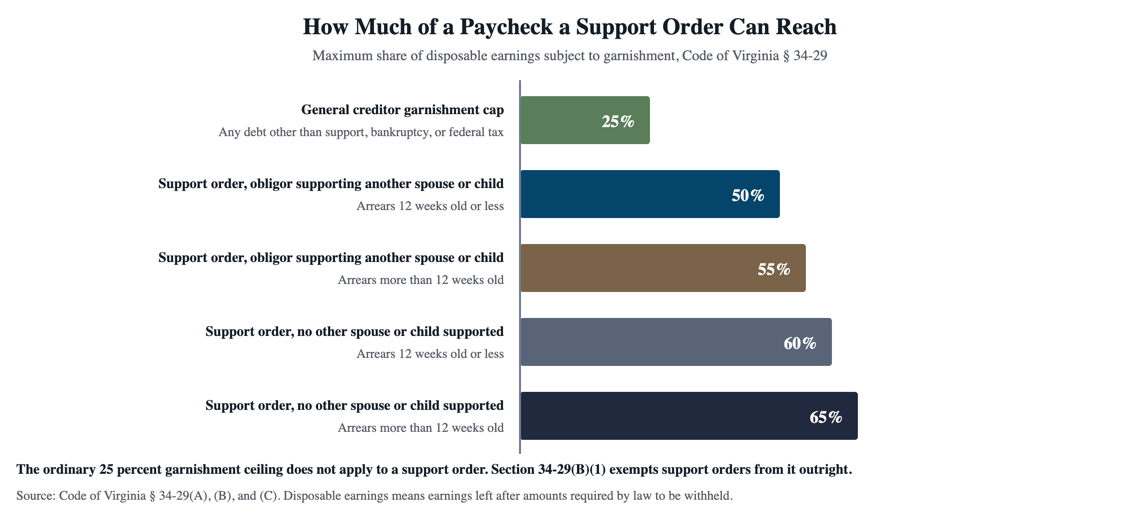
Payments are applied in a fixed order. Section 20-60.3(9) requires the order to direct that all payments credit current support obligations first, with any excess applied to arrears. A parent who sends extra money and expects it to reduce the arrears balance has to send more than the current month to get there.
What the Division of Child Support Enforcement can actually do
The Division of Child Support Enforcement sits inside the Virginia Department of Social Services, and Chapter 19 of Title 63.2 gives it a set of collection powers that operate without a new court hearing for each step. Parents on both sides of a support case tend to misunderstand the scope. It is broader than the paying parent expects and narrower than the receiving parent hopes.
Income withholding is the default, not the penalty. Under Va. Code § 63.2-1923, every administrative support order has to provide for immediate income withholding of current support plus an amount toward arrears, unless the obligor and the Department agree in writing to an alternative payment arrangement, or good cause is shown in a written determination explaining why immediate withholding would not be in the child’s best interests. The notice has to state the amount, say that withholding follows the obligor to any later job, and give ten days to request an appeal.
Where an order is already in default, Va. Code § 63.2-1924 takes over. Once the parent falls behind by an amount equal to one month of support, the Department serves the employer and notifies the parent, and the only ground for contesting is a mistake of fact, meaning an error in the identity of the payor or in the amount of current support or arrears. Ten days to request the contest. Disagreeing with the underlying order is not a defense at that stage.
| Tool | Authority | Trigger |
|---|---|---|
| Immediate income withholding | § 63.2-1923 | Built into every administrative support order from the start, unless a written alternative arrangement or good cause applies |
| Withholding on default | § 63.2-1924 | Falling behind by an amount equal to one month of support |
| Orders to withhold and deliver property | § 63.2-1929 | After an administrative support order is served and the hearing opportunity is exhausted, or whenever a court support order has been entered; takes priority over other creditors under state law |
| Professional, business, trade, occupational, or recreational license suspension | § 63.2-1937 | 30 days’ notice, and either a delinquency of 90 days or more or of $5,000 or more, or failure to comply with a subpoena, summons, or warrant in a paternity or support proceeding |
| Driver’s license suspension or non-renewal | § 46.2-320.1 | The same thresholds, effective 30 days after service of a notice of intent by the Department |
| Interest on arrears | §§ 20-78.2 and 6.2-302 | Automatic at six percent a year unless the receiving parent waives it in writing |
| Attorney fees | § 20-78.2 | Arrears, excluding interest, equal to or greater than three months of support |
Two thresholds run through that table and they are worth memorizing: 90 days delinquent, or $5,000 owed. Those numbers unlock both the occupational license petition under § 63.2-1937 and the DMV action under § 46.2-320.1, and § 20-60.3 requires every support order to warn the parents about both. The order also has to state whether either parent currently holds a license of the kind that can be suspended.
What the Division cannot do is worth stating just as plainly. It does not decide custody. It does not enforce visitation. A parent who is being denied time with the children does not have a remedy through the support agency, and a parent who is being paid nothing does not get to stop the other parent’s visits. Those are separate proceedings in the juvenile court, and Virginia treats them as separate on purpose. A parent tempted to withhold one to punish the other should read what Virginia courts do with the unclean hands doctrine in support and custody cases first.
One protection cuts the other way. Section 20-108.1(G) says child support payments, whether current or arrears, that a parent receives for the benefit of a child in that parent’s custody are not subject to garnishment. A creditor chasing the receiving parent cannot take the children’s support out of the account, and a bank is not required to figure out which portion of a deposit is traceable.
When one parent, or the child, lives in another state
Northern Virginia families move. Military families move on orders. The Uniform Interstate Family Support Act, codified at § 20-88.32 and following, is the framework that keeps a support order enforceable across state lines, and its central concept is continuing exclusive jurisdiction.
Under Va. Code § 20-88.39, a Virginia court that issued a child support order keeps and must exercise continuing exclusive jurisdiction to modify that order, provided the order is the controlling order and Virginia is still the residence of the obligor, the individual obligee, or the child. Virginia also keeps that jurisdiction where nobody lives here any longer but the parties consent in a record that Virginia may continue to exercise it. Virginia loses the power to modify if all the individual parties file consent in a record that another state with jurisdiction over one of them, or the state where the child lives, may modify the order and take over, or if the Virginia order is not the controlling order.
Enforcement and modification are separate questions, and that distinction saves families a lot of unnecessary filing. Under Va. Code § 20-88.40, a Virginia court that issued a support order can ask another state’s tribunal to enforce it, and can act as the responding tribunal to enforce an order it has continuing jurisdiction over. A parent does not need a new order in the new state to collect on the Virginia one.
| Question | Statute | Short answer |
|---|---|---|
| Can Virginia still change the amount? | § 20-88.39 | Yes if the Virginia order is the controlling order and the obligor, the obligee, or the child still lives in Virginia, or if the parties consent in a record |
| Can Virginia still collect on it? | § 20-88.40 | Yes; Virginia can ask another state to enforce, and can enforce as the responding tribunal |
| What if cases are filed in two states at once? | § 20-88.38 | Timing of the filings, whether a party timely challenged jurisdiction, and which state is the child’s home state decide which court proceeds |
| What defenses exist to enforcing a registered out-of-state order? | § 20-88.72 | Eight, including lack of personal jurisdiction, fraud, a later order, full or partial payment, and the statute of limitations, and the contesting party carries the burden |
The interstate mistake that costs the most is assuming a move changes the obligation. It does not. A parent who leaves Virginia still owes what the Virginia order says until a tribunal with the power to modify actually modifies it, and arrears accrued in the meantime remain collectible.
Parents who were never married start one step earlier
Where the parents were never married, support cannot be ordered against a man until parentage is established. Va. Code § 20-49.1 gives two direct routes and a fallback. Scientifically reliable genetic tests affirming at least a 98 percent probability of paternity carry the same legal effect as a judgment. So does a voluntary written statement of the father and mother, made under oath, acknowledging paternity, provided both parties were given a written and oral description of the rights, responsibilities, and consequences, including the right to rescind.
That rescission right has a hard edge. Either party may rescind within 60 days from the date the acknowledgment was signed, unless an administrative or judicial order relating to the child is entered first in a case that party was part of. After the window closes, the acknowledgment is binding and conclusive unless the person challenging it proves fraud, duress, or a material mistake of fact. And while such a challenge is pending, the legal responsibilities of the person who signed are not suspended except for good cause shown. A signature at the hospital is a legal act with a two-month clock on it.
Once parentage is established, everything above applies identically. There is no separate schedule, no different formula, and no reduced obligation because the parents were never married.
The mistakes that cost parents the most
Most of the money lost in Virginia child support cases is lost to timing and paperwork rather than to bad arguments. Six patterns account for the bulk of it, and every one of them is a rule written into the Code rather than a judgment call a court makes case by case.
The handshake reduction deserves the longest warning, because it is the most common and it is almost always made in good faith. A parent loses hours, calls the other parent, and they agree on a lower payment for a while. Nothing about that conversation touches the order. Section 20-60.3(14) makes each unpaid installment a judgment as it comes due, § 20-78.2 attaches interest to it, and § 20-108 forbids a court from going back and forgiving it. Two years of a well-meant private arrangement can produce a five-figure arrearage with a receiving parent who never intended to create one. The way to make that arrangement real is a consent order, and consent orders are neither slow nor expensive.
The coverage credit is the quietest of the six, and it runs in both directions. A parent who carries the children on an employer plan and never tells the court about it pays the full income share every month and absorbs the premium on top. A parent who claimed the credit and then dropped the coverage keeps a reduction they are no longer entitled to, and the correction eventually arrives with arrears attached. Both are fixable in a single filing, and both get more expensive the longer they run. The same is true of the overnight count. A parenting schedule that says one thing and a calendar that says another will eventually be reconciled by a court, and § 20-108.2(G)(3)(e) puts the presumption on the side of the parent who is actually doing the parenting.
Get the inputs right before the order is entered
Almost every child support fight that goes badly in Virginia was decided by an input rather than by an argument. The income figure, the number of overnight days, who carries the insurance, and the date the petition was filed do more to set the number than anything said at the hearing. Those are also the things that are cheapest to fix before an order exists and hardest to fix afterward. Miles Franklin handles child support establishment, modification, and enforcement for parents in Stafford, Fredericksburg, Spotsylvania, King George, and the surrounding counties.
Call (276) 773-6102 or use the form below to schedule a consultation.
Frequently asked questions about child support in Virginia
How is child support calculated in Virginia?
Virginia uses an income shares model set out in Va. Code § 20-108.2. The court adds both parents’ gross monthly incomes, reads the basic obligation off the statutory schedule for that combined income and the number of children, adds the cost of the children’s health, dental, and vision coverage and any work-related child care, and divides the total between the parents in proportion to their incomes. The parent who does not have primary physical custody pays their share, reduced by any coverage cost that parent pays directly. Section 20-108.1 makes that result a rebuttable presumption, so a judge who orders something different has to write down the guideline amount and justify the variance.
What counts as income for child support in Virginia?
Section 20-108.2(C) defines gross income as all income from all sources and lists salaries, wages, commissions, royalties, bonuses, dividends, severance pay, pensions, interest, trust income, annuities, capital gains, social security benefits, workers’ compensation, unemployment insurance, disability insurance, veterans’ benefits, spousal support, rental income, gifts, prizes, and awards. Four things are excluded: public assistance and social services benefits under § 63.2-100, federal supplemental security income, child support received for another child, and income from secondary employment taken on specifically to pay off an arrearage while it is being paid under the order. Self-employed parents may deduct reasonable business expenses, and half of any self-employment tax paid is deducted.
Does child support go down if the children stay with me more often?
It can, once the time passes 90 days a year. Under § 20-108.2(G)(3), a parent with custody or visitation of a child for more than 90 days of the year triggers the shared custody formula, which multiplies the basic obligation by 1.4 and weights it by each parent’s share of the year and each parent’s share of income. A day means a 24-hour period, and where the parent with fewer overnights has an overnight but keeps the child less than 24 hours, each parent is presumed to get half a day. The shared amount is presumptive unless a party shows the sole custody amount is lower, in which case the lower amount is what gets paid.
Can child support be changed in Virginia after the order is entered?
Yes, but not retroactively. Section 20-108 lets a court revise a support decree as the circumstances of the parents and the benefit of the children require, and then says no support order may be modified retroactively. The change can reach back only to the date notice of the filed modification petition was given to the responding party. That is why a parent whose income drops should file promptly rather than wait. The Department of Social Services can also initiate a review of a court-ordered amount under § 63.2-1921, and either party has 30 days from receiving notice of that review to request a hearing.
When does child support end in Virginia?
Not automatically at 18. Section 20-124.2(C) requires support to continue for a child over 18 who is a full-time high school student, is not self-supporting, and lives in the home of the parent receiving support, until the child turns 19 or graduates from high school, whichever comes first. A court may also order support to continue for an adult child who is severely and permanently mentally or physically disabled where the disability existed before 18, the child cannot live independently or self-support, and the child lives with the parent receiving support. If arrears remain when the youngest child emancipates, § 20-60.3(16) requires payments to continue at the same total amount until the arrears are paid.
What happens if a parent stops paying child support in Virginia?
Each missed payment becomes a judgment by operation of law as it comes due, under §§ 20-60.3(14) and 20-78.2, and it carries interest at the six percent judgment rate in § 6.2-302 unless the receiving parent waives interest in writing. Enforcement does not require a new hearing for each step. The Department may withhold from income once the arrears equal one month of support under § 63.2-1924, and may issue orders to withhold and deliver property under § 63.2-1929. At 90 days delinquent or $5,000 owed, a petition may be filed to suspend a professional, business, trade, occupational, or recreational license under § 63.2-1937, and the DMV may suspend or refuse to renew a driver’s license under § 46.2-320.1. Attorney fees are available where arrears reach three months of support.
Which court handles child support in Stafford County?
The Stafford County Juvenile and Domestic Relations District Court, at 1300 Courthouse Road, handles custody, visitation, and support under § 16.1-241(A). That is the forum for parents who were never married and for separated parents who have not filed for divorce. Once a divorce suit is filed in circuit court, § 16.1-244 divests the juvenile court of the support issues joined in the divorce and the circuit court takes them over. If the juvenile case was filed first and no final support order was entered, § 20-108.1(B) makes the circuit court’s award retroactive to the original juvenile court filing date, provided the petitioner was diligent about service.
Does a written agreement between the parents control the amount?
It is a factor, not a substitute for the calculation. A written agreement, stipulation, consent order, or decree containing an amount of child support is the fourteenth deviation factor in § 20-108.1(B), which means the court weighs it along with the other fourteen and still has to write findings if the ordered amount differs from the guideline. A court may affirm, ratify, and incorporate an agreement under § 20-109.1, and it may confirm a stipulation extending support beyond when it would otherwise end under § 20-124.2(C). What parents cannot do is contract the children’s support out of the court’s authority to revise it later under § 20-108.
Where to start
Run the guideline before anything else. Both gross monthly incomes, the number of children, the actual cost of the children’s health, dental, and vision coverage, the actual cost of work-related child care, and an honest count of overnight days will produce a number, and that number is the frame everything else fits into. Where the support question sits inside a divorce, the uncontested divorce process and the wider family law picture are worth reading alongside this. If the calculation has already been done and the order is entered, the questions worth asking are whether the worksheet in the court file matches the facts, whether anything has changed enough to justify a petition, and whether the modification petition should be filed today rather than after the next paycheck.
Questions about custody or visitation?
Every situation is different. If you have questions about how Virginia law applies to yours, contact the Law Office of Miles Franklin to schedule a consultation.
Schedule a Consultation →