
Adoption is one of the few areas of family law where nearly everyone involved wants the same result. That does not make it quick. Virginia routes adoption cases through several separate tracks, each with its own consent rules, its own waiting periods, and its own paperwork, and choosing the wrong track is the most common reason a case that should have taken six months takes eighteen. The other common reason is a consent that was signed too early, signed in the wrong place, or signed by someone whose rights nobody confirmed. This article walks through the routes, the clocks that decide whether a placement is secure, what a home study actually examines, and exactly what changes on the day a judge signs the final order. Every rule below is tied to the section of the Code of Virginia that creates it.

The routes a Virginia adoption can take
Chapter 12 of Title 63.2 is not one procedure. It is a general article followed by five separate articles, each written for a different situation, and the article that governs your case determines nearly everything else: which courthouse you start in, whether a home study is required, whether a six-month probationary period applies, and how quickly a final order can be entered.
The two full-length tracks are agency adoption and parental placement. In an agency adoption the birth parents sign an entrustment agreement with a licensed child-placing agency or a local department of social services, and the agency holds custody and consents to the eventual adoption. In a parental placement the birth parents choose the adoptive family themselves and place the child directly, which means the court, not an agency, has to satisfy itself that the consent was informed and that nothing improper changed hands.
Both are covered in more detail on my adoption practice page. The shorter tracks exist because the law recognizes that some families are already families. A stepparent who has been raising a child, a grandmother who has had physical custody for three years, an aunt who took in a nephew last spring, and an adult stepchild who wants the legal relationship formalized are all in situations where the state’s interest in a lengthy investigation is much weaker. Article 4, Article 4.1, and Article 5 give each of them a shorter path.
Foster parent adoption sits somewhere in between. It runs through the agency article, but with its own residency requirement in § 63.2-1229, and it can only proceed once the birth parents’ rights to the child have already been terminated.
| Route | How the case begins | What makes it distinct | Article |
|---|---|---|---|
| Agency adoption | Birth parents sign an entrustment agreement with a licensed child-placing agency or a local board, which then places the child. | The agency holds custody and gives its own consent to the adoption. Revocation rules run against the agency, not the adoptive parents. | §§ 63.2-1221 to 63.2-1229 |
| Parental placement | The birth parent or legal guardian places the child directly with a family they selected. | Consent is executed in juvenile and domestic relations district court, and the court must make seven specific findings before accepting it. | §§ 63.2-1230 to 63.2-1240 |
| Stepparent and confirmatory | A joint petition by a birth or adoptive parent and that parent’s spouse, or another person with a legitimate interest. | The spouse who is already a parent keeps every legal right. Investigation and the probationary period can be omitted. | §§ 63.2-1241, 63.2-1242 |
| Close relative adoption | A close relative who already has the child files, starting in juvenile court or, after two years, directly in circuit court. | No hearing is required to accept consent, and the meeting requirement between the two families is waived. | §§ 63.2-1242.1 to 63.2-1242.3 |
| Foster parent adoption | A foster parent petitions after the child has lived in the home continuously for the required period. | Six months if the agency holding custody consents, 18 months if it does not. Birth parents’ rights must already be terminated. | § 63.2-1229 |
| Adult adoption | A petition to adopt a person 18 or older. | No parent’s consent is ever required. The consent of the person being adopted is required in every case. | §§ 63.2-1243, 63.2-1244 |
Who may place a child, who may petition, and where the case is filed
Virginia limits who may place a child for adoption to four categories. Under § 63.2-1200, a child may be placed by a licensed child-placing agency, by a local board, by the child’s parent or legal guardian if the placement is a parental placement, or by an agency outside the Commonwealth that is licensed or otherwise duly authorized to place children for adoption under the laws it operates under. Nobody else. A well-meaning friend, a pastor, or a physician cannot place a child, and an arrangement that runs through one of them is not a placement Virginia recognizes.
The petition itself goes to a circuit court. Section 63.2-1201 provides that proceedings for the adoption of a minor child, and for a change of the child’s name, are instituted only by petition to a circuit court, and it gives three venue options: the county or city where the petitioner resides, the county or city where the child-placing agency is located, or the county or city where a birth parent executed consent. That last option matters more than people expect, because in a case where the adoptive family and the birth mother live in different parts of Virginia, it can decide which courthouse handles the case.
The same section requires the petition to contain a full disclosure of the circumstances under which the child came to live, and is living, in the home of the petitioner. That is not a formality. A petition that glosses over how the placement happened invites the very investigation the family is hoping to avoid.
Two eligibility rules are worth knowing before anyone drafts anything. Section 63.2-1201.1 allows previously married persons who stood in loco parentis during the marriage to adopt in the same manner as married persons, which reaches divorced stepparents who raised the child. And § 63.2-1205.1 bars certain offenders from adopting outright.
| Who may place a child | What that looks like |
|---|---|
| A licensed child-placing agency | A private agency licensed in Virginia, which takes custody by entrustment and consents to the adoption itself. |
| A local board | A local department of social services, most often where the child came into foster care. |
| The child’s parent or legal guardian | Only where the placement is a parental placement, which then triggers the juvenile court consent procedure. |
| An out-of-state agency | An agency outside the Commonwealth licensed or otherwise duly authorized to place children under the laws it operates under. |
The steps, in the order they actually happen
Families usually arrive with the steps out of order in their heads. They think of the home study as something that happens after the match, or they assume the judge signs once and it is finished. Here is the sequence Chapter 12 actually produces in a parental placement or agency case, which is the longest version of the process.
First, the home study. A licensed or duly authorized child-placing agency completes it before the placement, and under § 63.2-1231 it remains valid for 36 months from the date it is completed. Second, the placement and the consent. In a parental placement, consent is executed in the juvenile and domestic relations district court under § 63.2-1233, and the child must be at least in the third calendar day of life. Third, the revocation window runs out. Fourth, the petition is filed in circuit court.
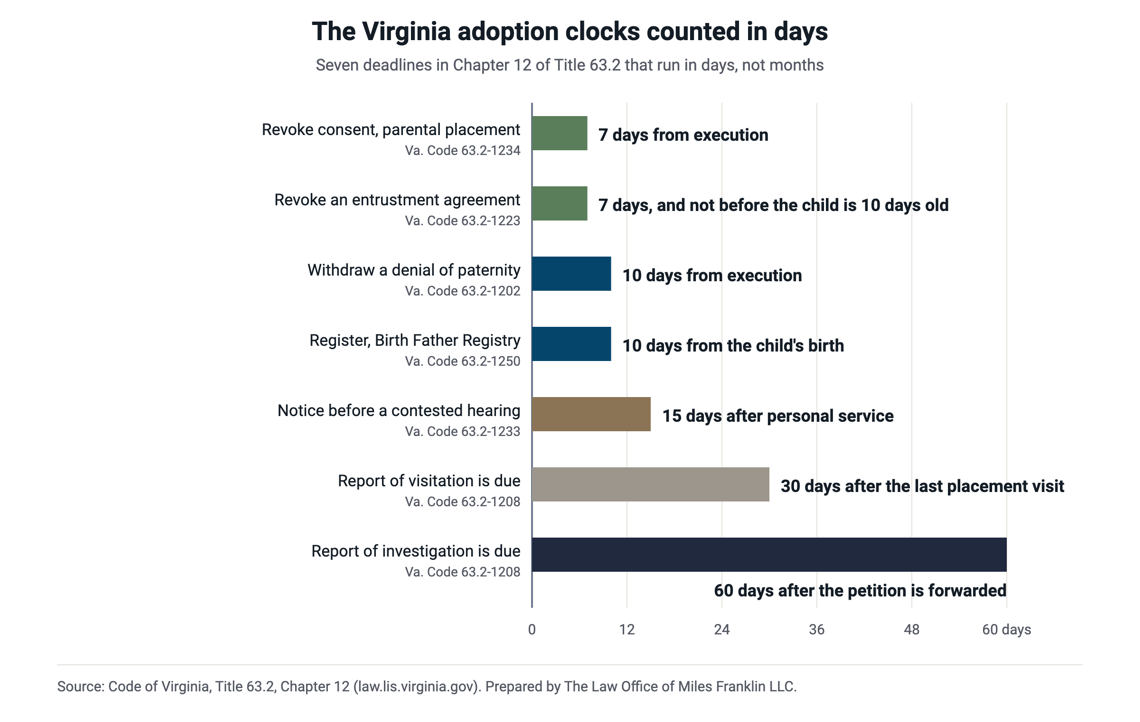
Fifth, the circuit court enters an order of reference, and the local department or agency files a report of investigation. Under § 63.2-1208 that report is due within 60 days after the petition and its exhibits are forwarded. Sixth, the court enters an interlocutory order. Under § 63.2-1209 that order declares that the child will be, to all intents and purposes, the child of the petitioner, subject to the probationary period and the final order.
Seventh, the probationary period. Section 63.2-1212 requires the child to be visited at least three times within a period of six months, with no less than 90 days between the first and last visit. All three visits are conducted in the presence of the child, and at least one takes place in the home of the petitioners with both petitioners present. Eighth, the report of visitation, due within 30 days after the last placement visit. Ninth, the final order under § 63.2-1213.
Consent: who signs it, when, and how long it can be taken back
Consent is where adoptions succeed or fall apart, and Virginia treats it with corresponding care. Section 63.2-1202 begins with the baseline: no petition for adoption is granted unless written consent to the proposed adoption is filed with the petition, in writing, signed under oath, and acknowledged before an officer authorized to take acknowledgments.
Who signs depends on the case. Under subsection C, consent is executed by the birth mother and by any man who is an acknowledged, adjudicated, or presumed father or who has registered with the Virginia Birth Father Registry, by the child-placing agency or local board having custody, and by the child if the child is 14 years of age or older, unless the circuit court finds that the best interests of the child are served by not requiring the child’s consent.
Then the clocks start. In a parental placement, § 63.2-1234 allows either consenting birth parent to revoke for any reason for up to seven days from execution, and revocation must be filed in writing during the clerk’s business hours. That seven-day period can be waived, but only in a writing signed when the child is at least 10 days old and only where the parent has had the benefit of independent legal counsel. In an agency case, § 63.2-1223 makes an entrustment agreement revocable until the child has reached the age of 10 days and seven days have elapsed from the date of execution, and it stays revocable while the child has not yet been placed in the physical custody of the prospective adoptive parents.
After those windows close, § 63.2-1204 narrows revocation to two grounds: proof of fraud or duress, or, after the child has been placed in an adoptive home, the written mutual consent of the birth parents and the prospective adoptive parents or the agency. If a deadline lands on a weekend or a holiday when the clerk’s office is closed, the period runs to the next business day.
| Document | Earliest it may be executed | How long it can be revoked | Authority |
|---|---|---|---|
| Consent in a parental placement | When the child is at least in the third calendar day of life. A birth father may consent before the birth. | Seven days from execution, for any reason, in writing during the clerk’s business hours. | § 63.2-1233; § 63.2-1234 |
| Waiver of the seven-day period | Only when the child is at least 10 days old and the parent has had independent legal counsel. | Not applicable once validly executed. | § 63.2-1234 |
| Entrustment agreement with an agency | May be executed earlier, but is not final until the child is 10 days old. | Until the child reaches 10 days old and seven days have passed, or any time before physical placement. | § 63.2-1223 |
| Denial of paternity | Any time, under oath and in writing. | Withdrawable for no more than 10 days after execution. Final once the child is 10 days old. | § 63.2-1202 |
| Consent of a child 14 or older | With the petition. The court may excuse it if the child’s best interests are served. | Governed by the general rules in § 63.2-1204. | § 63.2-1202 |
| Any consent, after the windows close | Already executed. | Only on proof of fraud or duress, or by written mutual consent after placement. | § 63.2-1204 |
When a birth parent will not consent
Not every case has a cooperative birth parent, and Chapter 12 does not require one. Section 63.2-1203 governs when consent is withheld or unobtainable, and § 63.2-1202 supplies several situations where no consent is required at all.
The clearest is termination. No notice or consent is required of any person whose parental rights have been terminated by a court of competent jurisdiction. Another is abandonment measured by conduct: a birth parent who has neither visited nor contacted the child for a period of six months immediately prior to the filing of the petition for adoption. A third is the sworn denial of paternity discussed above, which sits alongside the broader questions covered under paternity in Virginia.
Where a parent is present and objecting, the court decides whether consent is being withheld contrary to the best interests of the child. Section 63.2-1205 tells the judge what to weigh: the birth parent’s efforts to obtain or maintain legal and physical custody, whether the birth parent is currently willing and able to assume full custody, whether those efforts were thwarted by other people, the birth parent’s ability to care for the child, the age of the child, the quality of any previous relationship between the birth parent and the child and between the birth parent and any other minor children, the duration and suitability of the child’s present custodial environment, and the effect a change of physical custody would have on the child.
Read that list closely and a pattern appears. Most of the factors describe things that happened long before the petition was filed. A contested adoption is usually decided by a record built over years, not by argument made in a single hearing, which is why documentation of contact, support, and caretaking matters so much in these cases.

The Virginia Birth Father Registry and the ten-day clock
The registry is the piece of Virginia adoption law that surprises people most, and it is the one most likely to be decisive in a case involving an unmarried father. Article 7 of Chapter 12 establishes it, and § 63.2-1250 sets the rules.
A man who wants to be notified of a placement by a local board, an adoption proceeding, or a proceeding to terminate parental rights regarding a child he may have fathered has to register. The registration is timely if the Department receives it within 10 days of the child’s birth. If a child-placing agency gave him written notice, the deadline instead runs 10 days from personal service or 13 days from the date of certified or express mailing.
The consequence of missing it is severe and deliberate. Failure to timely register waives all rights of a man who is not acknowledged to be, presumed to be, or adjudicated the father to withhold consent to an adoption proceeding. The statute is explicit that lack of knowledge of the pregnancy does not excuse a late registration. There is a narrow exception where the man was actively misled, such as being told the pregnancy had ended when it had not.
The practical reading is straightforward. A father who is not married to the mother, not on the birth certificate, and not adjudicated by a court has roughly a week and a half from the birth to preserve his standing to object. A father in that position should register first and sort out the rest afterward. An adoptive family, for its part, should confirm the registry search was run and documented, because a placement built on an unsearched registry is a placement that can be attacked.
What the home study actually examines
Prospective adoptive parents tend to dread the home study, usually because they imagine it as an inspection of their housekeeping. The statute is more specific and less intrusive than the rumor. Section 63.2-1231 directs the agency to inquire into whether the prospective adoptive parents are financially able, morally suitable, and in satisfactory physical and mental health, and into the physical and mental condition of the child if that is known, along with the circumstances of the placement, any fees paid, and compliance with the statutory requirements.
It is conducted by a licensed or duly authorized child-placing agency or a local board, using the Mutual Family Assessment home study template. The same section requires a meeting: the agency social worker, family-services specialist, or other qualified equivalent worker must meet at least once with the birth parents and at least once with the prospective adoptive parents. Those meetings may be held simultaneously or separately by mutual agreement.
Timing is generous but not unlimited. A home study conducted for a parental placement or an agency placement is valid for 36 months from the date of completion, and additional criminal background checks may be required if more than 18 months have elapsed before finalization. Families who complete a study and then wait on a match should calendar both dates.
Cost is set by regulation rather than by statute. Section 63.2-1248 directs the Board to adopt fee schedules that include standards for determining the petitioner’s ability to pay and a scale based on income, family size, and the actual cost of the services provided, and it caps the fee: the fee charged shall not exceed the actual cost of the service.
| The inquiry | What it means in practice |
|---|---|
| Financially able | Whether the household can absorb a child, not whether it is wealthy. Pay records, a budget, and a look at debt load. |
| Morally suitable | Criminal background and child protective services checks, plus references. Additional checks may be required if more than 18 months pass before finalization. |
| Satisfactory physical and mental health | A physician’s statement. The question is capacity to parent, not the absence of any diagnosis. |
| The child’s condition, if known | Medical, developmental, and background information passed along so the placement is made with open eyes. |
| Informed and uncoerced consent | The court must find the birth parents knew the alternatives to adoption, the procedures, and their option to be represented by counsel. |
| Exchange of information | Both families exchange identifying, medical, social, and psychological information unless that is waived in writing. |
| Every dollar that moved | Any financial agreement, exchange of property, or fee charged or paid must be disclosed to the court. |
Stepparent and close relative adoption, the shorter path
If a child is already living with the person who wants to adopt, Virginia gets out of the way. Section 63.2-1241 lets a birth or adoptive parent and that parent’s spouse, or another person with a legitimate interest, file a joint petition. The court may proceed without referring the matter to the local director for investigation where the other birth or adoptive parent is deceased, gives written consent under oath, denies paternity, or cannot be identified, and also where the child is 14 or older and has lived in the home of the person desiring to adopt for at least five years. The court keeps discretion to order an investigation anyway.
Section 63.2-1210 then removes the waiting. The probationary period, the interlocutory order, and the order of reference are not required where the child is legally the child by birth or adoption of one of the petitioners, where one of the petitioners is a stepparent of the child, or, after a report of investigation, where the child has been in the physical custody of the petitioner continuously for at least three years immediately prior to the filing of the petition.
Close relative adoption has its own article. Under § 63.2-1242.2, where the child has been in the home less than two years, the proceeding, including court approval of the home study, commences in the juvenile and domestic relations district court, and three ordinary parental placement rules fall away: consent does not have to be executed in the presence of the prospective adoptive parents, the simultaneous meeting requirement is waived, and no hearing is required. After that court accepts the consents and appoints the relatives as custodians, the petition moves to circuit court, which may waive the order of reference and investigation if a home study is filed, omit the probationary period and the interlocutory order, and waive appointment of a guardian ad litem.
Where the child has continuously resided with or been in the physical custody of the close relative for two years or more, § 63.2-1242.3 sends the case straight to circuit court, with the investigation discretionary rather than required.
| Situation | What the court may omit | Authority |
|---|---|---|
| One petitioner is the child’s stepparent | Order of reference, interlocutory order, and the six-month probationary period. | § 63.2-1210(2) |
| Child is already the birth or adopted child of one petitioner | The same three steps. | § 63.2-1210(1) |
| Child in the petitioner’s continuous physical custody three years or more | Interlocutory order and probationary period, after the report of investigation is received. | § 63.2-1210(3) |
| Close relative, child in the home less than two years | The hearing on consent, the simultaneous meeting, the presence requirement, and, in circuit court, the probationary period and the guardian ad litem. | § 63.2-1242.2 |
| Close relative, child in the home two years or more | The juvenile court stage entirely. Investigation becomes discretionary. | § 63.2-1242.3 |
| Adult adoption | Every parental consent. The adoptee’s own consent is required in all cases. | § 63.2-1243 |
What you may legally pay, and what is a Class 6 felony
This is the part of Chapter 12 that people get wrong out of generosity rather than bad intent. Section 63.2-1218 states the rule broadly: no person or child-placing agency shall charge, pay, give, or agree to give or accept any money, property, service, or other thing of value except as specifically allowed by law. A violation is a Class 6 felony.
The permitted list is not short, and it covers most of what a birth mother actually needs. Reasonable and customary services provided by a licensed or duly authorized child-placing agency and the fees paid for them are allowed. So are medical expenses and insurance premiums directly related to the birth mother’s pregnancy and hospitalization for the birth, mental health counseling received by the birth mother or the birth father related to the adoption, and medical care expenses for the child.
Living expenses are allowed but conditioned. Payment or reimbursement for reasonable and necessary expenses for food, clothing, and shelter is permitted when the birth mother is unable to work for medical reasons related to the pregnancy. The condition, not the category, is what people miss. Reasonable expenses incidental to any required court appearance, including transportation, food, and lodging, are permitted, as are usual and customary fees for legal services in adoption proceedings and certain transportation expenses.
What is not on the list is any payment for the placement itself, in any form, whether it is called a gift, a loan, a bonus, or help with a car. Providing false information in an adoption proceeding carries its own penalty under § 63.2-1217, and § 63.2-1232 requires every financial agreement and fee to be disclosed to the court, so an off-book arrangement tends to surface at exactly the wrong moment.
| Expressly permitted | Not permitted |
|---|---|
| Reasonable and customary child-placing agency services and the fees paid for them. | Any money, property, service, or thing of value given or accepted for the placement itself. |
| Medical expenses and insurance premiums directly related to the pregnancy and the hospitalization for the birth. | Payments framed as gifts, loans, or bonuses tied to a birth parent signing consent. |
| Mental health counseling received by the birth mother or birth father related to the adoption. | Living expenses paid when the birth mother is able to work and has no pregnancy-related medical reason not to. |
| Medical care expenses for the child. | Any arrangement kept off the financial disclosure required by § 63.2-1232. |
| Food, clothing, and shelter when the birth mother cannot work for medical reasons related to the pregnancy. | Advertising or soliciting in the manner the section prohibits. |
| Transportation, food, and lodging incidental to any required court appearance, and usual and customary legal fees. | Anything else. The statute is a closed list, and a violation is a Class 6 felony. |
What changes the day the final order is entered
The final order is not a ceremony with legal decoration attached. It rearranges the child’s legal family completely, and it does so with unusual finality.
Section 63.2-1215 divests the birth parents, and the parents by previous adoption if there are any, of all legal rights and obligations with respect to the child, including the right to petition any court for visitation. Extended relatives are divested along with them, with the exception carved out in § 63.2-1241, which is why an adoption ends the visitation route otherwise available to grandparents in a Virginia custody case. That exception is the whole engine of stepparent adoption: a birth parent who is the husband or wife of one of the petitioners is not divested, so the child gains a parent instead of trading one.
Then the order closes. Section 63.2-1216 provides that after six months from the date of entry of a final order of adoption from which no appeal has been taken to the Court of Appeals, its validity is not subject to attack in any proceeding, collateral or direct, for any reason, including fraud, duress, failure to give any required notice, failure of any procedural requirement, or lack of jurisdiction over any person. Six months, and the door is shut.
Records follow. Under § 63.2-1220, a new birth certificate is issued following the procedures in § 32.1-262, and clerks forward records of adoption decrees entered in the preceding calendar month to the State Registrar on or before the tenth day of each month. Section 63.2-1220 also requires the Department to give adoptive families a document listing the post-adoption services available to them. Families adopting a child with special needs should also read § 63.2-1300, which governs adoption assistance.
| Question | Under the interlocutory order | After the final order |
|---|---|---|
| The child’s legal status | The child is, to all intents and purposes, the child of the petitioner, subject to the probationary period. | Permanent, with no probationary condition attached. |
| Birth parents’ rights | Consent has been given, but the case is not closed. | Divested of all legal rights and obligations, including the right to petition for visitation. |
| The stepparent exception | Not yet operative. | The petitioner’s spouse who is already a parent keeps every right. § 63.2-1241. |
| Challenging the adoption | Available on the grounds the Code provides. | Not subject to attack after six months, for any reason, absent a timely appeal. |
| The birth certificate | Unchanged. | A new certificate issues under the § 32.1-262 procedure. |
Where adoption cases are filed near Stafford
Two courthouses can be involved in the same adoption. A parental placement or a close relative case with less than two years in the home starts in the juvenile and domestic relations district court, because that is where the consents are accepted. The adoption petition itself always goes to a circuit court. Families in Stafford, Fredericksburg, and Spotsylvania often assume the two are in the same building, and in Stafford they are, while in Fredericksburg and Spotsylvania they are not. Driving to the wrong address on the day a consent is scheduled is a genuinely common way to lose a week, because the juvenile court has to fit the matter back onto its docket.
Venue is not always obvious either, and § 63.2-1201 gives more than one correct answer. The petition may be filed in the county or city where the petitioner resides, where the child-placing agency is located, or where a birth parent executed consent. In a case where the adoptive family lives in Stafford and the birth mother signed in another circuit, either courthouse may be available, and the choice can affect how quickly the matter is set for hearing. That is a decision worth making deliberately rather than by default, because circuit dockets in this region move at noticeably different speeds and an adoption petition is not usually an emergency in the clerk’s eyes.
| Locality | Circuit court, where the adoption petition is filed | Juvenile and domestic relations court, where consent is accepted |
|---|---|---|
| Stafford County | 1300 Courthouse Road, Stafford, VA 22555. (540) 658-8750. Clerk 8:00 a.m. to 4:00 p.m. | Same building, 1300 Courthouse Road, Stafford, VA 22555. (540) 658-8775. 8:00 a.m. to 4:00 p.m. |
| City of Fredericksburg | 701 Princess Anne Street, Suite 100, Fredericksburg, VA 22401. (540) 372-1066. Clerk 8:30 a.m. to 4:30 p.m. | 615 Princess Anne Street, Fredericksburg, VA 22401. (540) 372-1072. 8:00 a.m. to 4:00 p.m. |
| Spotsylvania County | 9107 Judicial Center Lane, Spotsylvania, VA 22553. (540) 507-7600. Clerk 8:00 a.m. to 4:00 p.m. | 9113 Courthouse Road, Judicial Center Building B, second floor, Spotsylvania, VA 22553. (540) 507-7676. 8:00 a.m. to 4:00 p.m. |
Two practical notes about the clerk’s office. First, a revocation of consent under § 63.2-1234 has to be filed in writing during business hours, so the clerk’s posted hours are part of the deadline, not a detail beside it. Second, if the seventh day lands on a Saturday, a Sunday, or a holiday when the office is closed, the period runs to the next business day. Anyone counting a revocation window should count it against a calendar with the court holidays marked, not against a phone reminder.
One further filing point applies whenever a child crosses a state line. Section 63.2-1240 provides that the court issuing an order in a parental placement is deemed the sending agency under the Interstate Compact on the Placement of Children. In plain terms, an out-of-state placement carries compact obligations stacked on top of every Chapter 12 step described above, and the child generally cannot travel to the receiving state until the compact office there has approved the placement. Families who match with a birth mother in another state, and families living outside Virginia who are adopting a Virginia-born child, should raise the compact at the first meeting rather than at the first hearing. In my experience it is the single most common reason an otherwise straightforward parental placement sits idle for two or three weeks, and it is almost entirely avoidable with one phone call made before anyone books travel.

Talk through your adoption before anything gets signed
Adoption cases are won or lost on paperwork executed in the first two weeks. If you are considering a stepparent adoption, a close relative adoption, or a placement, I can tell you which article of Chapter 12 governs your situation, what the consent timeline looks like, and what has to be filed and where. Call (276) 773-6102 or schedule a consultation below.
Frequently asked questions about adoption in Virginia
How long does an adoption take in Virginia?
It depends entirely on the route. A stepparent adoption where the other parent consents can move without a probationary period at all under § 63.2-1210, so the timeline is driven by court scheduling rather than by statute. A parental placement or agency adoption carries a six-month probationary period with three supervised visits under § 63.2-1212, plus a report of investigation due within 60 days under § 63.2-1208 and a report of visitation due within 30 days after the last visit. Those minimums stack, so a full-length case rarely finishes in under a year.
Can a birth parent change their mind after signing consent?
Yes, within a defined window. In a parental placement, either consenting birth parent may revoke for any reason for up to seven days from execution under § 63.2-1234, filed in writing during the clerk’s business hours. An entrustment agreement with an agency stays revocable until the child is 10 days old and seven days have passed, and it also stays revocable while the child has not been placed in the prospective adoptive parents’ physical custody. After those windows, § 63.2-1204 permits revocation only on proof of fraud or duress, or by written mutual consent after placement.
What if the birth father is unknown or will not participate?
Chapter 12 anticipates this. A man who is not acknowledged, presumed, or adjudicated to be the father must register with the Virginia Birth Father Registry within 10 days of the birth to preserve his right to withhold consent, and § 63.2-1250 states that lack of knowledge of the pregnancy does not excuse a late registration. A birth father may also file a sworn written denial of paternity, which becomes final and cannot be withdrawn once the child is 10 days old. Where a parent’s rights have already been terminated, no notice or consent is required from that person.
Does a stepparent adoption need a home study and a probationary period?
Usually neither. Section 63.2-1210(2) allows the circuit court to omit the order of reference, the interlocutory order, and the probationary period where one of the petitioners is a stepparent of the child. Section 63.2-1241 separately permits the court to proceed without referring the case for investigation where the other birth or adoptive parent is deceased, consents in writing under oath, denies paternity, or cannot be identified. Both are discretionary. The court may still order an investigation if something in the file warrants one.
How much can adoptive parents legally pay?
Only what § 63.2-1218 lists. That includes agency service fees, medical expenses and insurance premiums tied to the pregnancy and the birth, mental health counseling for a birth parent related to the adoption, the child’s medical care, food, clothing, and shelter when the birth mother cannot work for medical reasons related to the pregnancy, court-appearance costs, and usual and customary legal fees. Anything paid for the placement itself is prohibited, and a violation is a Class 6 felony. Every financial agreement has to be disclosed to the court under § 63.2-1232 regardless.
Does my child have to agree to the adoption?
If the child is 14 or older, yes, unless the court excuses it. Section 63.2-1202 requires consent from a child who is 14 years of age or older unless the circuit court finds that the best interests of the child will be served by not requiring that consent. A younger child does not sign. In practice a judge will still want to know how a child of any age understands what is happening, particularly in a contested case.
Can an adult be adopted in Virginia?
Yes, and it is more common than people expect. Section 63.2-1243 allows a petition to adopt a stepchild 18 or older to whom the petitioner stood in loco parentis for at least three months, a close relative 18 or older, a person 18 or older who is the petitioner’s birth child or who lived in the petitioner’s home for at least three months before turning 18, and, for good cause shown, any other person 18 or older who is at least 15 years younger than the petitioner and has known the petitioner for at least one year. No parent’s consent is required. The consent of the person being adopted is required in every case.
Adoption law rewards preparation and punishes improvisation. If you are thinking about any of these routes, the most useful thing you can do is get the article and the timeline right before anyone signs anything, and to look at how the adoption fits alongside the rest of your Virginia family law picture. Call (276) 773-6102 to talk it through.
Questions about your legal situation?
Every situation is different. If you have questions about how Virginia law applies to yours, contact the Law Office of Miles Franklin to schedule a consultation.
Schedule a Consultation →