
If your marriage is ending, your custody arrangement is falling apart, or a support order is no longer working, the courthouse on Judicial Center Lane is where your case will be decided. I am Miles Franklin, a family law attorney with an office in Stafford, and I represent parents and spouses throughout Spotsylvania County, from the Courthouse area and Thornburg to Massaponax, Chancellor, Salem Fields, and the Lake Anna side of the county. This page explains how Spotsylvania family law cases move through the local courts, what Virginia law requires before you file, and how I can help you take the right first step.

Family law matters I handle for Spotsylvania families
Every family arrives with a different problem. Some clients want a clean, uncontested exit from a marriage that has already ended in every way but the paperwork. Others are trying to protect a parenting relationship, correct a support order that no longer matches reality, or get in front of a situation before it reaches a courtroom. I take the time to understand what you are actually trying to accomplish and then build a plan around it, whether that means negotiating an agreement or preparing your case for a judge.
My family law practice covers the issues that most often bring Spotsylvania residents to my office:
- Divorce, both contested and uncontested
- Child custody and visitation, including modification of existing orders
- Child support and spousal support
- Equitable distribution of the marital home, retirement accounts, and debt
- Prenuptial agreements, adoption, paternity, and grandparents’ rights
If adoption is what brings you here, my step-by-step guide to adoption in Virginia covers each route, the consent deadlines, and what the home study involves.
You can read more about how I approach these cases on my Virginia family law page. If your situation touches another area of law, I also handle estate planning, criminal defense, and veterans’ benefits, so a single attorney can stay with you across related matters instead of handing you off.
Where a Spotsylvania family law case is actually filed
The most common question I hear at a first consultation is not about strategy. It is simply where the case goes. Virginia splits family matters between two courts, and Spotsylvania County keeps both of them on one campus off Courthouse Road, which makes the geography easier than the rules.
The Circuit Court grants divorces, divides marital property and debt, and enters the final decree. The Juvenile and Domestic Relations District Court handles custody, visitation, child and family support, paternity, and family-abuse protective orders when no divorce suit is pending. Filing in the wrong place costs time and filing fees, and it can delay relief you need now.
| Court | What it decides | Where it sits |
|---|---|---|
| Spotsylvania County Circuit Court 15th Judicial Circuit |
Divorce, equitable distribution of property and debt, spousal support in a divorce, custody and support once a divorce suit is filed, appeals from the J&DR court | 9107 Judicial Center Lane Spotsylvania, VA 22553 (540) 507-7600 |
| Spotsylvania County J&DR District Court 15th Judicial District |
Custody and visitation, child support, family support, paternity, family-abuse protective orders | 9113 Courthouse Road, Judicial Center, Building B, 2nd Floor Spotsylvania, VA 22553 (540) 507-7676 |
| Neighboring localities | Same court structure, different courthouse, if your case belongs in an adjoining locality | The City of Fredericksburg, Stafford, and King George share the 15th Circuit with Spotsylvania. See my Fredericksburg family law page for those addresses. |
Clerk’s office hours at both Spotsylvania courts run from 8:00 a.m. to 4:00 p.m., which surprises people who assume a courthouse keeps banking hours until five. Plan filings accordingly, and confirm current hours with the clerk before you drive out to the Judicial Center.
Which locality hears your divorce, and why it may not be Spotsylvania
Living in Spotsylvania does not automatically mean your divorce is heard in Spotsylvania. Virginia has a venue statute for divorce cases. Under Virginia Code Section 8.01-261(19), a divorce belongs in the county or city where the parties last lived together, or, at the option of the person filing, in the county or city where the other spouse lives if that spouse is a Virginia resident.
In practice, that matters for a lot of families in this area. Households move across the county line between Spotsylvania, Fredericksburg, and Stafford far more often than they move out of the region. If you last lived together in the City of Fredericksburg and then moved to Salem Fields, your divorce may properly belong in Fredericksburg Circuit Court even though your mail comes to a Spotsylvania address. This is worth settling before anything is filed, because a venue problem is an avoidable delay.
What Virginia requires before a divorce can be filed
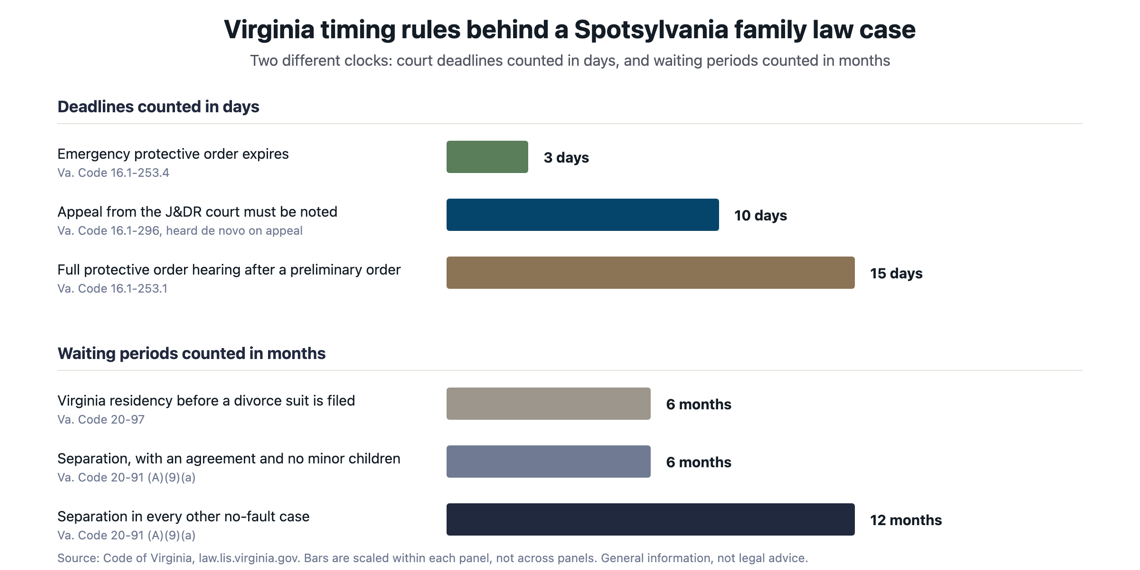
Virginia sets two clocks running before a divorce suit can move forward, and both catch people by surprise. The first is residency. Under Virginia Code Section 20-97, one of the parties must have been an actual bona fide resident and domiciliary of Virginia for at least six months before the suit is filed. For a county with as much military and federal-contract movement as Spotsylvania, that requirement is not academic. A recent move into the area can reset your timeline.
The second clock is separation. Under Virginia Code Section 20-91(A)(9)(a), spouses must live separate and apart without cohabitation and without interruption for one year. That drops to six months only when the parties have entered into a separation agreement and there are no minor children born to or adopted by either party. Fault-based grounds follow different rules, and which path fits your circumstances is worth discussing before anything is filed. My guide to filing an uncontested divorce in Virginia walks through the requirements in more detail.
Waiting periods are not wasted time. The months before a filing are usually the right window to gather financial records, document the date of separation, stabilize a temporary parenting schedule, and decide whether an agreement is realistic. Clients who use that period well tend to spend far less on litigation later.
Custody, visitation, and support in the Spotsylvania J&DR court
When there is no divorce suit pending, custody and support start in the J&DR District Court. Under Virginia Code Section 16.1-241, each J&DR court has exclusive original jurisdiction within its territory over the custody, visitation, support, control, or disposition of a child. The statute also makes clear that a party with a legitimate interest is to be broadly construed, which is how grandparents, step-grandparents, stepparents, and other relatives can be properly before the court in the right circumstances.
Virginia law does not tilt custody toward either parent. Under Virginia Code Section 20-124.2, as between the parents there is no presumption or inference of law in favor of either, the court gives primary consideration to the best interests of the child, and the court is directed to assure minor children of frequent and continuing contact with both parents when appropriate. Judges reach that decision using the ten best-interests factors in Virginia Code Section 20-124.3, which cover the child’s age and needs, the role each parent has played, each parent’s willingness to support the child’s relationship with the other, and the family’s circumstances.
It also helps to separate two things people often blur together. Legal custody is the authority to make major decisions about a child’s education, health care, and religious upbringing. Physical custody is where the child actually lives and the schedule that governs it. Virginia recognizes joint legal custody, joint physical custody, and sole custody as distinct arrangements under Virginia Code Section 20-124.1, and a great many Spotsylvania cases settle once both parents realize they are actually arguing about only one of the two.

Child support is more formulaic. Under Virginia Code Section 20-108.2, there is a rebuttable presumption that the amount produced by the statewide guideline is the correct amount of support. The guideline runs on both parents’ gross incomes, the custody arrangement, health insurance costs for the child, and work-related child care. A judge can deviate from the guideline figure, but only with written findings explaining why applying it would be unjust or inappropriate. That structure is good news for parents who want predictability, and it means the real work in a support case is usually getting the inputs right rather than arguing about the formula.
Temporary orders while a divorce is pending
A contested divorce can take many months, and most families cannot put life on hold while it runs. Virginia addresses that with pendente lite relief. Under Virginia Code Section 20-103, a court may order temporary spousal support, provide for the custody and maintenance of the minor children, order child support under the guidelines, require health care coverage, grant exclusive use and possession of the family residence during the pendency of the suit, and enter orders to preserve the estate of either spouse.
These temporary orders often set the tone for the rest of the case. A parenting schedule that works for six months has a way of becoming the schedule a judge is comfortable making permanent, so it is worth preparing for a pendente lite hearing seriously rather than treating it as a formality.
When safety is the immediate concern
If family abuse is part of the picture, the timeline changes completely. A magistrate or judge can issue an emergency protective order, and under Virginia Code Section 16.1-253.4, that order expires at 11:59 p.m. on the third day following issuance, extending to the next day the J&DR court is in session if the court is closed on that third day.
The next step is a preliminary protective order under Virginia Code Section 16.1-253.1, available to a person who alleges being subjected to family abuse within a reasonable period of time. A full hearing on that petition is held within 15 days of the issuance of the preliminary order, or on the next day the court is open if a closure prevents it. Those are short windows. If you are served with a protective order petition, or if you need one, the time to talk to an attorney is the same day, not the week of the hearing.
If the J&DR court rules against you
A decision in the J&DR District Court is not the end of the road. Under Virginia Code Section 16.1-296, an appeal to the Circuit Court must be noted within 10 days from the entry of a final judgment or order, and the case is then heard de novo, meaning the Circuit Court takes fresh evidence rather than reviewing a transcript.
Ten days is the tightest deadline in ordinary family practice, and it does not pause while you decide whether an appeal is worth it. If a Spotsylvania J&DR ruling went badly, call before that window closes. A case heard de novo in the Circuit Court is a genuine second chance to present the evidence properly, and it is lost entirely if the note of appeal is late.
Working with a Stafford attorney who practices in Spotsylvania
My office sits in Stafford, a short drive up Route 1 or Interstate 95 from the Spotsylvania Judicial Center, and I appear in the courts of this circuit regularly. I am a solo practitioner, which means the attorney you meet at your first consultation is the attorney who prepares your pleadings, negotiates on your behalf, and stands beside you in the courtroom. There is no rotating bench of associates and no need to re-explain your family to someone new.
My background as a former Virginia Army National Guard paralegal and a policy consultant shapes how I prepare a case: carefully, on paper, with the statutes in front of me. Spotsylvania County includes a large military and veteran population, and I understand how deployment schedules, service-connected disability income, and military retirement affect custody and support in ways a general practitioner may not think to ask about.
Every client’s circumstances are different, and every client deserves to be heard without judgment. Whether your case resolves in an agreement or has to be argued in front of a judge, my job is to get you the best outcome the facts and Virginia law allow.
Talk with a Spotsylvania family law attorney
If you have questions about a divorce, custody, or support matter in Spotsylvania County, I am here to help you understand your options and protect what matters most to your family. Call (276) 773-6102 or send me a few details and I will get back to you.
Frequently asked questions
Do I have to live in Spotsylvania County to hire you?
No. My office is in Stafford and I represent clients throughout the 15th Judicial Circuit, which includes Spotsylvania County, the City of Fredericksburg, Stafford, and King George. Where you live matters for which courthouse your case goes to, not for who can represent you.
Which Spotsylvania court will hear my custody case?
If no divorce suit is pending, custody and visitation begin in the Spotsylvania County Juvenile and Domestic Relations District Court at 9113 Courthouse Road, Building B. Once a divorce suit is filed in the Circuit Court, the Circuit Court can decide custody and support as part of that case. Which route makes sense depends on your situation, and it is one of the first things worth sorting out.
How long do I have to be separated before filing for divorce in Virginia?
Under Virginia Code Section 20-91(A)(9)(a), spouses generally must live separate and apart without cohabitation and without interruption for one year. The period drops to six months only if there are no minor children and the parties have signed a separation agreement. Fault-based grounds follow different rules. Virginia also requires six months of residency in the Commonwealth before the suit is filed under Section 20-97.
Can I change a child support order that no longer fits?
Yes, when circumstances have changed. Support is recalculated using the statewide guideline in Virginia Code Section 20-108.2, which creates a rebuttable presumption that the guideline figure is correct. A significant change in either parent’s income, in the custody schedule, or in child care or health insurance costs is the usual basis for asking a court to revisit an existing order.
How quickly do I have to appeal a J&DR decision?
Within 10 days of the entry of the final order, under Virginia Code Section 16.1-296. The appeal is heard de novo in the Circuit Court, which means new evidence and a fresh decision rather than a review of what happened below. Because that window is short, it is worth calling as soon as the order is entered rather than after.
If you are weighing a divorce, custody, or support question in Spotsylvania County, the sooner you understand your options the more of them you have. Call (276) 773-6102 or use the form below to schedule a consultation.